Support for Rooftop Solar Power Plant Profits
Electricity Production and Carbon Dioxide Reduction Effects
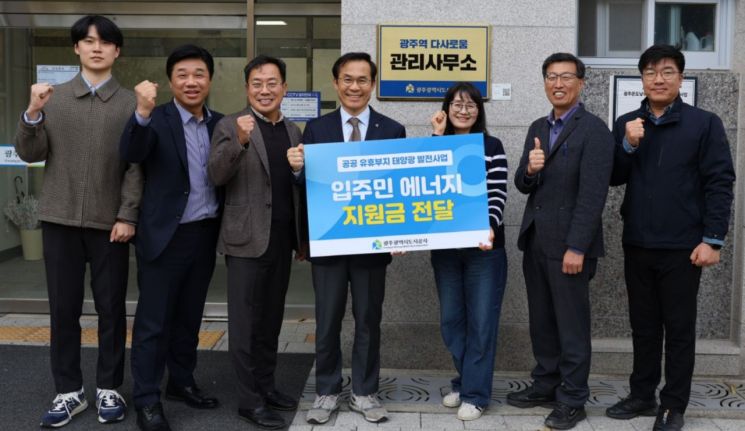 Kim Seung-nam, President of Gwangju Urban Corporation, visited the management office of Gwangju Yeokdasaroum Apartment on the 7th and delivered energy support funds. Photo by Gwangju Urban Corporation
Gwangju Urban Corporation announced on the 8th that it had provided a portion of the revenue generated from operating solar power plants at rental apartments as energy support funds to residents on the 7th.
Since 2021, the corporation has been promoting a solar power generation project utilizing rooftop spaces of rental apartments. Currently, it produces approximately 645 MWh of electricity annually through a 505 kW scale power generation facility, which contributes to reducing about 286 tons of carbon dioxide per year.
The corporation is also using part of the profits from this project as energy support funds for rental apartments and plans to provide about 180 million KRW over the next 20 years.
Starting with the Nongsung Bityeoulchae (273 kW) solar power plant completed in 2021, the corporation is expanding its solar power generation projects utilizing idle rooftop spaces of rental apartments such as Gwangju Station Dasaroum (232 kW) in 2023, Juwol Bityeoulchae (63 kW) in 2024, and Seorim Village (99 kW).
Kim Seungnam, president of Gwangju Urban Corporation, said, “With the recent rise in energy costs placing a heavy burden on households, we hope the energy support funds will be of some help. The corporation will continue to take the lead in ESG management for regional mutual growth.”
© The Asia Business Daily(www.asiae.co.kr). All rights reserved.

















