In the ‘Trump 2.0 era,’ concerns are rising over further disruption of global supply chains due to more aggressive America First policies, increased volatility in financial markets, and a comprehensive restructuring of industries, ushering in an era of ‘3不 (unpredictability, uncertainty, instability).’
On the 8th, Samil PwC released a report addressing the impact of Donald Trump’s election as U.S. President on the Korean economy and domestic companies, highlighting these points.
The main policy directions of the second Trump administration can be summarized by five keywords representing Trump: ▲Trade tariff increase ▲Reduction of corporate tax ▲Undocumented Immigrants control ▲MAGA (Make America Great Again) ▲Expansion of fossil fuel-related industries (Petroleum).
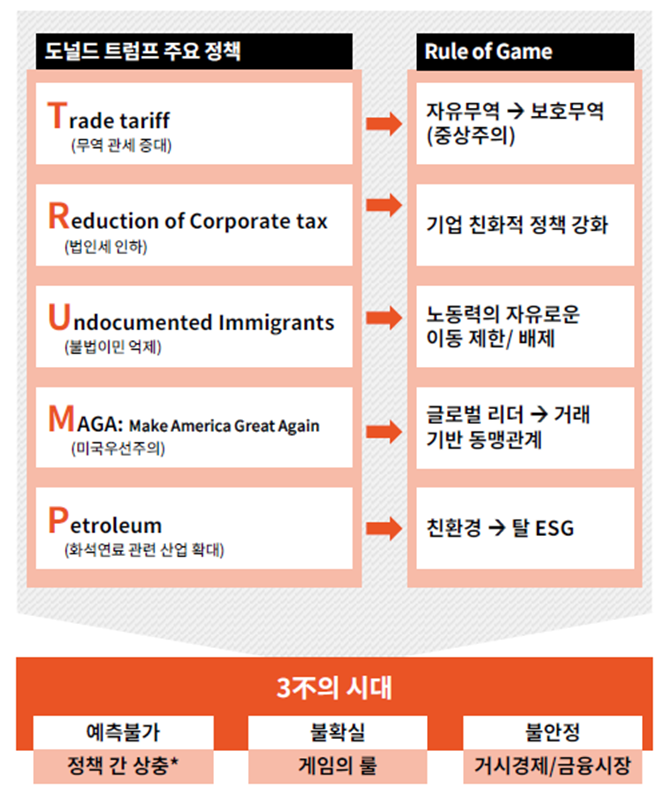
In the trade sector, stronger U.S. protectionism and higher tariff barriers than before are expected to increase the burden on Korea’s export sector. According to Trump’s key economic pledges, a universal tariff of 60% will be imposed on Chinese products, and 10-20% on imports from other countries including Korea. Korea’s total export volume is expected to decrease by approximately $44.8 billion (about 63 trillion KRW) as a result.
Tax and regulatory easing is also expected to impact the Korean economy and industries. If the corporate tax rate for production facilities in the U.S. is significantly reduced from the current 21% to 15%, the corporate tax burden on companies operating in the U.S. will be greatly alleviated. Maintaining low interest rates is also expected to stimulate corporate investment.
On the other hand, the effective tax rate related to international taxation may increase starting in 2026. Korean global companies operating in the U.S. may be required to reassess the tax efficiency of their investment and business operation structures. Dong-Yeol Lee, Tax Partner at Samil PwC, stated, “Domestic companies need to closely examine changes in the U.S. tax system and conduct detailed impact analyses to build wise strategies.”
Uncertainty around tax benefits already legislated and implemented, such as the Inflation Reduction Act (IRA), is expected to grow. However, repealing the IRA requires approval from both the House and Senate, and it is important to consider that the IRA’s beneficiary regions are mainly Republican congressional districts.
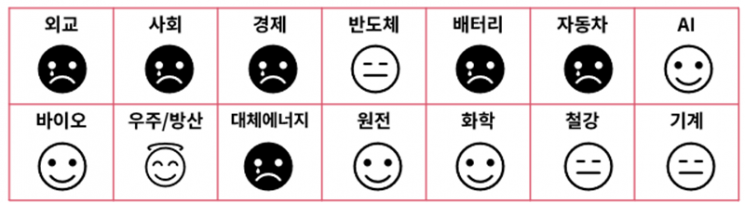
By industry, if IRA incentives are reduced, sectors such as batteries, electric vehicles, and machinery (in the eco-friendly energy field) are expected to be hit. If the support provisions of the semiconductor support law, known as the ‘CHIPS Act,’ are amended, benefits for Korean semiconductor companies may be reduced. A rollback of ESG (Environmental, Social, Governance) policies is expected to negatively impact eco-friendly industries such as electric vehicles and alternative energy, while benefiting petrochemical and nuclear industries.
Conversely, if security alliances among allied countries weaken, leading to increased defense spending, and policies aggressively promote dominance in the space industry, domestic companies are expected to have greater opportunities to enter the U.S. space industry. If regulations on big tech companies are eased, such as the repeal of the Biden administration’s AI executive order, domestic companies with advanced AI technologies are also expected to gain indirect benefits.
Minwoo Jung, Leader (Partner) of the IRA and Critical Raw Materials Act (CRMA) response team, said, “Before ‘onshoring’?expanding production facilities within the U.S.?fully takes off, it is necessary to seize opportunities for exporting domestic technologies or components with strengths and use this as a chance for structural reform of key industries. Additionally, global supply chains, including market-driven diversification of production bases, must be reassessed.” The full report is available on the Samil PwC website.
© The Asia Business Daily(www.asiae.co.kr). All rights reserved.
!["The Woman Who Threw Herself into the Water Clutching a Stolen Dior Bag"...A Grotesque Success Story That Shakes the Korean Psyche [Slate]](https://cwcontent.asiae.co.kr/asiaresize/183/2026021902243444107_1771435474.jpg)

















