Aligning the Timing of National Pension Benefits with Extension to Age 65
Business Sector: "Reemployment Over Extension... Flexibility Must Be Secured"
Both the ruling and opposition parties are accelerating legislation to extend the retirement age. There is little difference between the bills proposed or planned by both parties. However, the challenge remains to alleviate the concerns of the business community regarding the extension of the retirement age.
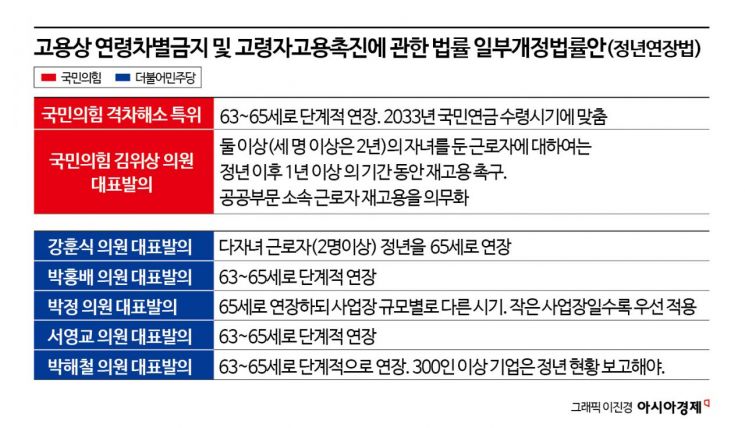
According to the National Assembly Legislative Information System on the 8th, a total of six partial amendment bills to the Act on Prohibition of Age Discrimination in Employment and Promotion of Employment for Older Persons (retirement age extension law) were proposed in the 22nd National Assembly. Members of the Democratic Party of Korea and the People Power Party each introduced five and one bills as main sponsors, respectively. The People Power Party’s Special Committee on Narrowing the Gap has launched a '65-year retirement age extension plan' aiming to propose it early next year, making discussions on extending the retirement age more active.
The retirement age extension law planned by the Special Committee on Narrowing the Gap focuses on resolving the current gap between the retirement age of 60 and the national pension eligibility age of 63. Since the national pension eligibility age may increase to 65 in 2033, the core is to gradually extend the retirement age to 65 in line with that timing. Jo Kyung-tae, chairman of the People Power Party’s Special Committee on Narrowing the Gap, said to reporters after a meeting on the 5th, "There was an argument that it would be reasonable to link the retirement age sequentially with the national pension receipt age because immediately extending it to 65 would impose a burden on companies."
In the Democratic Party, Representative Park Hong-bae has already proposed a bill with the same content as the Special Committee on Narrowing the Gap. In addition, there are bills proposing to extend the retirement age only for workers with multiple children (by Representatives Kim Wi-sang and Kang Hoon-sik) and to apply different timings for retirement age extension depending on the size of the workplace (by Representative Park Jung).
The business community voices negative opinions about extending the retirement age. Sohn Kyung-shik, chairman of the Korea Employers Federation, said at a meeting with the People Power Party last month, "Recently, retirement age extension bills are being discussed in the National Assembly without discussions on securing flexibility," adding, "If the statutory retirement age is uniformly extended, youth jobs will decrease and the dual structure of the labor market will worsen." He further stated, "Rather than extending the statutory retirement age, we should move toward reemployment through new contracts with employees who have reached retirement age."
The Korea Economic Association (KEA), a leading domestic economic organization with major conglomerates as members, announced on the 5th that seven out of ten domestic companies feel a management burden regarding the retirement age extension. Lee Sang-ho, head of the KEA’s Economic and Industrial Headquarters, said, "It is necessary to avoid uniform retirement age extension and create an environment where companies can utilize older workers by expanding benefits for companies employing older workers."
The People Power Party’s Special Committee on Narrowing the Gap intends to be fully prepared despite opposition from the business community. Chairman Jo said in a phone interview, "The difference with the Democratic Party lies in considering employment flexibility and wage system reform," adding, "We will achieve social consensus through discussions on the concerns raised by the business community." The committee is known to be considering revitalizing the 'wage peak system' as part of wage system reform. Although the wage peak system is currently implemented, it is necessary to consider the fact that companies do not actively execute it and the opposition from labor unions. The committee plans to gather opinions from various sectors through three policy forums before proposing the bill early next year.
© The Asia Business Daily(www.asiae.co.kr). All rights reserved.

















