Financial Services Commission to Discuss Virtual Asset Issues in December
Primary Agenda: Allowing Corporate Accounts for Virtual Assets
Focus on Whether Upbit's 70% Market Share Concentration Will Improve
As financial authorities in South Korea begin progressive discussions on allowing domestic corporations to invest in virtual assets, attention is focused on whether the Upbit monopoly, which holds a 70% market share, will be broken.
According to the government and the financial investment industry on the 8th, the Financial Services Commission plans to review policy directions with related ministries in December, based on issues discussed at this month's Virtual Asset Committee, including the issuance of real-name accounts for corporations.
The Virtual Asset Committee, an advisory body on virtual asset policy under the Financial Services Commission, was launched on the 6th. The committee is regarded as a 'control tower' that will lead the industry, including the enactment of the second-phase law and discussions on listing spot Exchange-Traded Funds (ETFs). It mentioned the allowance of virtual asset corporate accounts as the most urgent issue to discuss, raising expectations in the market. Since there was practically no legal basis for the 'ban,' it is anticipated that policy implementation will proceed quickly, as allowance could be possible through the establishment of model guidelines without legal amendments.
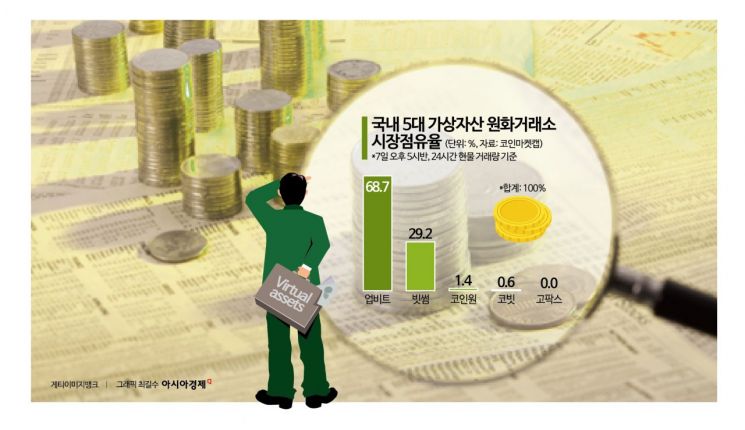
If virtual asset investment by domestic corporations is permitted, it is expected that the current phenomenon where Upbit, the top exchange among the five major Korean won trading platforms, accounts for 70-85% of total trading volume could naturally be resolved. As of the previous day, Upbit's market share was 68.7%, more than twice that of Bithumb, the second largest at 29.2%. The combined market share of the third to fifth ranked operators?Coinone, Korbit, and Gopax?is only about 2%. This is also why Upbit's monopoly has been repeatedly criticized during National Assembly audits. This year, Lee Kang-il, a member of the Democratic Party of Korea, voiced concerns that it constitutes a monopoly under the Fair Trade Act.
A representative from a domestic virtual asset exchange said, "Upbit's strategic collaboration with the internet bank K Bank has been somewhat successful, naturally increasing its market share. In a market centered on individuals, it is difficult to break the current entrenched structure, but if corporate investors enter, the market will be revitalized, and exchanges will be able to offer different incentives."
Especially since the beginning of this year, the entry of overseas exchanges such as Crypto.com and Binance had raised expectations for the emergence of a 'catfish' effect, but in reality, their entry into the domestic market is difficult. The Financial Intelligence Unit (FIU) of the Financial Services Commission has not granted approval due to incomplete documentation and disqualifications. This is also why the virtual asset industry expects corporate account allowance to come sooner.
It is also anticipated that improvements in accounting treatment and taxation systems related to corporate holdings of virtual assets will need to be considered together. Due to the nature of the virtual asset industry, prices vary across exchanges even for the same virtual asset. Lee Yong-woo, a former member of the National Assembly and head of the Economic Plus Research Institute, pointed out, "Allowing corporate accounts is necessary. Discussions on standardization are needed so that companies can perform accounting by reflecting price differences among virtual asset exchanges that offer different prices."
Professor Hwang Seok-jin of Dongguk University's Graduate School of International Information Security said, "Since corporations differ from individuals, it is necessary to consider how to tax gains obtained from holding and selling virtual assets. However, since the most important issue?the prohibition of corporate virtual asset accounts?is not explicitly stated in the law, secondary issues such as accounting treatment and tax system improvements can be gradually resolved."
© The Asia Business Daily(www.asiae.co.kr). All rights reserved.

















