IBs Lower South Korea's Growth Forecast from 2.5% to 2.3% This Year
Economic Uncertainty Also Cuts Next Year's Outlook to 2.0%
In the third quarter, South Korea's real Gross Domestic Product (GDP) growth rate fell short of expectations, prompting major global investment banks (IBs) to revise down their economic growth forecasts for South Korea this year. The IBs also lowered their growth projections for next year, reflecting economic uncertainties.
According to the International Finance Center on the 8th, the average economic growth forecast for South Korea this year by eight major IBs dropped by 0.2 percentage points within a month, from 2.5% at the end of September to 2.3% at the end of October.
By company, Barclays revised its forecast down from 2.6% to 2.3%, Goldman Sachs from 2.3% to 2.1%, JP Morgan from 2.7% to 2.2%, HSBC from 2.4% to 2.3%, and Nomura from 2.5% to 2.2%. Bank of America Merrill Lynch maintained its forecast at 2.5%, and Citi held at 2.3%.
Their economic growth forecasts had already fallen by 0.2 percentage points from an average of 2.7% at the end of June to 2.5% at the end of July, and this time they declined by an additional 0.2 percentage points.
The downward revision by IBs is interpreted as a response to South Korea's economy contracting by -0.2% in the second quarter and posting a 0.1% growth in the third quarter, which fell short of the expected 0.5%.
The Bank of Korea had projected a 2.5% economic growth rate for this year in its August economic outlook, but it is expected to lower this forecast in the economic outlook to be announced again on the 28th of this month. Lee Chang-yong, Governor of the Bank of Korea, mentioned at the National Assembly audit on the 29th of last month that "the growth rate this year might fall to around 2.2-2.3%."
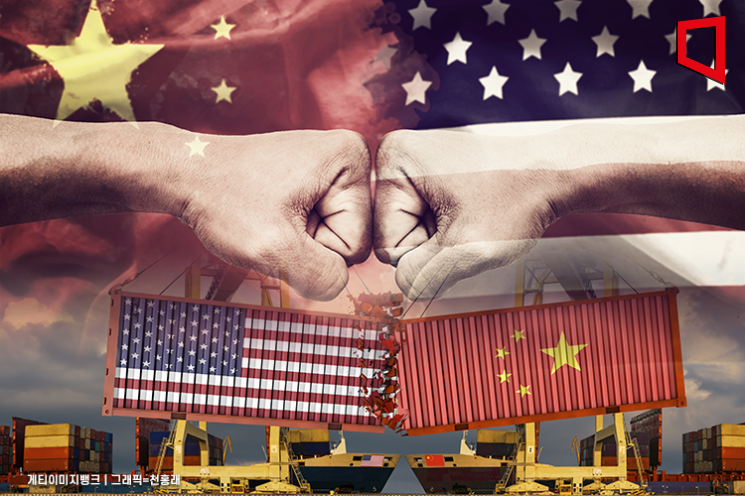
Reflecting uncertainties in the South Korean economy, IBs also lowered their average economic growth forecast for next year from 2.1% to 2.0%, a 0.1 percentage point decrease. Experts anticipate that the start of Donald Trump's second term government next year could negatively impact South Korea's economy. Since Trump has signaled tariff increases, there is a forecast that South Korea's economy, which records its largest exports to the United States, could be directly affected.
According to the Korea Institute for International Economic Policy, if the universal tariffs announced by Trump are actually implemented, South Korea's total export volume is estimated to decrease by between $22.2 billion and up to $44.8 billion annually. The Hyundai Research Institute predicts that if the second round of the US-China tariff war breaks out and the conflict spreads worldwide, South Korea's economic growth rate could drop by 0.5 percentage points, and in the worst case, by up to 1.1 percentage points.
Joo Won, head of the Economic Research Department at Hyundai Research Institute, emphasized, "Since the South Korean economy relies heavily on export performance for growth, it is necessary to strengthen domestic economic capabilities to prevent a downturn in exports caused by deteriorating trade conditions from leading to a domestic recession."
© The Asia Business Daily(www.asiae.co.kr). All rights reserved.
![Clutching a Stolen Dior Bag, Saying "I Hate Being Poor but Real"... The Grotesque Con of a "Human Knockoff" [Slate]](https://cwcontent.asiae.co.kr/asiaresize/183/2026021902243444107_1771435474.jpg)











