'Low-Cost, High-Efficiency' Competition Preparation
"We Will Overcome the Failed Jamboree"
Economic Ripple Effect Expected to Reach 42 Trillion Won
Jeonbuk Provincial Government has officially launched its bid to host the '2036 Summer Olympics.'
On the 7th, Jeonbuk Governor Kim Kwan-young held a press conference at the provincial office, stating, "By hosting the 2036 Summer Olympics, Jeonbuk aims to leap forward with the world and create a platform that wishes for global peace and prosperity." He officially declared the bid, saying, "We will unite Jeonbuk’s resources and capabilities to realize a future-oriented Olympics that blends tradition and innovation."
Jeonbuk set its vision as 'A Festival of Tradition and Future Welcoming the World.' The province revealed plans to prepare a 'low-cost, high-efficiency' event based on its abundant cultural resources and cutting-edge future technologies.
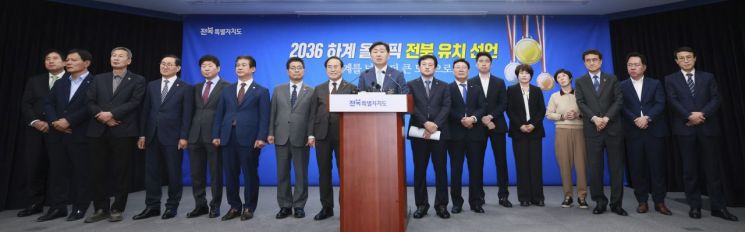 Jeonbuk Governor Kim Kwan-young held a press conference at the provincial office on the 7th and officially declared the challenge to host the '2036 Summer Olympics.' Photo by Jeonbuk Autonomous Province
The province plans to combine traditional culture with advanced technology to promote its cultural heritage worldwide and create an innovative festival where nature and the future coexist.
The core concept of the Olympics proposed by Jeonbuk is structured around 3S (Smart Digital, Sustainability, Social Harmony) and 4W (Hardware, Software, Smartware, Humanware). The province emphasized efficient operation through digital innovation, a sustainable event utilizing eco-friendly infrastructure, and social harmony involving global participation. It proposed a new form of Olympics with Hardware (eco-friendly future city infrastructure), Software (spread of K-Culture), Smartware (user experience innovation through AI and big data), and Humanware (governance centered on cooperation and solidarity).
The province explained that if it wins the bid, the venues will be designed using low-carbon, low-cost construction methods, actively utilizing 22 existing venues to minimize resource waste and lay the foundation for balanced regional development.
Eleven venues will be temporarily constructed as carbon-reducing wooden buildings or equipped with spectator stands to host events. The average travel distance between main venues will be limited to 33 km to enhance convenience. Additionally, in consultation with neighboring cities such as Gwangju, Daejeon, and Chungnam, swimming (Gwangju Nambu University), archery (Gwangju International Archery Range), and tennis (Chungnam International Tennis Center) venues will be jointly used.
The main stadium will be an expanded Jeonju World Cup Stadium, and a smart transportation system called 'J-Easy Path' will be established to provide optimal transit connecting venues, the athletes' village, and the media center. The estimated budget is 10.2905 trillion KRW.
The province outlined its funding plan as follows: 2.0278 trillion KRW from national government funds, 736 billion KRW from local government funds, 2.6202 trillion KRW from public institutions, 3.0665 trillion KRW from IOC support and sponsorships, 804.7 billion KRW from business revenue, and 1.0353 trillion KRW from other sources such as licenses and donations. The economic ripple effect is projected at 42 trillion KRW, with employment inducement expected to reach 470,000 jobs.
Governor Kim said, "We have been preparing for the Olympic bid for a year and a half," adding, "I believe Jeonbuk’s current capabilities are much greater than Seoul’s were in 1988."
Regarding concerns raised that it might be difficult for Jeonbuk to host large-scale events following the disruption of the Saemangeum Jamboree, Governor Kim responded, "We learned many lessons from the Jamboree and have confidence from successfully hosting the World Korean Business Convention." He added, "Building on this strength, we will also host the Summer Olympics and showcase Jeonbuk’s potential not only to Korea but to the entire world."
Meanwhile, the province plans to submit its bid application to the Korean Sport & Olympic Committee by the 12th. The 2036 Summer Olympics will be held over 17 days from July 28 to August 12. The Korean Sport & Olympic Committee will select the candidate city through procedures involving an evaluation committee, international committee, board of directors, and general assembly.
© The Asia Business Daily(www.asiae.co.kr). All rights reserved.

















