Ashley Queens Opens 6 New Stores in Q4
Eland Eats Expected to Achieve 500 Billion KRW Sales This Year
Rising Dining Costs Boost Demand for Value-for-Money Buffets
As high inflation tightens wallets and the 'Yono tribe' rises, buffet restaurants have entered their second heyday. Yono is an abbreviation of 'You Only Need One,' referring to the trend of purchasing only necessary items or mainly low-priced products. With soaring dining-out prices, Yono tribe members are enthusiastic about cost-effective buffet restaurants, leading to steadily increasing sales at Ashley Queens, VIPS, and others.
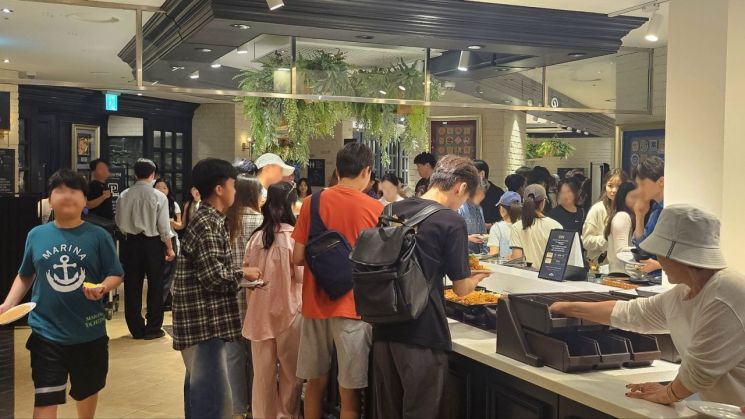
According to the dining industry on the 8th, E-Land Eats plans to open six new Ashley Queens stores in the fourth quarter alone. Last month, the Gwacheon branch and Pyeongtaek Godeok Urban Grove Mall branch already opened. This month, new stores will open at Shinsegae Department Store Gimhae and Hyundai U-Plex Sinchon. Next month, Shinpoong and AK Suwon branches are scheduled to open. Including the upcoming new locations, Ashley Queens will have a total of 110 stores this year. This represents a remarkable growth of 43% from 77 stores last year.
Ashley, which enjoyed its heyday with 155 stores in 2014, fell to 59 stores in 2022 after the COVID-19 pandemic. However, while similar brands like CJ Foodville's 'Seasonal Table' and Shinsegae Food's 'Olban' withdrew one after another, Ashley succeeded in making a comeback within two years by gaining a reputation as a 'buffet with long lines and great value.'
First, it is analyzed that improvements in the business structure have appeared since CEO Hwang Sung-yoon took office in 2021. E-Land Eats consolidated stores that were divided by price range into Ashley Classic, Ashley W, Ashley W+, and Ashley Queens into the premium Ashley Queens. At the same time, price increases were minimized. The weekday lunch price of Ashley Queens is 19,900 KRW, frozen for two years after a 2,000 KRW increase from 17,900 KRW in November 2022. Despite offering over 200 menu items including Korean, Western, Japanese, barbecue, and desserts, Ashley Queens maintained reasonable prices, attracting families, couples, office workers, and tourists, leading to a successful sales rebound.
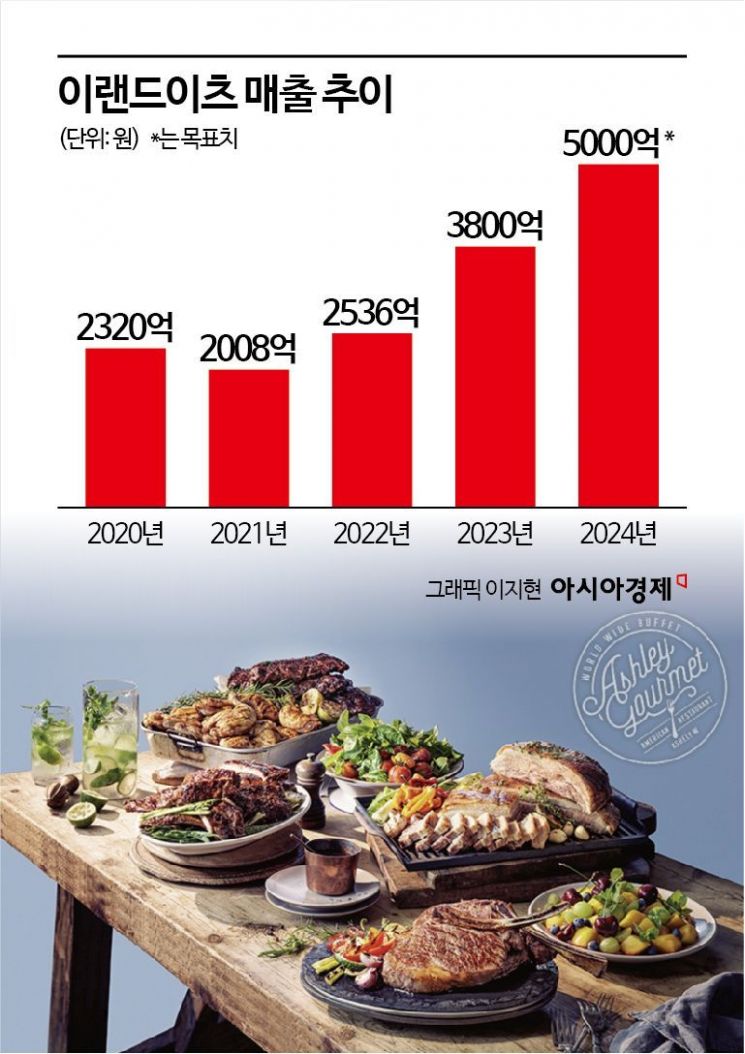
For example, Ashley Queens Jamsil Lotte Castle branch achieved annual sales of 8.6 billion KRW last year and is aiming to exceed 10 billion KRW this year. Thanks to Ashley Queens' success, E-Land Eats' sales are also expected to rise from 380 billion KRW last year to around 500 billion KRW this year. An E-Land Eats official said, "Even though sales from the ready-meal brand Home Restaurant are excluded from E-Land Eats starting this year, Ashley Queens, which accounts for about 70% of sales, is growing significantly, making it possible to achieve 500 billion KRW in sales."
Although more expensive than Ashley Queens, VIPS, a family restaurant operated by CJ Foodville, is also experiencing a new heyday. VIPS, which offers a buffet-style salad bar as a basic feature, saw its sales grow 66% in 2022 compared to the previous year and rose another 13% last year. VIPS' weekday lunch price is 37,900 KRW, higher than Ashley Queens, but it attracts consumers seeking a more premium dining experience.
The soaring dining-out prices play a role in the popularity of buffet restaurants. As various dining prices rise one after another, the cost-effectiveness of buffets stands out. While the YOLO tribe's 'flex' to flaunt wealth was common immediately after the endemic phase of infectious diseases, now the Yono tribe's frugal consumption culture, tightening belts amid high inflation, seems to be taking root.
In fact, according to a BC Card survey, from January 2020 to August 2024, the growth of the domestic food service industry was noticeably slow, but the buffet sector showed high growth, presenting a contrasting picture. During this period, card sales at all food service franchise stores increased by an average of 1.1% annually, whereas the buffet sector grew by an average of 8.9% annually.
An industry insider explained, "As the burden of dining-out prices increases, buffet preference has risen among consumers ranging from relatively low-income 20-something students to 30-something office workers and 40-something consumers with families, who can enjoy various foods at a reasonable cost," adding, "Recently, the trend is to attract even foreign tourists, especially in key commercial areas."
© The Asia Business Daily(www.asiae.co.kr). All rights reserved.
!["The Woman Who Threw Herself into the Water Clutching a Stolen Dior Bag"...A Grotesque Success Story That Shakes the Korean Psyche [Slate]](https://cwcontent.asiae.co.kr/asiaresize/183/2026021902243444107_1771435474.jpg)

















