The Education Committee of the Gyeongbuk Provincial Council (Chairperson Park Chae-a) commenced the 2024 administrative audit of the Gyeongsangbuk-do Office of Education headquarters, six affiliated institutions, and 11 education support offices from the 7th to the 20th, spanning 14 days.
The administrative audit is conducted pursuant to Article 49 of the Local Autonomy Act and the Ordinance on Administrative Audits and Investigations of the Gyeongsangbuk-do Provincial Council. This audit aims to identify issues and propose alternatives regarding the progress and performance of major current projects, as well as to represent the voices of the residents on educational matters.
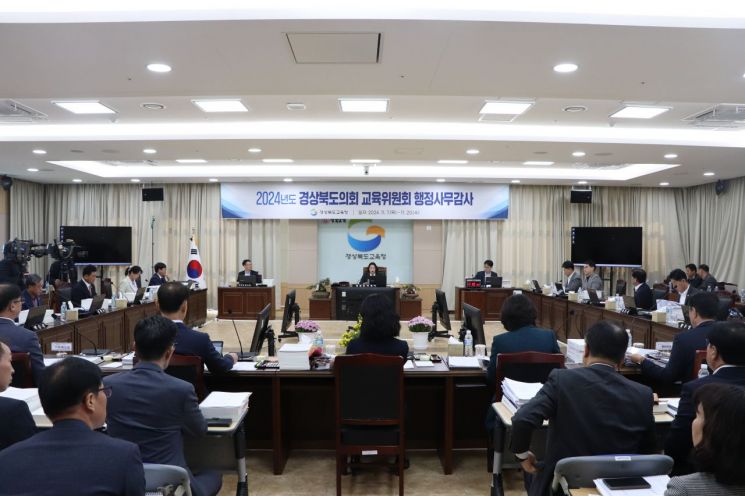
On the first day of the audit, the 7th, many criticisms were raised regarding the promotion of tasks, including pointing out problems with the Gyeongbuk Office of Education’s educational policies and suggesting various alternatives.
Assemblyman Jo Yong-jin (People Power Party, Gimcheon) highlighted the discrepancy in the quality of business trip reports registered on the Ministry of Personnel Management’s information system and the Office of Education’s website, requesting consideration to reflect the results of the review of overseas business trip reports in budget allocation. He also demanded a comprehensive inspection of compliance with submission deadlines and disclosure of overseas business trip reports, along with a plan for improvement based on the inspection results.
He requested a revision of regulations to require the attendance of external members at the Overseas Training Review Committee meetings, which currently only include internal members. He criticized the Gyeongbuk Provincial School Safety Mutual Aid Association for being operated inefficiently without ever obtaining the council’s approval since the establishment of the School Safety Mutual Aid Fund in 2007. He urged that the 2025 main budget for the School Safety Mutual Aid Association and the accident prevention fund receive approval from the Gyeongbuk Provincial Council, and that the fund operation plans and budget settlements from the fund’s establishment date through 2024 be disclosed to residents in an appropriate manner annually.
Assemblywoman Kim Kyung-sook (Democratic Party, Proportional Representation) inquired whether the Office of Education has any measures to prevent disadvantages to the Gyeongbuk Office of Education in the event of the Daegu-Gyeongbuk administrative integration, and expressed concerns about the superintendent appointing all executives, including the chairman of the School Safety Mutual Aid Association.
Assemblyman Kim Dae-il (People Power Party, Andong 3) mentioned that the Daegu-Gyeongbuk administrative integration contains no educational content. He expressed concerns about the impact on Gyeongbuk education, citing that less than a year after Gunwi was incorporated into Daegu on July 1, 2023, small schools in Gunwi are being closed, leaving only one elementary, middle, and high school each, with plans for consolidation.
Committee member Kim Hee-soo (People Power Party, Pohang 2) pointed out that although the number of students and meal participants is decreasing, food waste is increasing. He requested efforts to reduce waste output and costs through student preference surveys and accurate data management of food waste. He also noted that the high number of carryover projects might be due to a shortage of administrative or facility staff and urged improvements.
Committee member Park Seung-jik (People Power Party, Gyeongju 4) expressed regret about the response to the Daegu-Gyeongbuk administrative integration and emphasized that the Gyeongsangbuk-do Superintendent of Education should participate in the Daegu-Gyeongbuk Administrative Integration Council to play an important role. He mentioned the overseas outstanding student recruitment project and Korean students studying abroad, urging Gyeongbuk to actively develop various projects to lead the era of success for high school graduates as the overall educational goal.
Committee member Park Yong-seon (People Power Party, Pohang 5) stated that companies supplying used goods should be permanently banned and that the Gyeongbuk Office of Education should impose strong sanctions. He also pointed out that some public officials attempt to re-enter private schools without undergoing screening, and some private schools exploit this, urging the establishment of regulations to sanction such practices.
He noted that deepfake crimes among teenagers are increasing annually because children perceive deepfakes as games or play. He urged leading digital education through cooperation between schools and the Office of Education, customized class-level methods, and benchmarking other education offices such as the Seoul Metropolitan Office of Education.
Assemblyman Yoon Jong-ho (People Power Party, Gumi 6) pointed out that modular classrooms are difficult to function purely as goods and requested that technical staff, not administrative staff, handle them. He highlighted various issues such as insufficient construction periods due to concentration of modular classroom construction with one company, resulting in delays and liquidated damages, and problems like disguising used goods as new, urging improvements.
Assemblyman Jeong Han-seok (People Power Party, Chilgok 1) mentioned the issue of reemployment of retired senior public officials and pointed out the inconsistency of private contracts varying by region, stating the need to correct this during this opportunity.
Committee member Cha Ju-sik (Independent, Gyeongsan 1) asked how the 42.2 billion KRW returned from school accounting transfers is reflected in the next year’s revenue and postponed further questions.
Committee member Hwang Doo-young (People Power Party, Gumi 2) referred to the delayed response by the Office of Education regarding the sexual harassment incident by the principal of Andong Mojung School against a teacher. He urged proactive measures to prevent such situations. He also expressed doubts about whether the Gyeongbuk Office of Education is making efforts to revitalize the local economy, noting that only 3.5% of electronic blackboard suppliers are local companies and that the regional bonus point system grants only one point to local companies.
Chairperson Park Chae-a of the Education Committee (People Power Party, Gyeongsan 3) emphasized the importance of after-sales service (A/S) for electronic blackboards in school classes. She noted that in the past, many suppliers went bankrupt after selling all their products when demand was high, causing disruptions in classes due to lack of A/S. She stressed the need to form a T/F team related to electronic blackboards to actively manage and prevent such cases. Additionally, regarding the payment of allowances to the chairman of the School Safety Mutual Aid Association, she stated that fixed allowances are taxable as salary, demonstrating her expertise as a tax professional.
From the 8th, the Education Committee of the Gyeongbuk Provincial Council will conduct on-site audits of 11 education support offices, including Bonghwa Education Support Office, and six affiliated institutions.
© The Asia Business Daily(www.asiae.co.kr). All rights reserved.

















