Unusual Climate Caused by High Temperatures in September
More Than a Month Later Compared to Average Years
The first snowfall was observed on Mount Fuji, signaling the arrival of winter in Japan. It is the latest first snowfall in 130 years since observations and statistics on Mount Fuji's snowfall period began in 1894. On the 7th, NHK reported that an employee of the Kofu Local Meteorological Observatory in Yamanashi Prefecture, about 40 km from the summit of Mount Fuji, confirmed with the naked eye that snow had accumulated on Mount Fuji around 6 a.m. Previously, Kyodo News reported that snowfall on the summit of Mount Fuji was confirmed the day before in Shizuoka Prefecture, but due to clouds on the Yamanashi side, the meteorological observatory could not see the snow and officially announced the first snowfall observation on this day. NHK explained that this is the latest first snowfall on Mount Fuji in 130 years since the authorities began compiling related statistics in 1894.
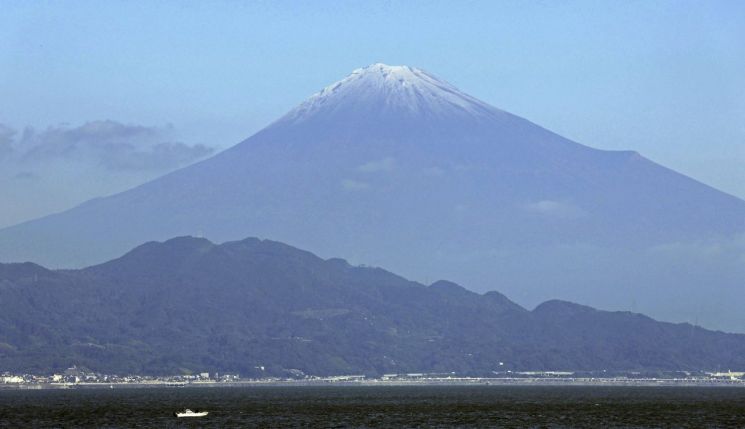 The first snowfall on Mount Fuji, which stands 3,776 meters tall, is visually confirmed by staff at the Gofu Regional Meteorological Observatory, located about 40 km from the summit. Over the past 30 years, the first snowfall on Mount Fuji has typically been observed around October 2 each year. AP·Yonhap News
Mount Fuji’s summit, standing at 3,776 meters, is usually snow-free for only about 2 to 3 months a year. Snow melts in July but typically returns by early October at the latest. The first snowfall on Mount Fuji is confirmed by employees of the Kofu Local Meteorological Observatory, located about 40 km from the summit, who visually check for snow accumulation. Over the past 30 years, the average date of the first snowfall observation has been around October 2. Last year, it was observed on October 5, and the year before last on September 30. This year, however, it is more than a month later. Furthermore, compared to the previous latest first snowfall dates of October 26 in 1955 and 2016, this year’s observation is more than ten days later.
The reason is abnormal high temperatures. According to the Japan Meteorological Agency, this summer was the hottest in Japan’s history. Last month, the average temperature near the summit of Mount Fuji was about 3 degrees higher than usual, at 1.6 degrees Celsius. A Japan Meteorological Agency official said, "Temperatures were abnormally high throughout this summer and continued until September. Because of this, the inflow of cold air seems to have been blocked." They added, "Even after the climbing season ended in September, high temperatures persisted, and due to this abnormal climate, the first snowfall was delayed. We also believe that climate change played a role in this."
© The Asia Business Daily(www.asiae.co.kr). All rights reserved.

















