Operation of Carbon Neutral Support Center and Expansion of Eco-friendly Vehicle Distribution to Establish a Low-Carbon Foundation
Jinju City in Gyeongnam is accelerating projects to transition to a carbon-neutral society, including operating the ‘Carbon Neutral Support Center’ and expanding the distribution and conversion of eco-friendly vehicles, to achieve the creation of a 2050 carbon-neutral city and the shift to a low-carbon, eco-friendly economic foundation.
In response to the government’s 2050 carbon neutrality strategy and the demand for transitioning to a carbon-neutral society, the city has designated and is operating the Carbon Neutral Support Center. Through a public announcement in January 2024, applications were received and, after document and on-site evaluations, Gyeongsang National University was designated. From 2024 to 2027, an annual support of 200 million KRW is being provided for four years.
The Jinju Carbon Neutral Support Center consists of a total of seven members including the center director. It supports tasks related to carbon neutrality policies and climate change adaptation, develops carbon-neutral construction models by sector such as energy, industry, and transportation, and supports research, education, and promotion related to carbon neutrality. The center plans to hold the ‘1st Jinju Carbon Neutral Support Center Forum’ in November to realize a carbon-neutral society together with public institutions, explore ways to spread and revitalize carbon-neutral culture, and promote the transition to a carbon-neutral society and raise awareness.
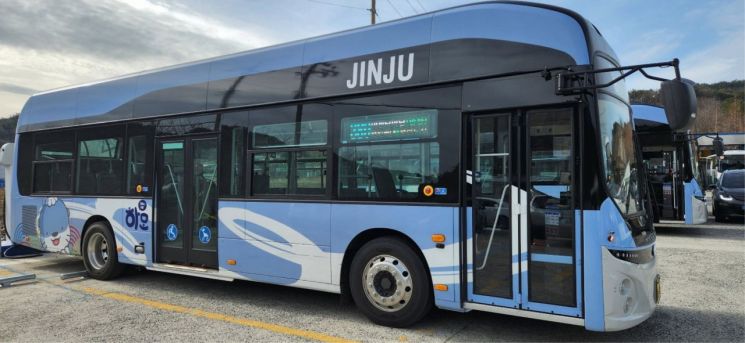
Additionally, Jinju City plans to distribute 165 hydrogen vehicles and 1,130 electric vehicles with a project budget of 23 billion KRW for the distribution of zero-emission eco-friendly hydrogen and electric vehicles. Since 2021, Jinju has expanded the distribution of eco-friendly vehicles through the Jinju-type eco-friendly mobility project, and over four years up to this year, 6,204 hydrogen and electric vehicles have been distributed, achieving greenhouse gas reduction effects.
To reduce fine dust, 4 billion KRW in project funds are being invested in early scrappage subsidies for old diesel vehicles, support projects for emission reduction devices, and construction machinery engine replacement projects, converting about 1,400 vehicles to eco-friendly vehicles. Up to this year, out of approximately 22,000 grade 4 and 5 diesel vehicles in Jinju, 10,702 vehicles have been supported, converting about 50% to eco-friendly vehicles.
Furthermore, as the demand for electric vehicles increases and concerns about electric vehicle fires arise, a new project in 2025 plans to support the costs of relocating electric vehicle charging facilities to above ground in apartment complexes.
Regarding electric vehicle fires in underground parking lots occurring nationwide, to prevent large-scale disasters and alleviate citizens’ anxiety, support of up to 1 million KRW per electric vehicle charging facility and up to 50 million KRW annually will be provided. This aims to build a safe electric vehicle charging infrastructure alongside the distribution of environmentally friendly vehicles.
A city official stated, “We will do our best to proactively respond to the climate crisis and create a clean Jinju to achieve a breakthrough reduction of greenhouse gases through 2050 carbon neutrality.”
© The Asia Business Daily(www.asiae.co.kr). All rights reserved.
![Clutching a Stolen Dior Bag, Saying "I Hate Being Poor but Real"... The Grotesque Con of a "Human Knockoff" [Slate]](https://cwcontent.asiae.co.kr/asiaresize/183/2026021902243444107_1771435474.jpg)
















