Trump Views Allies from Cost Perspective over Value
Possibility of Lifting North Korea Sanctions if US Mainland Threat Resolved
Kim Jong-un Likely to Demand Nuclear Arms Reduction Talks, Not Denuclearization
The 'Trump risk' has returned more strongly. Unlike the Biden administration, which emphasized values and norms, former President Donald Trump is expected to adopt a foreign and security policy that maximizes U.S. national interests. As long as threats to the U.S. mainland can be excluded, easing sanctions on North Korea could also be a possible option. Since he views the Korean Peninsula from a cost perspective rather than a value perspective, it is analyzed that this will pose a significant challenge to our security landscape.
Managing Alliances from a Transactional Perspective: 'Cost' over 'Value'
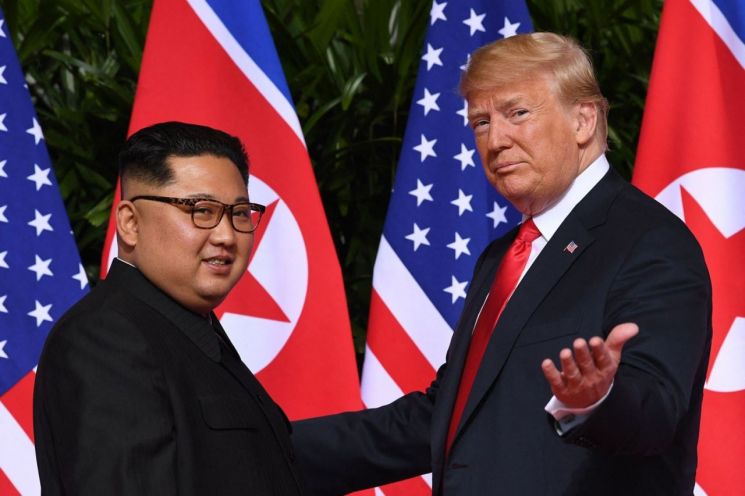 Former U.S. President Donald Trump (right) during the summit with North Korean Chairman Kim Jong-un in Singapore in June 2018. Photo by Yonhap News
Diplomatic authorities had been confident that the South Korea-U.S. alliance would remain solid regardless of the next U.S. administration, but the reality is quite different. The return of former President Trump is an outcome that North Korea would welcome more than South Korea.
Former President Trump views even alliances from a cost perspective. During the election period, he strongly demanded an increase in defense cost-sharing, likening South Korea to a 'money machine,' but regarding North Korea, he showed confidence in negotiations by flaunting his personal relationship with Chairman Kim Jong-un. It is not impossible that the goals of Chairman Kim, who wants to lift sanctions, and Trump's desire to eliminate threats to the U.S. mainland and stop the war, could align.
In 2017, the first year of Trump's first term, North Korea and the U.S. experienced an extreme confrontation remembered as 'fire and fury,' but the situation shifted through a series of talks. Former President Trump is likely to highlight his crisis management ability by temporarily suppressing North Korea's provocations. He may leverage this in 'security transactions' with South Korea or hold North Korea-U.S. talks that exclude South Korea's input, known as 'Korea passing.'
If a scenario similar to the past is replayed, North Korea is expected to bring more advanced demands to the table. Having already experienced the 'Hanoi no deal,' it is anticipated that North Korea will attempt 'nuclear arms reduction negotiations' based on recognition as a nuclear-armed state rather than denuclearization talks. While Trump was out of the White House, North Korea enshrined its nuclear weapons policy in its constitution and will complete its 'Five-Year Defense Development Plan' by next year.
How Will North Korea Respond? Likely to Raise Its Bargaining Chip Through Provocations
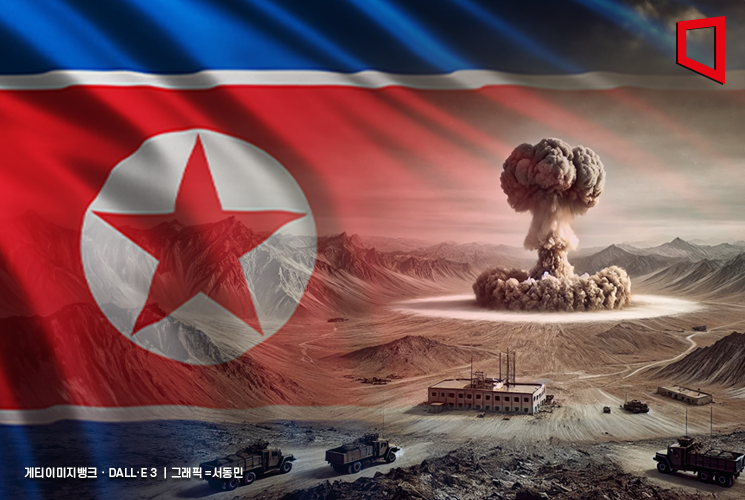
North Korea has one goal: to be recognized as a nuclear-armed state and to lift Western sanctions, thereby rising as a 'normal state.' Since it aims to raise its bargaining chip through provocations, the situation on the Korean Peninsula is bound to become unstable. This is why there are concerns about the launch of intercontinental ballistic missiles (ICBMs) capable of targeting the U.S. mainland and a seventh nuclear test.
Military authorities foresee various types of provocations, including hypersonic missile launches, space launch vehicles, submarine-launched ballistic missiles (SLBMs), and additional nuclear tests. Recently, North Korea fired several short-range ballistic missiles (SRBMs) around the Sariwon area, weapons that hinted at the possible mounting of the tactical nuclear warhead 'Hwaseon-31.'
If North Korea raises its negotiating power and proceeds to 'direct negotiations' with the U.S., South Korea could be cornered. North Korea will likely try to exclude the Yoon Suk-yeol administration, and if friction arises with the U.S. over defense cost-sharing, South Korea could be sidelined. This is why there are concerns that security risks on the Korean Peninsula will increase sharply.
Some argue that for the time being, the North Korea-U.S. standoff might actually reduce tensions on the Korean Peninsula. During the election period, former President Trump persistently attacked South Korea, demanding a reduction in the 'costs' associated with joint U.S.-South Korea military exercises. This implies that joint exercises and the deployment of U.S. strategic assets on the Korean Peninsula, agreed upon during the Biden administration, could be canceled. If joint exercises based on the South Korea-U.S. alliance are eased, North Korea will have fewer grounds for opposition.
Park Won-gon, a professor of North Korean Studies at Ewha Womans University, predicted, "The Trump administration may demand renegotiation of defense costs, but it is also possible that it will ask our government to cover costs related to joint exercises or the deployment of strategic assets."
© The Asia Business Daily(www.asiae.co.kr). All rights reserved.


















