Professor Lee Jae-jun of Pusan National University and Dr. Kim Tae-an of KIST Featured on Cover of Royal Society of Chemistry's 'Materials Horizons'
Demonstrating High Energy Dissipation Capability Using Disulfide Bond Exchange Reactions Activated by External Energy
Pusan National University and the Korea Institute of Science and Technology (KIST) have announced innovative research results that can protect buildings, automobiles, and people from shockwave damage caused by explosions or high-speed collisions.
When collisions or explosions occur, large stress wave energy is rapidly transmitted, causing significant damage to objects or people. At this time, special materials that can absorb or disperse that energy are needed, but materials developed so far have had limitations in repeated and continuous use.
Pusan National University (President Choi Jae-won) announced on the 7th that a research team led by Professor Lee Jae-jun of the Department of Polymer Engineering at Pusan National University and Dr. Kim Tae-an of KIST succeeded in developing a special polymer that can absorb large external energy during collisions and explosions, self-heal, and be recycled for long-term use.
Commonly referred to as “shockwaves,” “high-strain rate stress waves” are generated by explosions and rapid collisions between objects, causing serious damage not only to objects such as buildings and vehicles but also to human health.
To prevent such additional damage, materials that use physical bond dissociation to absorb incoming external energy or additives that can cause structural collapse to attenuate energy have been reported from a materials perspective, but their use has been limited in terms of repeatability and lifespan.
In response, the joint research team from Pusan National University and KIST synthesized a “dynamic covalent bond polymer network with effective high-energy dissipation ability by controlling the activity of dynamic covalent bond exchange reactions through catalysts” and demonstrated self-healing ability and chemical recyclability, evaluating and reporting its value as a high-energy dissipative material.
This study is significant as the first detailed research result linking the necessary conditions for dynamic polymer networks to effectively exhibit high-energy dissipation ability with the viscoelastic behavior of materials.
In particular, unlike other dynamic polymer networks, it was the first to introduce that the energy dissipation ability varies depending on the activation degree of exchange reactions while containing countless dynamic covalent bonds. The limited repeatability of previously reported high-energy dissipative materials was overcome by self-healing performance, and the sustainability of the material was enhanced by recovering monomers and crosslinkers through chemical recycling methods.
To this end, the research team directly synthesized monomers and crosslinkers with different properties based on α-lipoic acid, a naturally derived substance containing disulfide bonds.
By comparing single polymers made from various synthesized monomers, it was revealed that the viscoelastic behavior of the material changes depending on the length of the side chain and the presence of secondary bonds, and the changing tan δ (tangent delta) value correlates with the dissipation of high-energy stress waves.
Tan δ is defined as the ratio of loss modulus to storage modulus and represents the energy dissipation ability relative to energy storage capacity, serving as an indicator to measure the damping ability of materials.
The research team showed that the dynamic elastomer made from combinations of these monomers and crosslinkers can increase high-energy dissipation ability from 50% to 70% depending on the catalyst content, confirming performance comparable to PDMS and polyurea, which have been reported as excellent dissipative materials.
Due to the nature of high-energy dissipative materials, damage to the material caused by exposure to irregular and strong energy is inevitable; however, this material possesses excellent self-healing ability based on disulfide group exchange reactions and can be converted and recovered back into monomers and crosslinkers under basic conditions, proving it to be a material capable of long-term continuous use.
This research achievement was selected as the cover paper of the November 7 issue of “Materials Horizons,” a prestigious materials science journal published by the Royal Society of Chemistry (RSC) in the United Kingdom.
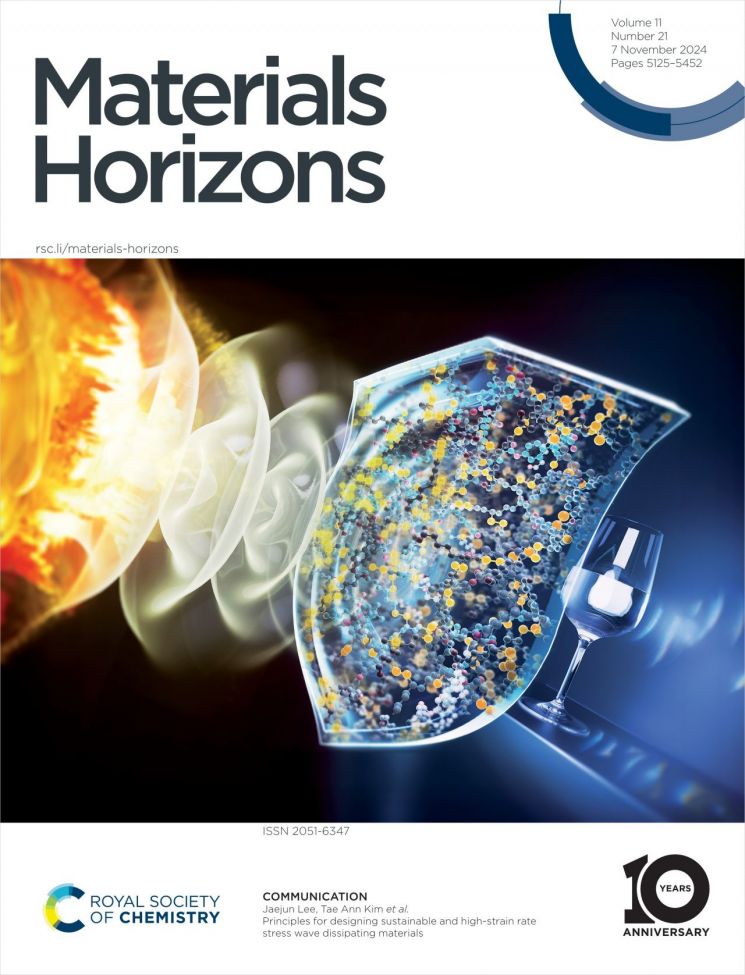
Dr. Kim Tae-an of KIST, who led the research, said, “This research result is significant in that it presents a material that can effectively absorb impact energy, which can cause serious damage, while being recoverable as the original monomer upon disposal, enabling sustainable use.” He especially noted, “Since this material is a dynamic polymer network, it can be flexibly utilized in processing aspects depending on the application, such as foams and coatings, beyond simple film states.”
Professor Lee Jae-jun of Pusan National University, co-corresponding author of the paper, explained, “With the increase in activities in space environments where rapid collisions are frequent and the intensifying conflicts between countries leading to frequent high-energy explosions in battlefield environments, equipment, structures, and the human body will be increasingly exposed to high-strain rate stress waves. This research presents material design principles that effectively disperse such stress waves and protect against them by utilizing dynamic covalent bond chemistry.”
This research was conducted with support from the National Research Council of Science & Technology and the National Research Foundation of Korea, led by Dr. Kim Tae-an of KIST and Professor Lee Jae-jun of Pusan National University as co-corresponding authors, with graduate students Juho Lee (KIST student researcher and doctoral candidate in the Department of Materials Science and Engineering at Seoul National University), Kyungmin Park (master’s student in the Department of Polymer Engineering at Pusan National University), and Dongju Lee (KIST student researcher) as co-first authors. Professor Ahn Cheol-hee of Seoul National University’s Department of Materials Science and Engineering and student researcher Shin Ji-yoon of KIST participated as co-authors.
 From the left: Professor Lee Jae-jun, Dr. Kim Tae-an, PhD candidate Lee Joo-ho, master's candidate Park Kyung-min, and KIST student Lee Dong-joo.
© The Asia Business Daily(www.asiae.co.kr). All rights reserved.
![Clutching a Stolen Dior Bag, Saying "I Hate Being Poor but Real"... The Grotesque Con of a "Human Knockoff" [Slate]](https://cwcontent.asiae.co.kr/asiaresize/183/2026021902243444107_1771435474.jpg)

















