Sam-il PwC Holds Seminar on Preventing Financial Accidents
Strengthening Accountability Structures and Executive Responsibilities
Need to Reset Financial Accident Management Systems
The recently introduced Accountability Structure System in the financial industry is gaining attention as a major change that will elevate internal controls within financial companies to a global regulatory standard. With the implementation of this system, financial companies are required to improve their internal control frameworks using new technologies, adopt a zero-tolerance policy toward internal control violations, and promote a culture of internal whistleblowing.
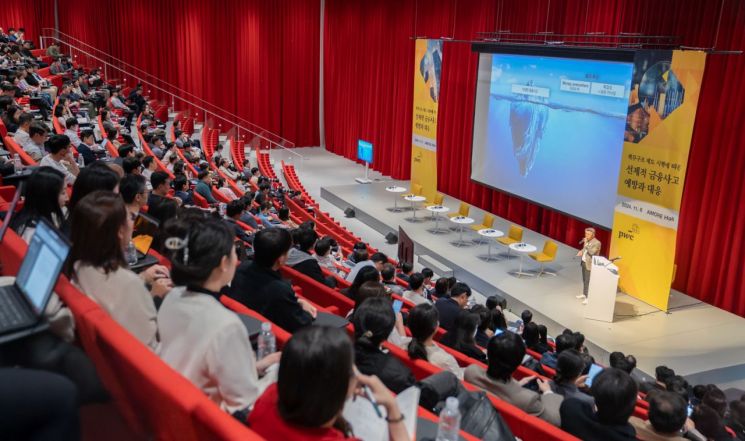
On the 6th, Samil PwC held a seminar at its Seoul headquarters titled "Proactive Prevention and Response to Financial Incidents Following the Implementation of the Accountability Structure System," attended by over 200 financial industry stakeholders who discussed measures to strengthen internal controls after the system's introduction. The seminar was organized to reset the direction of internal controls and explore enhancement strategies utilizing new technologies such as AI.
In the first session, Yeo-Hyun Yoon, Partner at Samil PwC, explained the changes the Accountability Structure System will bring to internal controls in financial companies, forecasting that “as risk management responsibilities are directly assigned to executives, organizational and individual accountability will be strengthened.” He analyzed that, especially considering the high reliance on human factors in the Korean financial industry, the need for internal control infrastructure will become more prominent.
Following this, Partner Hyun-Chul Park explained, “The implementation of the Accountability Structure System will further subdivide the roles of individual executives, making enterprise-wide integrated management more important.” He emphasized that evidence management and performance evaluation, which can prove internal control activities within financial companies, will impact business objectives, and introduced cases of fraud detection using machine learning and AI technologies.
In the third session, Partner Sung-Jin Kim of Samil PwC described changes in financial incident management systems, and Young-Do Kim, Head of Banking Research at the Korea Institute of Finance, discussed changes in the global regulatory environment for financial incidents. Attorney Si-Mok Kim from the law firm Yulchon introduced legal response measures and key issues in the event of financial incidents, emphasizing the importance of financial incident prevention and regulatory compliance.
At the end of the seminar, participants exchanged questions and answers regarding practical difficulties expected during the introduction of the Accountability Structure System and implementation strategies for smaller financial institutions. Partner Hyun-Chul Park stated, “The Accountability Structure System will be an important turning point for domestic financial companies to strengthen internal controls,” expressing hope that the seminar would contribute to the prevention of financial incidents and improvement of internal controls.
This seminar was regarded as a forum to explore challenges facing the financial industry ahead of the Accountability Structure System’s introduction and response strategies within the new regulatory environment, providing important direction for financial companies to establish internal control systems at a global standard.
© The Asia Business Daily(www.asiae.co.kr). All rights reserved.

















