Conflict Over Cement Price Adjustment Without Comprehensive Diagnosis
"Only Material Industry Bears the Pain, Need to Consider Complex Factors Like Labor Cost Increase"
The 'Construction Material Supply Stabilization Council,' operated by the government to stabilize construction costs, is facing difficulties. Instead of diagnosing the various causes of rising construction costs and finding solutions, conflicts over cement price adjustments have continued, causing backlash from related industries.
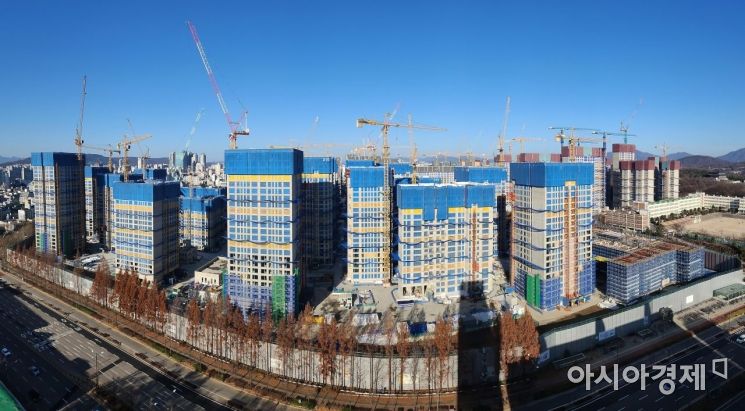
According to the government and related industries on the 7th, the Ministry of Land, Infrastructure and Transport held two meetings of the Construction Material Supply Stabilization Council at the Government Sejong Complex on the 14th of last month and the 4th of this month. Attendees included the Ministry of Land, Infrastructure and Transport, Ministry of Economy and Finance, Ministry of Trade, Industry and Energy, Ministry of Environment, the Korea Cement Association, Korea Ready-Mixed Concrete Association, and the Korea Construction Material Workers' Council (Geonjahoe).
The meetings were follow-up measures to the government's announcement on the 2nd of last month of the 'Construction Cost Stabilization Plan for Revitalizing the Construction Industry.' They were held to stabilize construction costs, which have risen about 30% since 2020, through voluntary negotiations between demand and supply parties. The problem is that in both meetings, only cement price adjustments were treated as the core agenda.
At the meetings, the construction industry repeatedly argued that cement prices should be lowered because production costs have decreased due to the reduction in bituminous coal prices. Meanwhile, the cement industry maintained its existing position that the 10.2% increase in electricity rates, which now account for more than 30% of production costs, negates the effect of bituminous coal price reductions, and that price adjustments are difficult due to investments in eco-friendly facilities.
In particular, the cement industry expressed dissatisfaction that the rise in construction costs and sale prices is being blamed solely on cement price increases, without considering the comprehensive effects of rising labor costs, land prices, and financial costs.
The Korea Cement Association had previously expressed "active welcome" for the operation of the council immediately after the government's announcement of the construction cost stabilization plan. At that time, the association stated, "We hope the council will go beyond a 'pinpoint solution' focused on revitalizing the construction industry and discuss a 'comprehensive solution' that diagnoses the entire industrial ecosystem linked to construction and overcomes the crisis."
However, after the second council meeting, a cement industry official said, "If the council is a place to discuss cement prices, it will be burdensome to participate in future meetings." This means that, having expected discussions on comprehensive solutions, the cement industry has no further expectations for the council, which continues to focus solely on cement price adjustments, and may not attend future meetings.
The ready-mixed concrete (Remicon) industry also feels uncomfortable with the council meetings. An industry official said at a meeting, "Why should we attend a meeting that discusses cement prices?" On the 23rd of last month, Geonjahoe sent an official letter titled 'Promotion of Cement Price Reduction Negotiations' to Remicon groups and manufacturers, pressuring Remicon companies to take the lead in negotiating price reductions with cement companies.
A Remicon industry official lamented, "If cement prices go down, next will be Remicon's turn. The construction industry's demand to 'cut our own flesh' is nonsense," adding, "The proportion of Remicon prices in apartment sale prices is only 1.2%, so it is problematic that cement and Remicon price increases are being pointed to as the main causes of the sharp rise in construction costs."
In response, a construction industry official explained, "Cement accounts for about 2% of construction costs, but when combined with Remicon and mortar, which use cement as a raw material, it reaches 10%. Since cement price increases affect the price increases of other materials, cement prices must be lowered."
The Ministry of Land, Infrastructure and Transport, which leads the council, said, "The government cannot interfere with private price decisions, so we only recommend that Geonjahoe, the cement industry, and the Remicon industry come together to negotiate," and has not actively mediated.
Regarding this, a cement industry official emphasized, "While we welcome the government's policy to stabilize construction costs, we need to reconsider whether it is only asking the material industry to share the burden," and stressed, "It is necessary to more closely examine the complex factors on site, such as rising labor costs."
© The Asia Business Daily(www.asiae.co.kr). All rights reserved.
![Clutching a Stolen Dior Bag, Saying "I Hate Being Poor but Real"... The Grotesque Con of a "Human Knockoff" [Slate]](https://cwcontent.asiae.co.kr/asiaresize/183/2026021902243444107_1771435474.jpg)
















