Training for Guided Missile Interception Using Cheongung-II and Patriot Systems
Our military conducted a live-fire guided missile interception exercise in the West Sea region, involving the Air Force Missile Defense Command forces. This serves as a warning message against various provocations following North Korea's recent launches of intercontinental ballistic missiles (ICBMs) and short-range ballistic missiles (SRBMs).
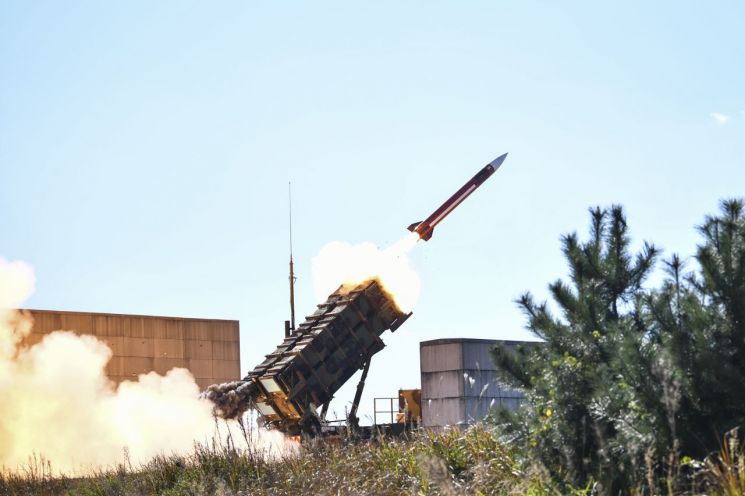
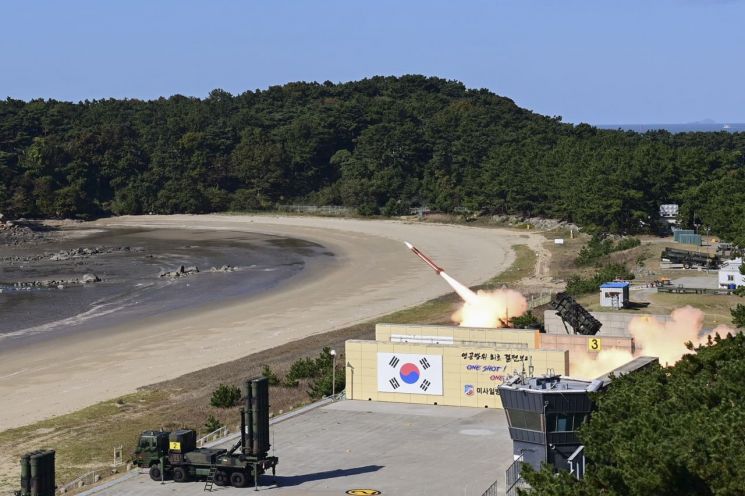
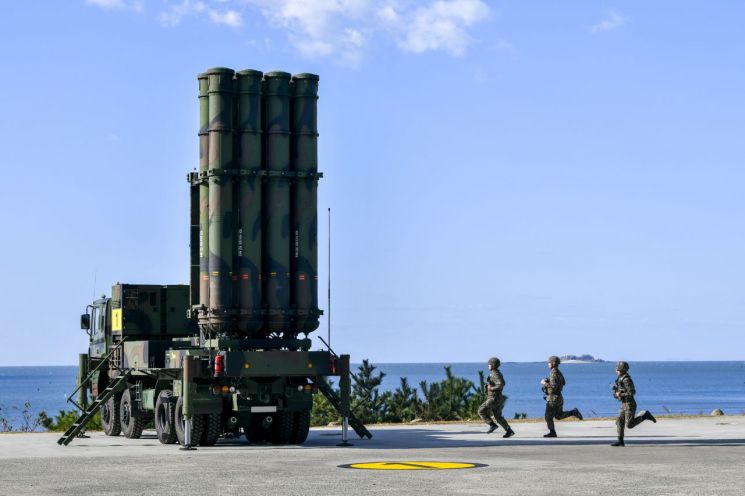
On the 6th, the Joint Chiefs of Staff stated, "This exercise proceeded with procedures to intercept targets using our military's Cheongung-II and Patriot surface-to-air guided missiles, successfully shooting down a simulated missile." Four units under the Missile Defense Command participated in the exercise.
Initially, our military planned to launch the Hyunmoo-II, but it was reportedly not launched due to weather and other conditions. The Hyunmoo-II, classified as an SRBM, has a maximum range of 1000 km, capable of striking all of North Korea. In October 2022, our military also launched the Hyunmoo-IIC in response to North Korea's launch of an intermediate-range ballistic missile (IRBM). Cheongung is an air defense weapon system used to intercept enemy aircraft and missiles.
Full Mobilization Training of North Korean Missile Interception Systems
The military conducted this live-fire guided missile interception exercise because there is a forecast that North Korea may engage in various provocations, including the recent launches of ICBMs and SRBMs, hypersonic missiles, space launch vehicles, submarine-launched ballistic missiles (SLBMs), and a seventh nuclear test. This exercise is intended to send a warning message to North Korea.
Warning Against Military Provocations Including the Seventh Nuclear Test
A Joint Chiefs of Staff official told the Ministry of National Defense press corps, "North Korea's launch of SRBMs today, following the ICBM launch intended as a threat to the U.S., once again shows that the Korean Peninsula is also under nuclear threat," adding, "They mobilized transporter erector launchers (TELs) to launch multiple missiles in a surprise attack, which can be seen as a threat that they could launch nuclear-armed missiles."
Recently, North Korea launched multiple SRBMs from the Sariwon area into the East Sea. Our military estimates that the missiles launched by North Korea are 600mm super-large multiple rocket launchers. North Korea's 600mm super-large multiple rocket launcher is a multiple rocket launcher applying ballistic missile technology, and North Korea has hinted that it can equip this weapon with the tactical nuclear warhead 'Hwasan-31'.
When asked if there are signs that North Korea is preparing additional provocations, a Joint Chiefs of Staff official replied, "The military does not speculate on nonexistent activities, but there are several activities that South Korea and the U.S. are jointly tracking," adding, "Considerable progress has been made in preparing hypersonic missiles, and Dongchang-ri (West Sea Satellite Launch Site) is also being significantly prepared."
Detection of SLBM Launch Movements
The official continued, "SLBM-related activities are ongoing around the Sinpo area," adding, "For Kim Jong-un, it seems that by the end of this year, he will hold many cards in his hand, thinking 'Shall I try this?'"
Our military also assesses that North Korea's seventh nuclear test can be conducted at the Punggye-ri nuclear test site anytime if the supreme leader decides to do so. Currently, no imminent signs of a nuclear test have been detected in Tunnel No. 3 at Punggye-ri, but conversely, there are no signs indicating that a nuclear test will not be conducted, according to the Joint Chiefs of Staff official.
Possibility of Additional Nuclear Tests to Prove Tactical Nuclear Capability
The Joint Chiefs of Staff official said, "North Korea's activities related to increasing nuclear material have been rising throughout the year, and the cumulative amount seems to have increased more than initially expected at the beginning of the year," adding, "What Kim Jong-un wants is the completion of nuclear forces, so they are producing materials, conducting tests, and increasing warheads and delivery systems, proceeding with various tasks according to schedule."
He also stated, "If North Korea conducts additional nuclear tests, South Korea and the U.S. believe that small tactical nuclear weapons will be prioritized," adding, "They have already developed hydrogen bomb-level weapons, which are difficult to miniaturize, and there is a need and likelihood to reinforce the message that they threaten the entire Korean Peninsula with super-large multiple rocket launchers and other means."
The Joint Chiefs of Staff official said, "Our military maintains a posture to intercept and strike any provocations by North Korea and has its own training plans related to ICBMs and SRBMs," adding, "We plan to conduct surface-to-air guided missile launches and surface-to-surface missile launch exercises, and we also have plans for future South Korea-U.S. joint exercises."
© The Asia Business Daily(www.asiae.co.kr). All rights reserved.



















