Government-wide Task Force Announces Measures Against Deepfake Sexual Crimes
Ministry of Science and ICT and Korea Communications Commission Enhance Platform Accountability
Increase Budget and Personnel for Monitoring and Removal Support
The government is promoting various regulations on domestic and international platform companies to respond to deepfake sex crimes.
The inter-ministerial deepfake response task force (TF) team announced the "Strengthened Measures to Respond to Deepfake Sex Crimes," jointly prepared by related ministries, on the 6th.

Recently, as generative artificial intelligence (AI) technology has become widespread and closed platforms such as Telegram have expanded, deepfake sex crimes have emerged as a social issue, especially among people in their teens and twenties.
Accordingly, an inter-ministerial TF composed of the Office for Government Policy Coordination, Ministry of Education, Ministry of Justice, Ministry of National Defense, Ministry of Science and ICT, Korea Communications Commission, Ministry of Gender Equality and Family, and National Police Agency was formed to prepare response measures.
The plan includes comprehensive measures such as prevention and education to stop the creation of deepfake sex crime materials, prevention of distribution of sex crime materials through platform regulation, victim support, and punishment of perpetrators.
Among them, the Ministry of Science and ICT and the Korea Communications Commission will strengthen regulations on platform companies pointed out as hotbeds for the distribution of illegal sex crime materials.
Until now, overseas-based platforms without domestic offices, such as Telegram, have been in a blind spot for management because domestic laws did not apply. In contrast, domestic platforms like Naver and Kakao, or overseas platforms with domestic offices such as Google, have been managed according to relevant laws.
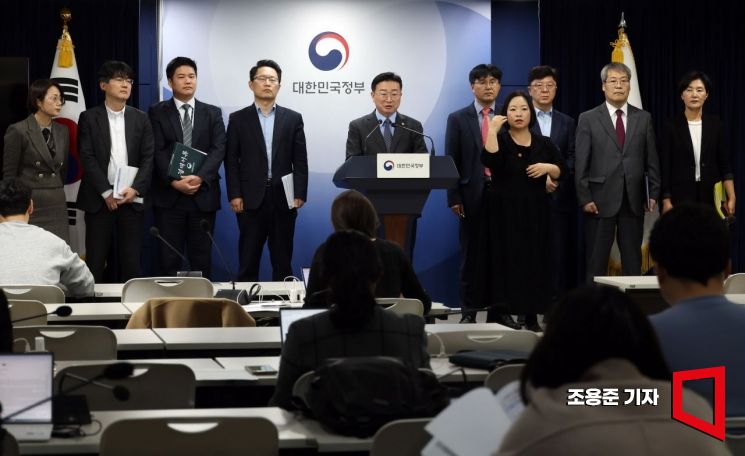 Kim Jong-moon, Chair of the Government-wide Task Force on Deepfake Response (First Deputy Minister of the Office for Government Policy Coordination), is announcing measures to strengthen joint deepfake sex crime response by related ministries at the Government Seoul Office in Jongno, Seoul, on the 6th. Photo by Jo Yong-jun
Looking at the main legal obligations of platforms, under the Information and Communications Network Act, there are obligations such as ▲designation of persons responsible for youth protection and prevention of illegal filming material distribution ▲prohibition and deletion of distribution of illegal information such as obscene materials ▲submission of transparency reports ▲submission of related items and documents.
Under the Telecommunications Business Act, there are obligations such as ▲business registration ▲measures to prevent distribution of illegal filming materials ▲technical and administrative measures.
The government decided to actively interpret domestic laws and promote regulations on domestic and international platform operators such as Telegram.
In particular, distributing open channel access links and passwords to unspecified many people to induce access is actively interpreted as ▲providing and mediating harmful materials to youth and ▲distribution of illegal filming materials, and regulations on operators will be enforced based on this.
The Korea Communications Commission interprets Telegram as a provider and mediator of harmful materials to youth and will request materials related to youth protection officers, notify the obligation to designate such officers, notify the obligation to designate a domestic agent, and demand corrective orders and other obligations. If these obligations are not fulfilled, sanctions such as fines will be imposed.
For platform operators such as Naver and Meta, who are also value-added telecommunications service providers, legal sanctions such as corrective orders and fines will be actively imposed if they fail to fulfill their obligations to prevent the distribution of illegal filming materials.
Additionally, through amendments to the Information and Communications Network Act, the contents of transparency reports will be strengthened. Efforts to prevent distribution of illegal filming materials, results of reports and deletions, and designation of responsible persons will be submitted annually. A clause imposing fines on platform operators for submitting deficient or false transparency reports will be newly established.
Measures such as suspension of service use and withdrawal will be promoted against those who post digital sex crime materials such as fake sexual videos.

The Korea Communications Commission and the Ministry of Gender Equality and Family will focus on monitoring overseas social networking services (SNS) by increasing monitoring personnel and introducing AI-based new technologies to prevent sex crimes.
The Korea Communications Standards Commission will establish consultation channels not only with domestic portals and global platform companies but also with platforms without domestic offices. In September, the Commission achieved results such as establishing a hotline with Telegram and conducting working-level consultations.
The Ministry of Science and ICT plans to operate the "AI Ethics and Reliability Forum" to encourage responsible AI use by companies, including AI safety evaluation and development of AI-generated content identification technologies. Participants in this forum include Naver, Kakao, SK Telecom, Microsoft Korea, Google Korea, and LG AI Research.
At the briefing, Kim Jong-moon, First Deputy Minister of the Office for Government Policy Coordination, stated, "We will continue to operate the deepfake sex crime response TF and meticulously review and supplement follow-up measures of this plan, such as victim support, strengthened crackdowns, passage of legislation, and budget securing."
© The Asia Business Daily(www.asiae.co.kr). All rights reserved.
![Clutching a Stolen Dior Bag, Saying "I Hate Being Poor but Real"... The Grotesque Con of a "Human Knockoff" [Slate]](https://cwcontent.asiae.co.kr/asiaresize/183/2026021902243444107_1771435474.jpg)


















