Expansion of Supply for Kimchi-Making Ingredients like Cabbage and Radish
Wholesale Prices Stabilize Amid Declining Trend
Discount Support for All Kimchi-Making Ingredients
As kimchi-making ingredient prices have stabilized this month, the government is investing 17 billion won in budget to support discounts on kimchi-making ingredients until next month.
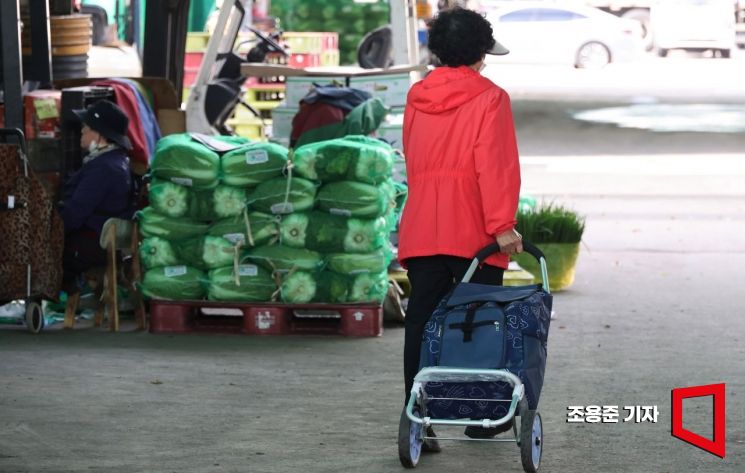
On the 6th, the Ministry of Agriculture, Food and Rural Affairs forecasted that prices of kimchi-making ingredients are on a downward trend and will stabilize further after mid-month. Last month, the wholesale price of napa cabbage rose to 8,299 won per head and radish to 2,509 won each, but prices have been falling with increased supply this month. As of the 6th, the wholesale price of napa cabbage dropped to 2,844 won per head, and radish to 1,831 won each.
For napa cabbage, shipments have increased in several regions including Haenam, Gangneung, Chuncheon, and Asan. The volume of napa cabbage brought into Garak Market was less than 700 tons at the beginning of this month, but the Ministry of Agriculture, Food and Rural Affairs explained that it is expected to stabilize above 700 tons by mid-month. Radish tends to follow napa cabbage’s harvest by about 10 days, so supply is expected to improve subsequently.
Park Sun-yeon, Director of Distribution and Consumption Policy at the Ministry of Agriculture, Food and Rural Affairs, said, "Consumer prices rose 1.3% year-on-year last month, and agricultural and livestock products overall increased by 1.1%. This is the first time that the increase rate of agricultural and livestock products was lower than the overall inflation rate."
She added, "Since October, temperatures have been suitable for growth, and thanks to farmers’ efforts in growth management, prices have entered a stable phase. There were reports that kimchi factories’ operating rates had declined, but upon verification, they are currently operating normally."
Other kimchi-making ingredients such as dried red pepper powder (gochugaru), onions, garlic, and green onions also have sufficient supply capacity. In the case of gochugaru, wholesale prices are falling along with increased dried red pepper production compared to last year. For facility-grown vegetables like tomatoes and pumpkins, whose prices have risen, shipments are expected to increase after late this month as weather improves.
The Ministry of Agriculture, Food and Rural Affairs will provide discount support on all kimchi-making ingredients starting from the 7th to reduce the burden of kimchi-making costs. At large and small supermarkets nationwide, as well as online malls, consumers can purchase kimchi-making ingredients at prices up to 40% lower, with a limit of 20,000 to 30,000 won per person. Pork for boiled meat, which sees increased demand during kimchi-making season, will be available at about 20% discounted prices, and sea products such as solar salt, salted seafood, and oysters can be purchased at prices up to 50% lower.
Additionally, to support consumers using traditional markets, zero-pay agricultural discount gift certificates worth a total of 5 billion won will be issued and sold at 30% lower prices starting from the 11th. For the convenience of the elderly, the certificates will be sold exclusively to consumers aged 65 and older from the 18th to the 24th.
The government has allocated a total budget of 17 billion won, including 12 billion won from the Ministry of Agriculture, Food and Rural Affairs and 5 billion won from the Ministry of Oceans and Fisheries, to continue discount support until next month. The Ministry explained that the actual budget spent may vary depending on the quantity sold during the discount period.
Director Park said, "We will monitor the supply and price trends of kimchi-making ingredients and stabilize supply by releasing government stockpiles early if necessary. We will make every effort to reduce the burden on consumers through discount support."
© The Asia Business Daily(www.asiae.co.kr). All rights reserved.
![Clutching a Stolen Dior Bag, Saying "I Hate Being Poor but Real"... The Grotesque Con of a "Human Knockoff" [Slate]](https://cwcontent.asiae.co.kr/asiaresize/183/2026021902243444107_1771435474.jpg)
















