"Even with a badge, it's hard to ask someone to give up their seat"
Awareness of leaving seats empty for others is still lacking
Public skeptical about government's expansion of priority seating
Ms. Lee (31), who is two months pregnant, finds commuting exhausting. She uses public transportation to commute, but even when her body is tired, it is difficult to use the pregnant woman priority seats. Lee said, “I just endure it because I’m afraid of getting backlash if I say something. When I ask for understanding during really tough times, I feel so hurt every time.” This is not just Lee’s experience but one shared by most pregnant women.
On the morning of the 6th, between 8 and 10 a.m., the situation on public transportation was checked and found to be the same. Ten Seoul city buses were inspected, and all the pregnant woman seats were occupied by non-pregnant passengers. The subway situation was no different. Lines 1, 2, 4, and 5 of the subway were checked in order, but there were no empty pregnant woman seats.
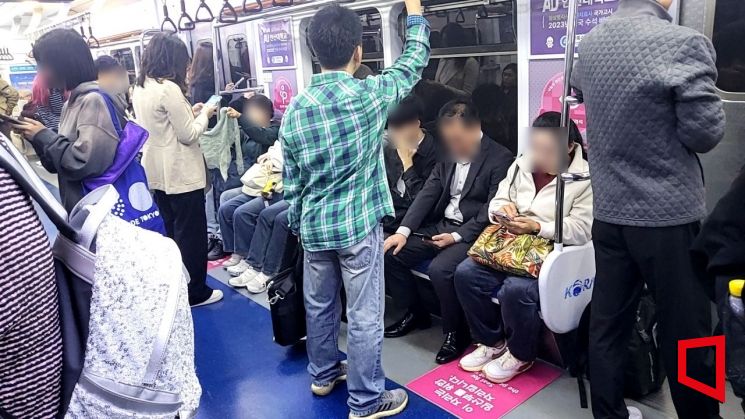 Around 9 a.m. on the 6th, citizens are sitting in the pregnant women’s seats on the Seoul subway. Photo by Shim Sung-ah
When asked an elderly person sitting in a pregnant woman seat if they knew it was a priority seat, they said, “I was going to get up if a pregnant woman came,” and then moved elsewhere. Seoul Metro, which operates subway lines 1 through 8, encourages keeping pregnant woman priority seats vacant. This is to ensure that pregnant women can sit comfortably whenever they need to. From January to September, 4,668 complaints related to pregnant woman priority seats were received. This averages to about 500 complaints per month.
The reason pregnant women cannot use the seats prepared for them on public transportation is that the policy is based on voluntary compliance rather than enforcement. There are no penalties or disadvantages for non-pregnant passengers sitting in pregnant woman seats on subways or buses. Citizens are expected to voluntarily leave these seats vacant out of consideration, and pregnant women should be able to use the seats whenever they are empty, but the reality is different.
The overcrowding of public transportation during rush hours also makes it difficult for the pregnant woman priority seat system to take root. It is pointed out that expecting citizens to voluntarily avoid sitting in certain seats when it is already hard to stand properly is unrealistic. However, there is also a considerable opinion that policy efforts should be made so that pregnant women can use public transportation comfortably, in order to uphold the purpose of the system.
In this regard, the government plans to expand the ‘pregnant woman priority seat’ policy. The pregnant woman priority seats, which were designated only on some intercity buses, will be expanded to all intercity buses. The Low Fertility and Aging Society Committee announced on the 30th of last month that, to improve convenience for pregnant women who need to travel long distances between Seoul and Gyeonggi areas during commuting hours, pregnant woman priority seats (seats for the transportation disadvantaged) will be visually and clearly distinguished on intercity buses. However, public opinion remains skeptical.
Ms. Yoo (30), who is four months pregnant, said, “I agree with increasing the number of pregnant woman seats, but before that, I wish there was a more active campaign to keep the existing seats vacant.” Mr. Jung Jin-woo (28) also said, “I have never seen a pregnant woman seat empty during commuting hours,” and added, “Since it’s not properly observed now, blindly expanding pregnant woman seats seems meaningless.”
Professor Song In-han of Yonsei University Graduate School of Social Welfare said, “I fully understand the intention behind expanding pregnant woman priority seats on intercity buses, but it is necessary to carefully review the problems and limitations observed in the operation of pregnant woman seats on subways and buses and approach this cautiously.” Professor Song emphasized, “Misunderstandings and conflicts surrounding pregnant woman seats continue to occur even now, so if this is implemented lightly as just one of many policies, its effectiveness may further decline. There needs to be a discussion about how much our society can show consideration and a social consensus must be formed.”
© The Asia Business Daily(www.asiae.co.kr). All rights reserved.

![Clutching a Stolen Dior Bag, Saying "I Hate Being Poor but Real"... The Grotesque Con of a "Human Knockoff" [Slate]](https://cwcontent.asiae.co.kr/asiaresize/183/2026021902243444107_1771435474.jpg)















