Korea's First IOJT International Conference
The International Organization for Judicial Training (IOJT) International Conference, an international organization with 140 major judicial training institutions from around the world as members, was held in South Korea for the first time in Northeast Asia. The hottest topic at this international conference was undoubtedly 'Artificial Intelligence (AI).' Presentations were made on countries currently utilizing AI in trial procedures and judges' trial work, along with explanations of AI models being developed by the Korean judiciary.
The Judicial Research and Training Institute (Director Kwon Ki-hoon) jointly hosted the '11th IOJT International Conference' with the International Organization for Judicial Training (IOJT) from November 3 to 7 at Sono Calm Goyang in Ilsandong-gu, Goyang-si, Gyeonggi Province.
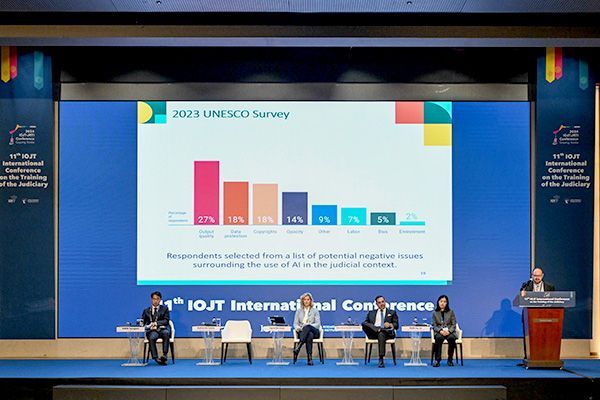 On the 5th, the session titled "Strategies to Strengthen Judicial Competence for the Rule of Law in the Age of Artificial Intelligence" was held at Sono Calm Goyang in Ilsandong-gu, Goyang-si, Gyeonggi Province during the "11th IOJT International Conference."
 [Photo by Legal News]
This international conference was held under the main theme of 'Judicial Education at a Crossroads: Preparing for the Future of Justice,' featuring a total of 41 sessions with over 120 domestic and international judges delivering presentations and engaging in discussions.
"Developing a Model to Recommend Similar Judgments and Assist Trial Work"
Kim Taek-woo (47, 40th Judicial Research and Training Institute class), Information Planning Officer at the Judicial Informatization Office of the Court Administration, introduced the AI models currently being developed by the Korean courts during the session titled 'Strategic Approaches to the AI Era.'
Kim explained the 'Similar Case Judgment Recommendation Model,' stating, "When documents such as complaints, answers, and preparatory briefs are input into this model, it calculates similarity and recommends a list of the most similar cases." He added, "By clicking on the list, users can view the judgments of those similar cases." However, he noted a limitation that if multiple documents of the same type are submitted, they may be merged and considered as one document, which conflicts with the purpose of content-level document search in existing systems.
He also introduced the 'Litigation Procedure Guide Bot' being developed for litigants. For example, when a query like "Please guide me on the payment order procedure" is entered, the model explains the relevant procedures and provides information necessary for litigation, such as required documents and litigation costs. It is expected to offer consultations in various fields including civil litigation, criminal litigation, family litigation, administrative litigation, patent litigation, personal bankruptcy/recovery, compulsory execution, family relation registration, deposit, juvenile protection, and family protection. Kim said, "We are developing the 'Litigation Procedure Guide Bot' so that the general public can easily access judicial information anytime," adding, "It is a model that understands the intent of queries or keywords related to litigation procedures and provides appropriate answers." He further mentioned, "We are also developing a legal terminology explanation service, which is scheduled to be launched in the first half of next year."
He introduced models that convert litigants' voices into text during trials and an 'LLM architecture' model that assists trial work. LLM-based services include △intelligent search △summarization △comparison and analysis △document drafting. Utilizing these models is expected to enable the rapid and accurate creation of review reports and support correction and verification through AI-based research results on case summaries, issues, and related legal materials. Kim stated, "To protect personal and sensitive information, we plan to establish a generative AI for public interest use within the court's internal network around next year," adding, "We anticipate an era where every judge will be matched with an AI trial researcher."
Kim also emphasized that the goal of intelligent judicialization is to realize citizens' fundamental rights and guarantee judicial independence. He said, "The judicial informatization efforts of the Korean courts, such as electronic litigation, began to realize the fundamental rights of the right to be judged by a judge as stipulated in the Constitution and the right to a speedy trial," stressing, "We aim to use these efforts as a means to guarantee judicial independence based on the provision that judges adjudicate independently according to their conscience."
Brazil Uses AI to Draft Judgments
Examples of countries already utilizing AI in trial work were also introduced.
Currently, Brazil uses AI for judicial administration, case processing automation, drafting judgments, and detecting litigation abuse. Additionally, in 2020, the Brazilian National Judicial Council issued a resolution emphasizing that AI tools must be supervised and controlled by judges and that diversity must be reflected when developing AI tools.
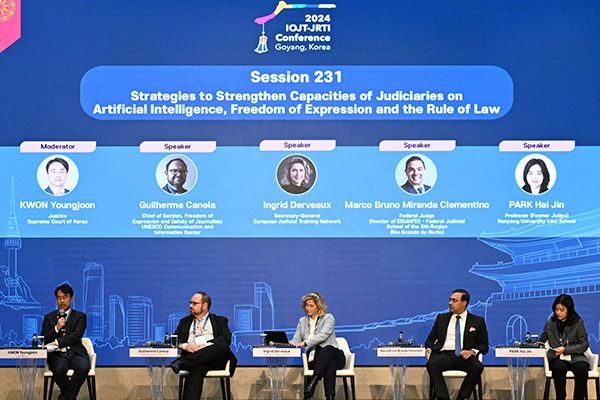
Marco Bruno Miranda Clementino, a federal judge of Brazil, stated in the session 'Strategies to Strengthen Judicial Capacity for the Rule of Law in the AI Era,' "The Brazilian National Judicial Council has allowed the use of AI for drafting judgments," adding, "However, there is a caveat that AI tools must be used under the supervision of judges." He further explained, "Training related to AI was conducted throughout last year and this year in Brazil," and "In some regions, workshops on how to use LLM tools are being provided to judges and court clerks."
China also announced plans for digital courts in February last year and is transitioning trial-related matters conducted offline to online. Guangming, Deputy Director of the Chinese Judicial Training Institute, emphasized, "During the transition to online, we provided education to the public and judges," adding, "We focused on how to manage information and will further strive to digitalize the traditional litigation system."
Guidelines Introduced Emphasizing 'Priority Implementation of AI Impact Assessments'
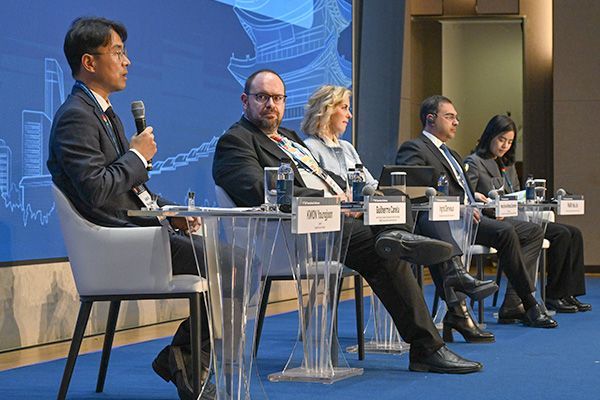
Presentations on guidelines related to AI used by judiciaries worldwide were also conducted. UNESCO introduced the 'Draft Guidelines for AI Use in the Judiciary' (tentative title) during the session 'Strategies to Strengthen Judicial Capacity for the Rule of Law in the AI Era,' chaired by Supreme Court Justice Kwon Young-jun (54, 25th class).
According to a survey conducted by UNESCO last year (96 countries, 500 respondents), 93% of judicial institution workers surveyed were aware of AI technology, and 44% were using AI tools such as ChatGPT in their work. However, only 9% of all respondents answered that their institutions had established AI-related guidelines or provided AI training.
In response, UNESCO has prepared draft guidelines for the use of AI systems in courts and tribunals worldwide. The guidelines aim to provide comprehensive guidance to courts to ensure that the use of AI technology aligns with the fundamental principles of justice, human rights, and the rule of law.
Guillermo Canilla, head of UNESCO's section on freedom of expression and media protection, said, "When adopting AI tools, it is essential to first conduct impact assessments and prepare impact assessment reports," adding, "It is also important to establish internal risk management systems and cybersecurity." He continued, "Subsequently, relevant education and training should be provided to legal professionals who will use these tools," emphasizing, "Specific guidelines tailored to each institution and organization are also necessary."
Han Su-hyun, Legal Times Reporter
※This article is based on content supplied by Law Times.
© The Asia Business Daily(www.asiae.co.kr). All rights reserved.



















