Announcement of Statistics Korea's Economically Active Population Survey Results on the 6th
The number of people who are neither working nor seeking jobs, simply 'taking a break,' has increased by more than 240,000 over the past year.
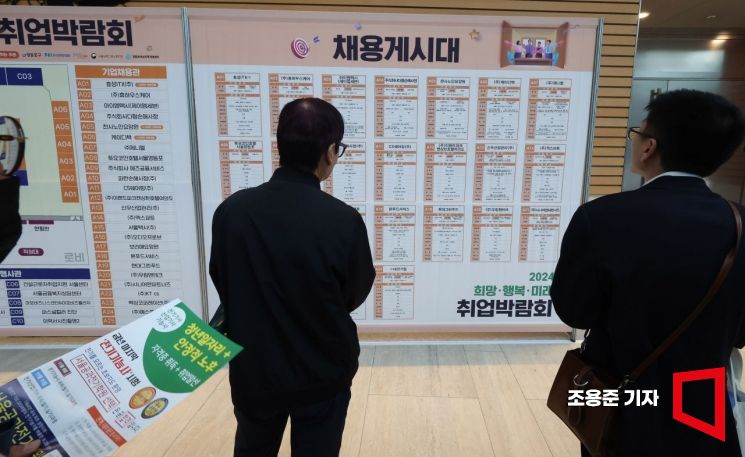 On the 15th, job seekers carefully examined the job posting board at the '2024 Hope Happiness Future Job Fair' hosted by Yeongdeungpo-gu, Hankyung Association Middle-aged Tomorrow Center, Seoul Southern Employment and Labor Office, and Yeongdeungpo Women's Human Resources Development Center, held at the FKI Tower in Yeouido, Seoul. Photo by Jo Yongjun jun21@
On the 6th, Statistics Korea announced the results of the "Supplementary Survey on Non-Wage Workers and Economically Inactive Population" from the Economically Active Population Survey containing this information. According to Statistics Korea, the economically inactive population in August this year was 16,211,000, an increase of 48,000 compared to last year.
The economically inactive population refers to people aged 15 and over who are of working age but are neither employed nor seeking employment. The proportion of the economically inactive population among those aged 15 and over was 35.6%, the same as last year. By activity status, the largest group was homemakers (36.8%), followed by those attending school or taking courses (20.0%), and those 'taking a break' (15.8%).
The population 'taking a break,' neither working nor job-seeking, increased by 245,000 compared to a year ago. Their share among the economically inactive population also rose from 14.4% to 15.8%. By age group, those in their 60s increased by 80,000, while those in their 70s and 20s increased by 65,000 and 54,000 respectively.
The reasons for 'taking a break' varied by age group. Among the youth, the most common response was "difficulty finding the desired job," at 30.8%. A similar reason, "no jobs available," was reported by 9.9%. For other age groups excluding the youth, the most common response was "poor health." As a second reason, people in their 30s, 40s, and 50s cited "difficulty finding the desired job," while those aged 60 and over cited "continuing to rest after resignation."
© The Asia Business Daily(www.asiae.co.kr). All rights reserved.

















