Recovery Trend in Manufacturing Due to ICT Export Growth
Retail Sales and Construction Investment Continue to Decline
Inflation Growth Slows to Around 1%
On the 6th, the Korea Development Institute (KDI), a government-funded research institute, assessed the recent economic situation by stating, "Recently, our economy has maintained a favorable export flow centered on ICT items," but also noted that "the prolonged slump in construction investment is constraining domestic demand recovery." Expressing concerns about domestic demand weakness for 12 consecutive months, KDI distanced itself from the government's diagnosis of a 'sign of domestic demand recovery.'
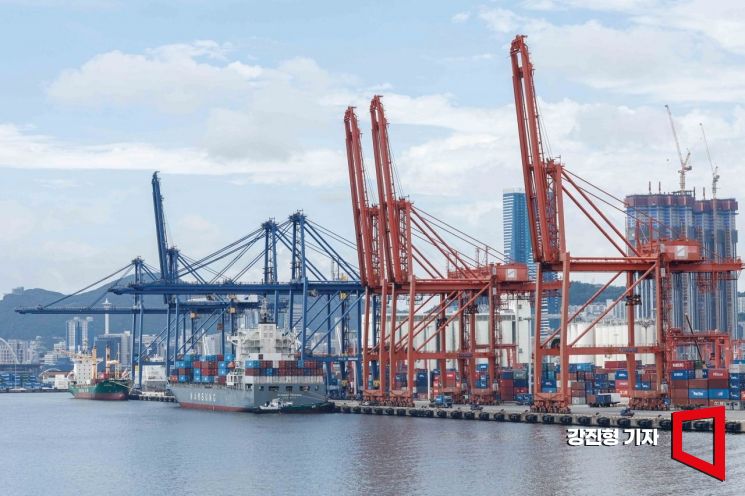
In the 'November Economic Trends' report released that day, KDI evaluated that the manufacturing recovery trend is being maintained due to the increase in ICT exports. Specifically, it explained, "Although the export growth rate has narrowed due to base effects, the favorable trend centered on ICT items continues," and "inventory rates are declining mainly in semiconductors, and the average operating rate remains at a high level."
Last month's exports increased by 4.6% compared to the same month last year, showing a slowdown in growth compared to the previous month (7.5%). While shipbuilding (-28.5%) and petroleum products (-34.9%) declined, ICT (28.4%) continued its growth trend. KDI explained, "Although the growth in semiconductor export volume has slowed due to base effects, export prices are still maintaining a high growth rate, indicating that external demand remains at a high level."
However, despite the recent increase in facility investment, KDI assessed that domestic demand recovery is constrained due to sluggish goods consumption and construction investment. KDI mentioned, "Semiconductor facility investment has increased significantly, suggesting that the export boom may gradually reflect in the domestic economy," but added, "while service consumption continues to grow moderately, the decline in goods consumption persists."
It continued, "Although some leading indicators related to construction are improving, construction output continues to decline, indicating a contraction in the construction industry," and added, "the inflation rate is also continuing its slowing trend." In last month's economic trends report, KDI also evaluated that "domestic demand recovery is delayed mainly due to construction investment, limiting economic improvement."
Recently, goods consumption has continued to decline across most categories. Retail sales in September decreased by 2.2% compared to the same month last year, widening the decline from August (-1.3%). Passenger cars (2.1%) increased due to easing production disruptions, but items such as food and beverages (-6.1%), clothing (-2.3%), and cosmetics (-10.2%) showed negative trends.
Construction investment shows contraction mainly in the building sector, which had been sluggish in orders, despite improvements in leading indicators such as construction orders and housing starts. Construction output (constant prices) in September decreased by 12.1% compared to the same month last year, deepening the decline from July (-9.2%) and August (-9.2%). KDI forecasted, "It is expected that there will be a time lag before improvements in leading indicators translate into construction investment."
Regarding inflation, KDI evaluated, "With demand-side inflationary pressures remaining low and price increases narrowing across many items, a sharp decline in petroleum prices has sustained the slowing inflation trend." Last month, the consumer price index rose by 1.3% year-on-year, lower than the previous month (1.6%). Core inflation, which excludes volatile items, was 1.8%, slightly below the inflation stabilization target (2%).
Regarding the financial market, KDI assessed that "overall stability is maintained, but rising market interest rates raise concerns about increased debt repayment burdens on vulnerable groups." KDI also explained about the housing market, "While demand contraction continues in non-metropolitan areas, loan regulations have reduced the price increase rate in the metropolitan area."
KDI stated, "The global economy maintained moderate growth due to policy interest rate cuts, while concerns over the US fiscal deficit and strong growth caused a sharp rise in government bond yields." Additionally, "Although financial indicator volatility increased due to US policy uncertainty, the possibility of a soft landing in major countries limited financial market instability."
© The Asia Business Daily(www.asiae.co.kr). All rights reserved.
![Clutching a Stolen Dior Bag, Saying "I Hate Being Poor but Real"... The Grotesque Con of a "Human Knockoff" [Slate]](https://cwcontent.asiae.co.kr/asiaresize/183/2026021902243444107_1771435474.jpg)











