North Korea's UPR After 5 Years: What Recommendations Will Emerge?
10 North Korean Human Rights Groups Begin On-Site Activities
"Guarantee Right to Survival and Implement UN Recommendations"
Ahead of the Universal Periodic Review (UPR) by the United Nations to assess North Korea's human rights situation, South Korean North Korean human rights organizations rushed to the 'North Korean Embassy.' They delivered a statement condemning the Kim Jong-un regime's atrocities, including focusing on nuclear development instead of guaranteeing residents' right to survival and dispatching young people to Russia.
On the 5th (local time), 10 North Korean human rights organizations, including the UN Human Rights Policy Center (KOCUN), issued a statement at the North Korean Mission in Geneva, Switzerland, and placed letters and human rights situation reports into the North Korean Mission's mail reception box. The organizations criticized, "North Korea is concentrating its available resources, which should be used for the survival and welfare of its people, on nuclear development and military activities such as dispatching young people to Russia."
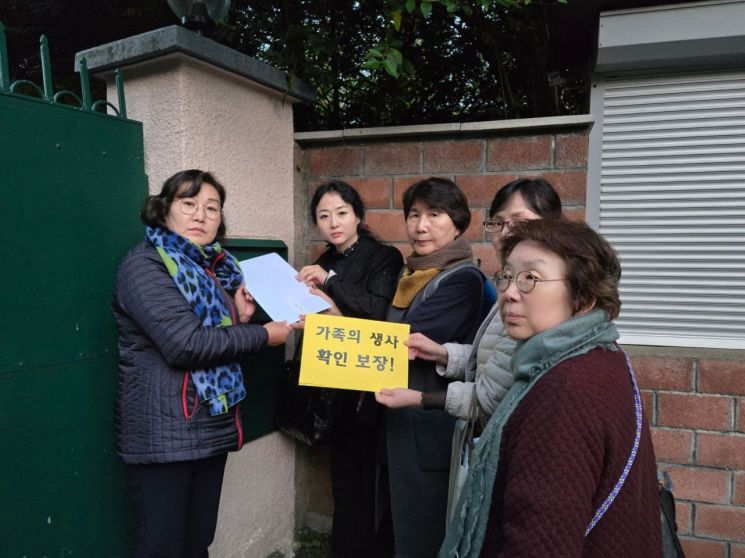 (From left) Choi Min-kyung, Representative of the Families of North Korean Detention Victims, Lee Han-byeol, Director of the North Korean Human Rights Promotion Center, Shin Hye-su, Chairperson of the UN Human Rights Policy Center, Lee So-ra, Director of Modumoi-ja, Lee Seong-ui, Chairperson of the 6.25 War Abductees' Families Association. Provided by North Korea Justice Solidarity
The statement was joined by Freedom to Move (F2M), the Institute for North Korean Human Rights (INKHR), the International Democracy Hub (IDH), Justice for North Korea (JFNK), the Korea Future Women’s Institute (KFWI), Let's All Gather (KOA), Moolmangcho (MMC), the North Korean Imprisonment Victims’ Families Association (NKIVFA), and the Korean War Abductees’ Families Union (KWAFU).
The organizations pointed out, "It has been 10 years since the UN Commission of Inquiry (COI) report on North Korean human rights was published, yet North Korean residents continue to suffer violations of various human rights, including basic survival rights and freedom of expression," adding, "Despite the international community expressing deep concern over North Korea's human rights issues, North Korea does not follow the UN's recommendations for human rights improvement." They urged, "North Korea must actively engage in human rights dialogue," and called on the regime to "comply with international agreements, submit reports on their implementation, and immediately implement UPR recommendations."
The actions of these organizations began two days before the 4th North Korean UPR. They first issued a statement in South Korea before departure, and in April this year, they submitted joint and individual reports according to UPR guidelines. The reports from each organization notably pointed out the 'three major evil laws' of the Kim Jong-un era, including the Anti-Reactionary Thought and Culture Rejection Law, the Youth Education Guarantee Law, and the Pyongyang Cultural Language Protection Law. They also raised issues regarding enforced disappearances and the abuse of the death penalty, and demanded the immediate repatriation of abductees, detainees, and prisoners of war, among other recommendations to the North Korean authorities.
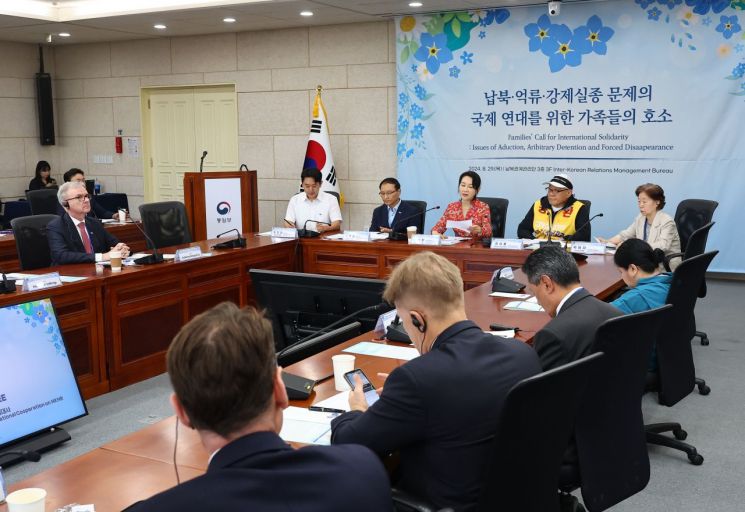 In August this year, a public hearing titled 'Appeal of Families for International Solidarity on the Issues of Abduction, Detention, and Forced Disappearance' was held at the Ministry of Unification's Inter-Korean Relations Management Division in Jongno-gu, Seoul.
 [Image source=Yonhap News]
This North Korean UPR is the fourth review held after five years since 2019. Given the intertwined issues such as the military closeness between North Korea and Russia and the 'dispatch of North Korean troops' incident, attention is focused on whether strong criticisms will emerge.
The UPR is a representative UN human rights protection mechanism that regularly reviews the human rights situation of all member states and recommends that countries under review amend laws, systems, and policies. However, UPR recommendations do not have legal binding force. Therefore, the recommendations made by countries conducting the 'human rights audit' must be clear to increase the burden on the country under review. This is why diplomatic efforts, both governmental and civilian, are important.
The Ministry of Unification has gathered diplomats in South Korea to provide testimonies on abductees, detainees, and enforced disappearances, requesting cooperation to ensure these issues are raised during the North Korean UPR. On the 28th of last month (local time), the '2024 North Korean Human Rights International Dialogue' was held in Geneva, attended by former North Korean Embassy political counselor to Cuba, Il-gyu Lee, among others. The Ministry of Foreign Affairs also conducted opinion-gathering through civil society meetings.
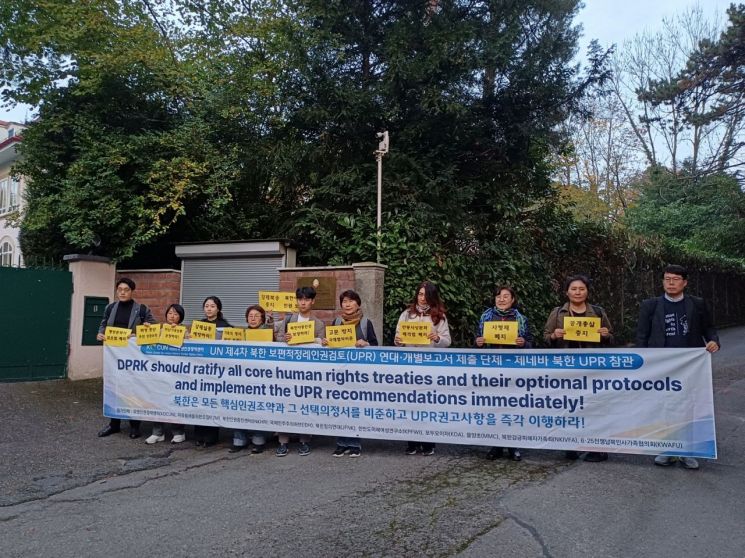 Ten North Korean human rights organizations are urging for human rights improvements on the 5th (local time) in front of the North Korean Mission building in Geneva, Switzerland. Provided by North Korea Justice Coalition
The efforts of civil organizations engaged in field activities are also a key point. On that day, Hanbyeol Lee, director of the Institute for North Korean Human Rights, and Minkyeong Choi, representative of the North Korean Imprisonment Victims’ Families Association, who are defectors and victims of North Korean abuses, stood in front of the North Korean Mission. Their presence itself is expected to serve as a symbolic warning.
Director Lee’s brother was forcibly repatriated and sent to a political prison camp, and his whereabouts remain unknown. Representative Choi is a defector who suffered forced repatriation four times in China and authored the book "North Korean Escape," which deals with the atrocities committed by North Korea during the repatriation of defectors.
The organizations plan to carry out various activities to improve North Korean human rights, including holding an event titled "Raising Voices for Freedom, Dignity, and Hope" as a side event at the UN Geneva Office until the day of the North Korean UPR.
Meanwhile, the Transitional Justice Working Group (TJWG), a human rights investigation record organization, released a report titled "The Non-Existent Existence" on the 31st of last month, tracking enforced disappearance crimes occurring inside North Korea. The investigation revealed that a significant portion of enforced disappearance crimes were carried out by the State Security Department (Boibu). The organized involvement of an institution directly under the Chairman of the State Affairs Commission suggests the perpetrator responsibility of the Kim Jong-un regime. Additionally, the report includes testimonies pointing to China and Russia’s tacit approval or complicity in the forced repatriation issue.
© The Asia Business Daily(www.asiae.co.kr). All rights reserved.



















