"Extremely Close" Contest Expected to Take Days for Vote Counting
Late Counting Reversal in Battleground States Leads to Biden's Defeat
"This Year, 'Blue Shift' Likely Less Pronounced Than Before"
On the 5th (local time), an ultra-close contest unfolded in the U.S. presidential election, leading to projections that vote counting will take several days. Given that the 2020 election held on November 3rd only confirmed results on the 7th of the same month, it is expected that this year will also require a considerable amount of time to finalize the winner. Former President Donald Trump, who initially took the lead in the early counting, fell behind President Joe Biden toward the end, sparking claims of 'election fraud.' Interest is growing as to whether similar allegations will arise again this year due to inevitable shifts in momentum during the counting process.

The Washington Post (WP) reported that during the 2020 presidential election, in key battleground states, former President Trump initially led in early counts but was later overtaken by President Biden, resulting in phenomena known as the 'red mirage' and 'blue shift.' These terms derive from the colors symbolizing the Republican Party (red) and the Democratic Party (blue), describing the developments during the vote counting process.
WP explained, "In some states, the counting procedures tend to reflect Democratic votes later in the process, which can mistakenly give the impression that the Republicans are winning," adding that "former President Trump used the red mirage to deny his defeat in the 2020 election."
On election day, November 3, 2020, in battleground states such as Pennsylvania, Wisconsin, and Michigan, former President Trump appeared to be leading early on, but the results gradually reversed starting the next day. Michigan and Wisconsin saw reversals on November 4, the second day of counting, while Pennsylvania and Georgia experienced shifts on November 6, the fourth day. The vote margin between President Biden and former President Trump in these four battleground states was only between 0.2% and 1.2 percentage points.
This reversal during the counting process was largely influenced by mail-in ballots. Since the COVID-19 pandemic was ongoing in 2020, Democrats tended to vote by mail more than Republicans, and mail-in ballots took longer to process than in-person ballots, causing delays in reflecting results. In Pennsylvania, which was expected to decide the election outcome, the winner was only confirmed on November 7, ultimately leading to President Biden's final victory confirmation.
Additionally, in the 2020 election, strong Republican support was seen in states where voting and counting occurred earlier, while results from large cities with strong Democratic support, such as California, were reflected later in the counting process.
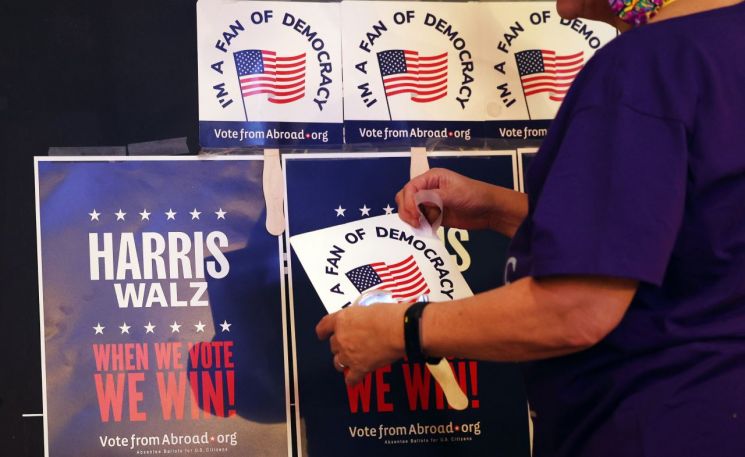
This pattern is expected to continue this year. With an ultra-close race between former President Trump and Vice President Kamala Harris, the results from seven battleground states (Arizona, Georgia, Michigan, Nevada, North Carolina, Pennsylvania, Wisconsin) are anticipated to directly determine the election outcome. These seven states do not allow early processing of absentee ballots before the election.
However, the 'blue shift' phenomenon is expected to be less pronounced this year compared to 2020. During the 2020 election, conspiracy theories about vote manipulation led Republican supporters to avoid mail-in and early voting. This time, former President Trump has encouraged voting and participated in early voting himself, making it uncertain which candidate early voting will favor in each state. Edward Foley, a professor at Ohio State University who coined the term 'blue shift' in 2013, predicted, "A smaller-scale blue shift is expected in Pennsylvania this year."
Given these circumstances, the likelihood of former President Trump continuing to claim election fraud is increasing. In 2020, Trump repeatedly mentioned the possibility of election fraud throughout the counting process. On November 4 of that year, he declared at the White House, "We won this election," calling the ongoing counting in key states a "massive fraud." The next day, he told reporters, "If the legal votes are counted, I will win."
This year, immediately after voting in West Palm Beach, Florida, Trump claimed, "I did great in the first election (2016), did much better in the second election (2020), but something happened," asserting that his defeat was due to election fraud. When asked if he would accept the results if he lost, he replied, "If it's a fair election." This statement is also interpreted as leaving room for contesting the election results.
© The Asia Business Daily(www.asiae.co.kr). All rights reserved.


















