Listed Companies Outside Large Corporations Amount to Only 869.7 Billion KRW
Over the past two and a half years, the total amount of stock-based compensation paid to executives and employees by large corporations has surpassed 3.5 trillion KRW. Hyundai Motor Company granted stock-based compensation worth 497.5 billion KRW to its executives and employees during this period, the highest among domestic companies. Naver (332.1 billion KRW), Celltrion (322.2 billion KRW), Kia (269.8 billion KRW), and SK Hynix (244.2 billion KRW) followed.
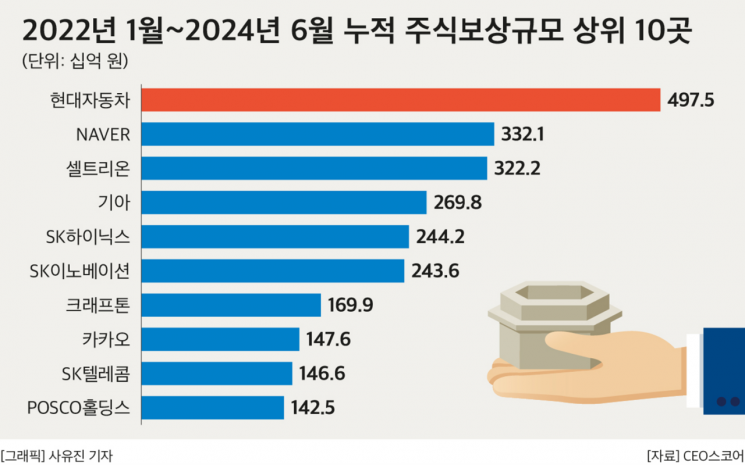 Top 10 Companies by Cumulative Stock Compensation Scale from January 2022 to June 2024. Provided by CEO Score
On the 6th, CEO Score, a corporate data research institute, announced an analysis of data from 167 companies that granted stock-based compensation among the top 500 companies by market capitalization as of the end of September this year. The total amount of stock-based compensation granted from January 2022 to June this year was 4.436 trillion KRW. Among this, listed companies within large business groups accounted for 80%, indicating an overwhelmingly high proportion of stock compensation among top large corporations.
Stock-based compensation is a system where stocks are granted to executives and employees as performance rewards. This includes stock options, stock grants, restricted stock awards (RSA), restricted stock units (RSU), and performance stock units (PSU). Stock options give employees the right to purchase stocks at a predetermined exercise price, while stock grants provide performance bonuses in the form of stocks instead of cash. RSA, RSU, and PSU grant stocks based on a certain percentage of performance bonuses or salaries and are paid in stocks or cash upon meeting specific conditions.
Among listed companies within large business groups (59 companies), 3.5662 trillion KRW worth of stock-based compensation was paid from 2022 to the first half of this year. Of this, stock-based compensation excluding stock options (such as stock grants, RSU, PSU) accounted for 1.6295 trillion KRW (45.7%). By year, 1.5628 trillion KRW was paid in 2022, 1.278 trillion KRW in 2023, and 725.5 billion KRW in the first half of this year.
Listed companies outside large business groups (108 companies) paid 869.7 billion KRW in stock-based compensation during the same period, with stock options accounting for the largest share at 610.9 billion KRW (70.2%). By year, the amounts were 353.1 billion KRW in 2022, 325.9 billion KRW in 2023, and 190.7 billion KRW in the first half of this year.
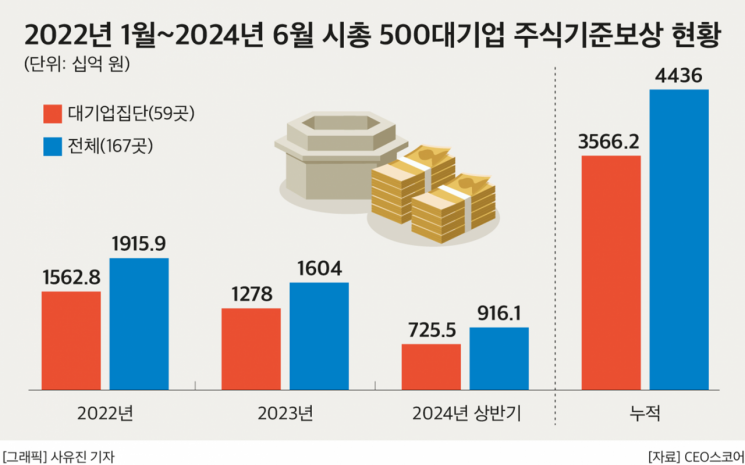 Status of Stock-Based Compensation for the Top 500 Companies by Market Capitalization from January 2022 to June 2024. Provided by CEO Score
Hyundai Motor Company paid 210.1 billion KRW in 2022, 286.1 billion KRW in 2023, and 1.2 billion KRW in stock-based compensation in the first half of this year. Hyundai Motor grants stocks annually based on wage negotiations in the second half of the year, and in March this year, it newly introduced the RSU system for outstanding executives. Hyundai Motor plans to pay stocks worth a record 560.1 billion KRW in the second half of this year.
Naver granted a total of 332.1 billion KRW in stock compensation over two and a half years. Of this, 70.3 billion KRW in 2022, 77.2 billion KRW in 2023, and 38.8 billion KRW in the first half of this year were paid as stock grants. RSU payments were 71.2 billion KRW in 2022 and 74.7 billion KRW in 2023.
Celltrion granted stock options worth 166.7 billion KRW in the first half of this year alone, while Kia grants stocks annually based on wage negotiations in the second half of the year, with approximately 169.5 billion KRW expected to be paid this month. SK Hynix also paid 244.2 billion KRW in stock-based compensation to its executives and employees.
Among the top 20 companies in stock-based compensation, 19 were affiliates of large business groups. SK Group had four affiliates, while Hyundai Motor Group and Hanwha Group each had three affiliates in the top ranks. On the other hand, among listed companies outside large business groups, Hyundai Elevator was the only one included in the top 20 with 49.9 billion KRW. On November 10 last year, Hyundai Elevator sold stocks to its employee stock ownership association, stating it aimed to promote the economic and social status of workers and enhance labor-management cooperation through revitalizing employee stock ownership.
© The Asia Business Daily(www.asiae.co.kr). All rights reserved.


















