A fine was confirmed for a union member who repeatedly posted insulting messages targeting a franchise owner, with whom they had conflicts over commission issues, in a group KakaoTalk chatroom attended by about 40 people, including members of the delivery workers' union.
The victim, a man in his 40s and father of three children, left a note in August 2021 stating that life had become difficult due to his activities as a union member, and then passed away.
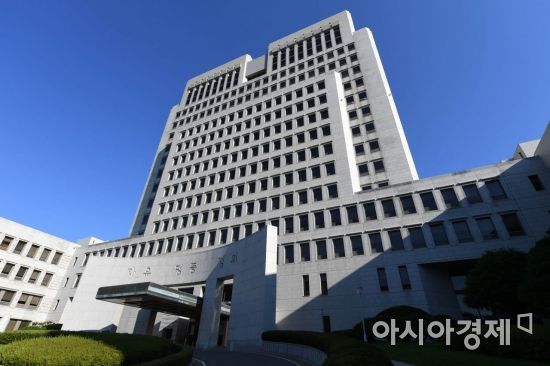
According to the legal community on the 6th, the Supreme Court's 2nd Division (Presiding Justice Kwon Young-jun) dismissed the appeal of delivery worker A, who was indicted for insult, and upheld the original court ruling that sentenced A to a fine of 1 million won.
The court explained the reason for dismissing A's appeal, stating, "There is no error in the lower court's judgment that violates the rules of logic and experience, exceeds the limits of free evaluation of evidence, or misinterprets the legal principles regarding the establishment of the crime of insult and justifiable acts."
A was prosecuted for posting insulting messages targeting B, the franchise owner of CJ Logistics' Gimpo Janggi delivery point, in a KakaoTalk chatroom with about 40 participants, including delivery union members, from May to July 2021. The messages included statements such as "B's endless corruption and embezzlement like cabbage that keeps peeling away, and numerous illegal acts must now come to an end," and "What a bastard, exactly a midnight escape," which insulted B.
When a message about B being hospitalized was posted in the chatroom, A also wrote, "Persistent guy... When will you finally fall?"
The prosecutor charged A with insult. The first trial court sentenced A to a fine of 1 million won.
The court judged that the expression "B's endless corruption and embezzlement like cabbage that keeps peeling away, and numerous illegal acts must now come to an end" implied that the victim was committing illegal corruption, thereby lowering the victim's social evaluation and external honor in the overall context of the writing.
Regarding A's expression "Persistent guy... When will you finally fall?" after hearing about B's hospitalization, the court pointed out that since the message about the victim's hospitalization was posted in the union's internal group KakaoTalk chatroom and written by the defendant, it could be seen as a contemptuous expression wishing for a more serious situation to occur to the victim beyond just being hospitalized, considering the context of the conversation.
Finally, about the expression "What a bastard, exactly a midnight escape," the court stated that it euphemistically referred to the victim as a "gaesaekki" (a derogatory term) and implied that the victim would run away, which was sufficient to damage the victim's social evaluation.
The court also concluded that since the chatroom where these messages were posted was a group KakaoTalk chatroom with about 40 participants, most of whom were delivery union members but also included non-members, and considering that the messages were eventually delivered to the victim B's side leading to a complaint, it was reasonable to view the messages as expressing abstract judgments or contemptuous feelings that lowered B's social evaluation, constituting an act of insult against the victim.
Meanwhile, A claimed justifiable conduct during the trial, but it was not accepted.
The court stated, "Considering that the defendant sent these messages without properly understanding the facts about the victim and without concrete grounds, and that some of the defendant's messages contained only contemptuous expressions, it is difficult to regard the defendant's actions as justifiable conduct that does not violate social norms."
A appealed, but the second trial court's judgment was the same.
During the appeal, A's side argued that the prosecutor's inclusion of the fact that victim B had died in the indictment was illegal, violating the principle of the indictment's exclusivity ("Gongsojang Ilbonjuui").
The principle of indictment exclusivity requires that when a prosecutor files an indictment, only the indictment itself should be submitted to the court, and evidence or anything that could cause prejudice to the court regarding the facts of the indictment should not be submitted.
The court first cited a precedent from the Supreme Court's full bench, stating, "Whether the principle of indictment exclusivity is violated should be judged specifically in the case based on whether the contents of documents or other items attached or cited in the indictment, and facts stated in the indictment beyond what the law requires, cause prejudice to the judge or jury and hinder their understanding of the substance of the crime, considering the type and content of the crime described in the indictment."
It continued, "If it is recognized that the indictment violates the principle of indictment exclusivity, the procedure is considered invalid due to violation of legal provisions, and the principle is to dismiss the indictment. However, if no objection was raised by the defendant regarding the manner of indictment, and the court proceeded with the trial judging that there was no hindrance in understanding the substance of the crime, and the evidence investigation was completed and the judge formed a conviction, considering the dynamic stability of the litigation process and the economy of litigation, it is no longer possible to claim a violation of the principle of indictment exclusivity to challenge the validity of the already conducted litigation process."
The court added, "In this case, it is clear from the records that the defense counsel newly raised such an argument during the second trial, after the evidence investigation was completed in the lower court, so the argument cannot be accepted without further examination."
A's side did not initially object to the prosecutor's inclusion of B's death in the indictment during the first trial, but after being convicted, newly raised the 'misinterpretation of law' argument in the second trial, which is not accepted according to Supreme Court precedents.
The court also added, "Meanwhile, the facts included in the indictment that the victim (deceased) were stated to indicate the seriousness of the crime, the impact on the victim, and the circumstances and progress of the case, and it is difficult to see that such statements themselves cause prejudice to the court or hinder the court's understanding of the substance of the crime."
The Supreme Court also found no problem with the second trial court's judgment.
B, who had worked in delivery for 12 years, left a note saying, "I worked through the night and opened a franchise, but the illegal strikes, obstruction of work, and notices of even stronger union activities by union members I had never experienced before made every day hell. My depression reached its peak, and I could no longer endure it. I hope you (the union) do not forget that someone chose the path of death because they could not endure it because of you," and passed away on August 30, 2021.
After B's death, the bereaved family filed a complaint naming 13 union members of the National Delivery Workers' Union Gimpo branch as perpetrators.
The delivery workers' union later held a press conference, stating, "We will return to our original intentions and boldly carry out internal reforms," and pledged to take strict measures against verbal abuse and group bullying.
Another delivery union member prosecuted in this case was sentenced to 8 months in prison with a 2-year probation by the Uijeongbu District Court Goyang Branch in 2022, and another received 4 months in prison with a 1-year probation from the Incheon District Court.
© The Asia Business Daily(www.asiae.co.kr). All rights reserved.

















