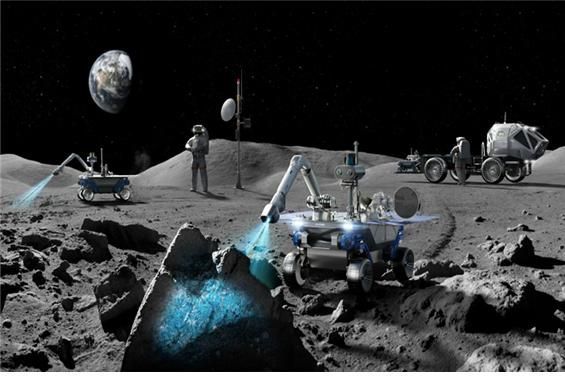
On the 6th, the Ministry of Trade, Industry and Energy held a 'Project Launch Agreement Ceremony for the Development of Domestic Technology for Rover Drive Components for Planetary Exploration' at the Korea Automotive Research Institute in Cheonan, Chungnam.
A rover is a space exploration vehicle operated either manned or unmanned, serving as a core means of planetary exploration and a concentration of advanced technology. Globally, more than 100 lunar exploration projects are expected to be promoted by 2030, with global companies such as GM, Lockheed Martin, Toyota, and Honda competitively developing rovers. Domestic companies are also proactively investing in rover technology development to pioneer the new space industry.
Accordingly, the Ministry of Trade, Industry and Energy has planned for the first time a project to develop rover components operable even in space, supporting the development of advanced space component technologies led by the private sector.
This project involves 13 institutions and companies with high scalability in industrial technology, including ▲Mobility (Korea Automotive Research Institute, Hyundai Motor Company) ▲Robotics (Robotro) ▲Nuclear Power (Korea Atomic Energy Research Institute) ▲Space (Justec) ▲Advanced Components (Hanil Hightech). Notably, Justec (satellite) and Hanil Hightech (launch vehicle), which have experience in developing space components, as well as Hyundai Motor Company, are participating as demand companies.
The participating companies will invest a total of 23 billion KRW, including 18.1 billion KRW of government funding, to develop about 10 core components for rovers operable in extreme environments such as cryogenic temperatures, high vacuum, and high radiation. These include motors, drivers, reducers, suspension devices, robotic arms, airless wheels, integrated modules, special lubrication technologies for extreme space environments, and rotating components.
The Ministry explained, "These core component technologies can be jointly utilized in advanced fields such as unmanned mobile platforms, robots, and mobility, as well as in extreme environments, which is expected to expand opportunities for creating related new industries." Attendees at the event included Lee Seung-ryeol, Director of Industrial Policy at the Ministry of Trade, Industry and Energy; Na Seung-sik, President of the Korea Automotive Research Institute; Jeon Yoon-jong, President of the Korea Evaluation Institute of Industrial Technology (KEIT); Choi Dong-soo, CEO of Justec; Lee Kyu-won, CEO of Robotro; Shim Chung-woo, Vice President of Hanil Hightech; and Lee Jun-young, Executive Director of Hyundai Motor Company.
© The Asia Business Daily(www.asiae.co.kr). All rights reserved.

















