Cumulative Sales Price Change Rate This Year -6.01%
Decline Due to No Positive Factors and High Supply of Move-ins
The reputation of Sejong City, which recorded the highest annual apartment price increase rate nationwide in 2020 at 44.9%, is collapsing. Sejong City, once excited about the completion of the administrative capital, has seen its upward trend falter due to sluggish additional relocation of public institutions and external factors such as interest rate hikes. Ultimately, housing prices fell for over 70 weeks until the end of 2022.
This year as well, among the 17 cities and provinces nationwide, Sejong City has the highest cumulative apartment price decline rate until early November. It has even surpassed the decline rate of the same period last year. With no positive factors and an increasing supply of new housing, housing prices are unable to escape a downward trend.
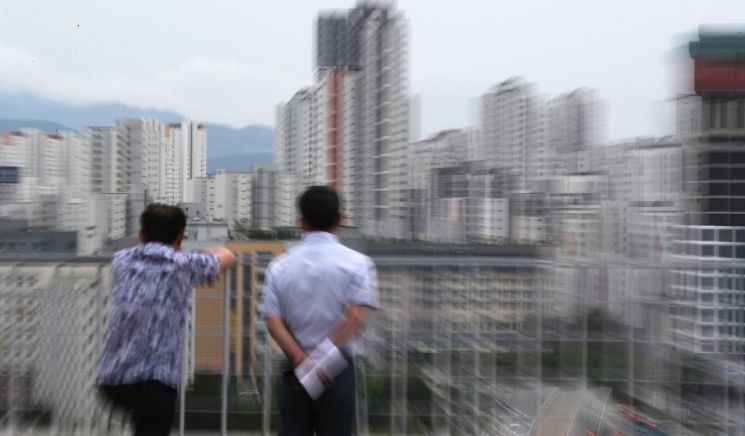 Government officials are talking in the rooftop park of the Government Sejong Complex, with the Sejong City apartment complex visible. / Photo by Yonhap News
According to the Korea Real Estate Board on the 13th, the apartment price change rate in Sejong City until the first week of November this year recorded -6.01%, the largest decline nationwide. The drop has widened compared to the same period last year (-4.93%).
On the 4th of this month, an 84㎡ unit in Gowoon-dong Garak Village Complex 10, Easy The One, was traded at 405 million KRW. Compared to the same size units sold at 430 million KRW in April and 450 million KRW in January, this is about 50 million KRW lower. Last year, prices also fell, with the same size unit changing hands at 470 million KRW, but the decline has deepened this year.
In Boram-dong Horyeoul Village Complex 8, Jungheung Eco City, an 84㎡ unit was traded at a peak of 650 million KRW last year and maintained the 600 million KRW range until the first half of this year. However, it was sold for 568 million KRW last month.
Even in Naseong-dong, the most popular area in Sejong City, housing prices have not escaped decline. An 84㎡ unit in Naritjae Village Complex 3, which changed hands for 880 million KRW last month, was priced at 950 million KRW in the first half of this year. An 84㎡ unit in Dodam-dong Doream Village Complex 11, Bando Yubora, which had risen to 660 million KRW last year, was traded for 580 million KRW last month.
Experts analyze that although Sejong City experienced a "straw effect" (where a large city absorbs the population or economic power of surrounding smaller cities) in its early development, it has reached growth limits because it is not a new city centered on industry. Ham Young-jin, head of the Real Estate Research Lab at Woori Bank, said, "There are positive factors such as the relocation of the National Assembly and public institutions, but these are not immediate achievements, and since jobs are an important factor and there is no expandable industry, a virtuous cycle of demand does not occur."
Sejong City also has the largest decline in jeonse (long-term lease) prices among cities and provinces nationwide. The cumulative decline rate until recently this year is 5.30%. This is quite different from the atmosphere in Busan and Ulsan, where jeonse prices fell by more than 10% during the same period last year but have turned to rise, and Daegu, which shows a 3.35% decline. Ham said, "Next year, the supply of new housing in Sejong City will decrease significantly, so the decline rate of jeonse prices will also ease. However, whether the market will fully recover is uncertain."
© The Asia Business Daily(www.asiae.co.kr). All rights reserved.
!["The Woman Who Threw Herself into the Water Clutching a Stolen Dior Bag"...A Grotesque Success Story That Shakes the Korean Psyche [Slate]](https://cwcontent.asiae.co.kr/asiaresize/183/2026021902243444107_1771435474.jpg)
















