Representative Stone Pagoda of the Goryeo Dynasty... Damaged During Japanese Occupation and Korean War, Then Wandered
Restoration Completed... Located at the Original Wonju Beopcheonsa Site Exhibition Hall
Wonju City and National Research Institute of Cultural Heritage Jointly Hold Restoration Ceremony and Events
Wonju City, Gangwon Special Self-Governing Province (Mayor Won Kang-su), and the National Research Institute of Cultural Heritage (Director Lim Jong-duk) announced on the 5th that the restoration work of the national treasure ‘Wonju Beopcheonsa Site Jikwang Guksa Pagoda’ has been completed, and a joint restoration commemorative ceremony will be held at 10:30 a.m. on the 12th.
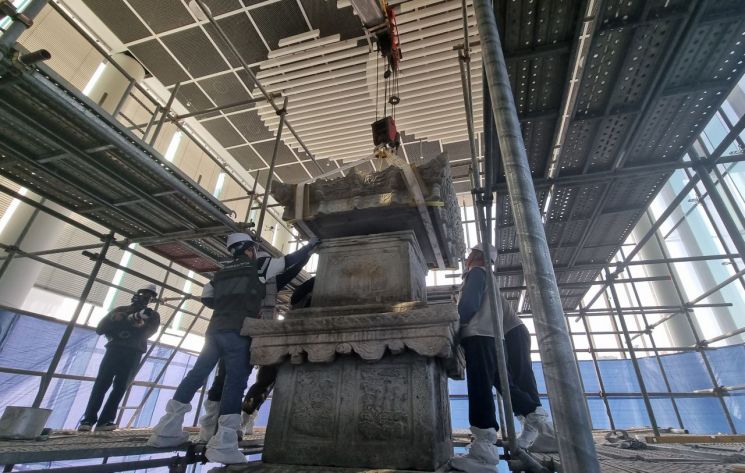 The restoration work of the 'Wonju Beopcheonsa Site Jigwang Guksa Pagoda,' known as a representative stone pagoda of the Goryeo Dynasty, has been completed. Wonju City and the National Research Institute of Cultural Heritage will jointly hold a restoration commemorative ceremony at 10:30 a.m. on the 12th. The photo shows cultural heritage restoration experts fully restoring the Jigwang Guksa Pagoda at the Beopcheonsa Site Exhibition Hall in Buron-myeon, Wonju City, Gangwon Province, on October 17. Photo by Yonhap News
This event was organized as a historic occasion to commemorate the return of the Jikwang Guksa Pagoda to the Wonju Beopcheonsa Site after 113 years, and to announce the preservation treatment of the pagoda damaged during the Japanese colonial period and the Korean War, as well as the indoor restoration achievements within the relic exhibition hall.
As part of the National Heritage Administration’s vivid national heritage utilization project, the event will begin with a pre-ceremony performance titled ‘Sijeol Inyeon,’ a musical drama dealing with the life story of Jikwang Guksa, followed by the restoration commemorative ceremony and cultural and artistic events in which local residents and children can participate together.
The Jikwang Guksa Pagoda is a representative stone pagoda of the Goryeo Dynasty built to honor the monk Jikwang Guksa Haerin (984?1070), widely known for its very ornate and exquisite decorations.
The Jikwang Guksa Pagoda, originally located at the Wonju Beopcheonsa Site, was first taken out in 1911 during the Japanese colonial period. It was then moved through Myeongdong in Seoul and Osaka in Japan before settling within the Gyeongbokgung Palace grounds. In 2016, it was dismantled for preservation treatment and transferred to the National Research Institute of Cultural Heritage (formerly the National Research Institute of Cultural Properties).
By 2020, preservation treatment of 29 pagoda components was completed over approximately five years, and in December of last year, the Beopcheonsa Site relic exhibition hall was decided as the final restoration location.
The assembly work was undertaken by the Cultural Heritage Conservation Science Center (Director Park Jong-seo) of the National Research Institute of Cultural Heritage, while Wonju City carried out the surrounding maintenance work. The completed stone pagoda stands 5.39 meters tall and weighs 24.6 tons.
In particular, an isolation base design was incorporated to ensure the pagoda can withstand shocks equivalent to a magnitude 7 earthquake, and the preservation treatment and restoration underwent numerous expert reviews to restore the pagoda’s original value.
The result is evaluated as a product of synergistic effects from scientific preservation methods such as laser cleaning and collaboration with artisans possessing traditional techniques. The restoration was completed through joint research in various fields, including iconography and pattern studies, as well as research on the origin of the restoration stones, making it a highly significant case.
Moreover, this is the first historic case of a stone cultural heritage that was illegally taken overseas being restored to its original place. It is expected to become an excellent ‘national treasure’ cultural heritage representing the image of Wonju City and Gangwon Special Self-Governing Province, serving as a nationwide historical tourism resource.
A Wonju City official stated, “We will continue to manage and preserve the Jikwang Guksa Pagoda well, and also strive to ensure that the cultural heritage of our hometown, which left its place, can find its rightful place.”
© The Asia Business Daily(www.asiae.co.kr). All rights reserved.

















