Optimism Prevails for KOSDAQ as Uncertainty over Financial Investment Tax Eases
KOSDAQ Falls 13% While KOSPI Drops 3% This Year
Some Overseas Individual Investment Funds Expected to Return to KOSDAQ Market
Optimistic forecasts continue for the KOSDAQ market, which has underperformed compared to major global stock markets this year. The resolution of uncertainties related to the financial investment income tax (FIIT) is expected to bring back individual 'big player' investors who had turned away from the KOSDAQ market.
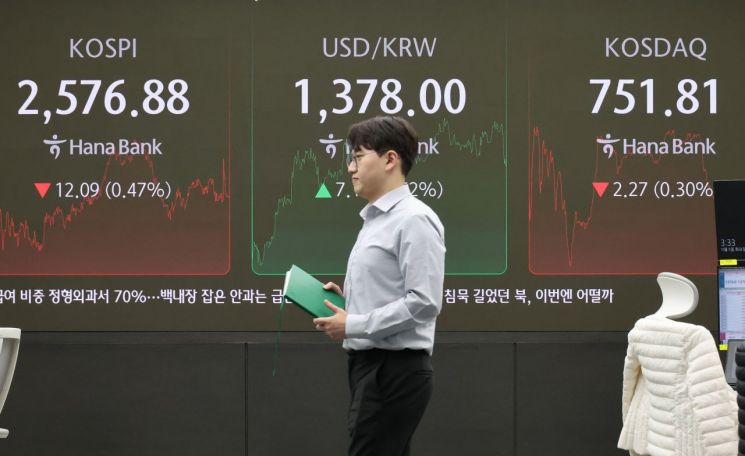
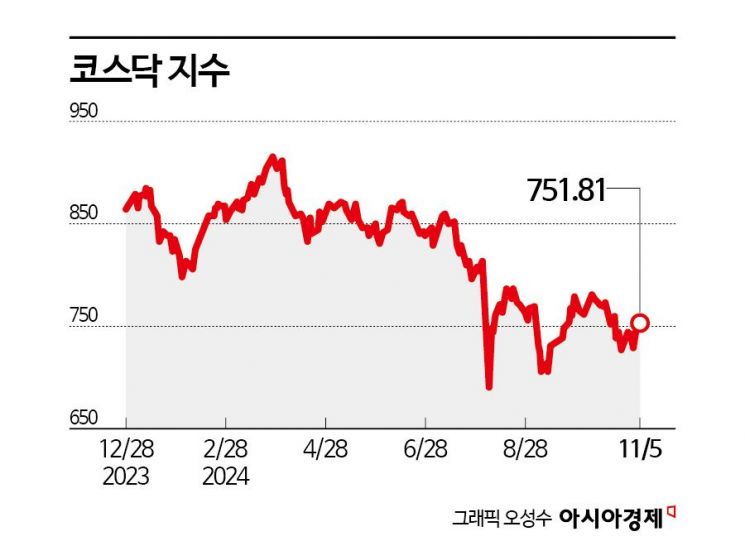
According to the Korea Exchange on the 6th, the KOSDAQ index has fallen by about 13% since the beginning of this year. The KOSDAQ index, which was above the 860 level at the end of last year, plunged to the 750 level. During the same period, the KOSPI fell by 3%, while the Nasdaq Composite Index in the New York stock market rose by 20%.
Researcher Hainhwan KB Securities explained, "The reasons for the KOSDAQ market's poor performance were concerns about the introduction of FIIT and delayed interest rate cuts," adding, "This was compounded by the slowdown in the secondary battery industry along with the sluggishness in the semiconductor, media, entertainment, and gaming sectors."
With political circles reaching a consensus on abolishing FIIT, a foundation for the KOSDAQ rebound has been laid. Researcher Seungjae Lee of iM Securities stated, "The controversy over the implementation of FIIT cooled the investment enthusiasm in the domestic stock market, and investors seeking to avoid tax burdens turned their attention to overseas markets," explaining, "Overseas investment by domestic individual investors is at an all-time high."
As of the 30th of last month, investor deposit funds stood at 49.5973 trillion won, marking the lowest level since January 26. Investor deposit funds refer to the money deposited by investors at securities firms to trade financial products. The balance of credit loans also exceeded 20 trillion won in June this year but decreased to about 17.9 trillion won by the end of last month. The decline in standby investment funds indicates that domestic investors have low expectations for domestic stocks and other financial products.
The trading volume indicator is also hitting bottom. Last month, the average trading volume relative to the KOSDAQ market capitalization was 1.6%, lower than the 10-year average of 2.2%. One reason for the decrease in trading volume appears to be the strong tendency to avoid domestic investment due to FIIT-related issues.
Researcher Lee predicted, "The abolition of FIIT will create an environment for domestic investors to return to the domestic stock market," adding, "Funds will rapidly flow into the KOSDAQ market, which has a high proportion of individual investors." He further stated, "This will resolve the differentiation phenomenon between the KOSPI and KOSDAQ markets," and "The recovery speed of the stock market compared to the KOSPI could be steeper."
Researcher Jongyoung Kim of IBK Investment & Securities also analyzed, "If tax-related issues are resolved by the end of the year, there is a high possibility that year-end trading volume will increase," adding, "An increase in trading volume will strengthen the effect on individual stocks."
Researcher Younghwan Kim of NH Investment & Securities judged, "The difference in returns between the KOSPI and KOSDAQ tends to converge close to zero," and "With the Democratic Party's agreement to abolish FIIT, the risk of a sharp outflow of individual supply and demand from the KOSDAQ market has diminished, so the KOSDAQ market's performance is likely to improve compared to the KOSPI."
© The Asia Business Daily(www.asiae.co.kr). All rights reserved.


















