Bank of Korea Governor Lee Chang-yong Points Out Real Estate Fund Concentration
"Hindrance to Our Economic Development, Structural Improvement Absolutely Necessary"
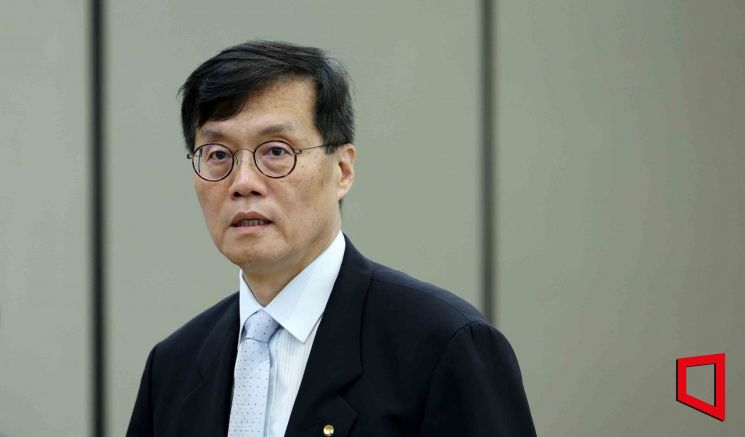
Lee Chang-yong, Governor of the Bank of Korea, argued that the debt ratio of domestic households and companies is too high compared to other countries, and that it is excessively concentrated in the real estate sector, making structural improvement absolutely necessary.
Governor Lee stated on the 5th at a joint policy symposium held by the Korean Finance Association and the Bank of Korea in Jung-gu, Seoul, that structural problems in the financial sectors of households and companies in Korea must be resolved.
He pointed out, "The private debt of households and companies in our country exceeded twice the gross domestic product (GDP) as of the end of last year, showing a higher level compared to major countries," adding, "In particular, the excessive concentration of debt in the real estate sector is problematic."

Governor Lee said, "The household debt-to-GDP ratio has rapidly increased from the 50% range in the early 2000s to nearly 100% immediately after COVID-19," diagnosing that "this is the result of households heavily relying on debt to purchase homes or secure jeonse (long-term lease) funds." He especially added, "Looking at the asset composition of Korean households, the proportion of non-financial assets such as real estate reaches 80%, which is very high compared to other countries like the United States (37%)."
Governor Lee explained, "Corporate loans have also become significantly concentrated in real estate," stating, "As funds flowed into the real estate sector for a long time, the proportion of corporate real estate-related loans to GDP, which was 9% at the end of 2010, increased to 24% by the end of last year."
He emphasized, "The concentration of funds in unproductive sectors causes inefficiency in resource allocation and weakens growth engines," adding, "Excessive fund concentration in the real estate sector can trigger a financial crisis and increase social costs." He continued, "From this perspective, the structural problems in household and corporate finance are important issues that must be resolved for the sustainable growth of our economy."
He also analyzed that structural problems such as excessive leverage in the real estate sector directly affect economic growth and financial stability, thus having a significant impact on the conduct of monetary policy.
Governor Lee said, "Recently, considerations of conflicts between growth and financial stability in monetary policy decisions have become much more important than in the past," explaining, "While there is a need to ease principal and interest repayment burdens and stimulate consumption, it is also necessary to consider that lowering interest rates could expand private credit and worsen structural problems in the long term."
© The Asia Business Daily(www.asiae.co.kr). All rights reserved.
!["The Woman Who Threw Herself into the Water Clutching a Stolen Dior Bag"...A Grotesque Success Story That Shakes the Korean Psyche [Slate]](https://cwcontent.asiae.co.kr/asiaresize/183/2026021902243444107_1771435474.jpg)

















