A Danish Port Town Facing Regional Extinction Crisis
Wigobi Hits Big, Attracts 11 Trillion Won in Investment Funds
The weight loss drug 'Wegovy,' gaining attention both domestically and internationally, was developed by Novo Nordisk, Denmark's largest pharmaceutical company. Although this company has grown into a multinational pharmaceutical giant today, its main factory is located in Kalundborg, a port town near Copenhagen, the capital of Denmark. Once struggling with issues such as aging population, poverty, and deteriorating infrastructure, this town has reportedly attracted astronomical investments thanks to the homecoming of Novo Nordisk.
On the 3rd of this month (local time), the British public broadcaster BBC highlighted the Novo Nordisk factory in Kalundborg. This factory has been a core facility and the largest plant of Novo Nordisk since the past. It still produces Wegovy today.
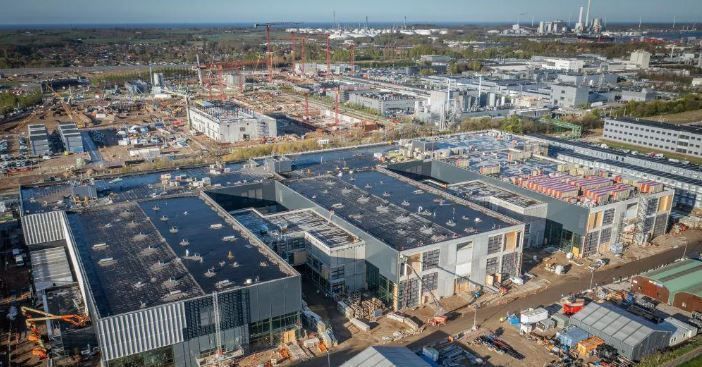 Wiegobi Factory in Kalunbor, Denmark, Undergoing Expansion Construction
 [Image Source=Captured from BBC Homepage]
As global demand for Wegovy has surged, Novo Nordisk recently decided to invest ?6.5 billion (approximately $8.5 billion or 11 trillion KRW) in the Kalundborg factory. This means an average investment of ?400,000 (about 714 million KRW) per resident in a town with only 16,000 inhabitants.
The scale of the factory expansion construction is reportedly so enormous that it causes traffic congestion throughout the entire town. Every morning, long lines form due to trucks and laborers entering from the outskirts of the town, a phenomenon locals refer to as the 'Norvo Queue.'
In fact, until recently, Kalundborg was facing a 'local extinction' crisis. Young people were heading to the capital Copenhagen, infrastructure was aging, and the number of proper hospitals and schools was steadily decreasing. Ironically, although the Kalundborg factory is the world's largest Wegovy production complex, the town's childhood obesity rate is said to be the highest in Denmark.
 It is said that several elementary schools in Kalunbor have been closed due to population outflow. [Image source=Captured from BBC homepage]
Local residents hold hope that the astronomical investment of 11 trillion KRW will reverse Kalundborg's fate. In an interview with the BBC, one resident said, "Right now, I think it's too boring to settle here," but also expressed a desire for their children to return to Kalundborg after completing university studies.
Currently, Novo Nordisk employs 4,500 production workers at the Kalundborg factory and plans to hire an additional 1,250 employees. This means that more than one-third of the town's population are Novo Nordisk employees.
Novo Nordisk is driving not only this town but also the entire Danish economy. Based on data from the first to third quarters of last year, Denmark's cumulative economic growth rate was 1.1%, but excluding the pharmaceutical sector, the overall economy shrank by 0.8%. In other words, only the pharmaceutical industry and exports, including Novo Nordisk, experienced growth.
© The Asia Business Daily(www.asiae.co.kr). All rights reserved.


















