Display Streets, Schools, and Public Facilities in Romanization and Hangul
Also Publish Chiachia Language Dictionary and Textbooks in Hangul
The New York Times (NYT), a major American daily newspaper, has spotlighted the case of the Indonesian minority ethnic group, the Cia-Cia people, who have preserved their unique culture by adopting Hangul in 2009, as a successful example of ethnic identity preservation. On the 4th (local time), NYT introduced the adoption of Hangul by the Cia-Cia, stating, "The language of the Indonesian Cia-Cia people has been passed down orally for centuries. Now, the children of the tribe are learning to write it using Hangul, the Korean script."
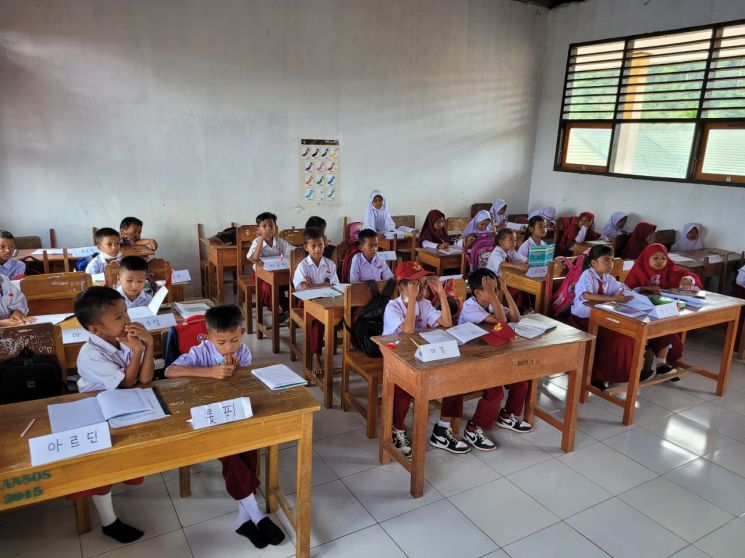 In 2009, Korean scholars attempted to spread Hangul based on the fact that the pronunciation of the Jurchen language is similar to Korean, which is a syllable-based language. Now, 15 years later, children of the Jurchen people are learning their ancestors' language in Hangul at school.
 [Photo by Asia Economy DB]
The native language 'Cia-Cia language,' spoken by about 93,000 Cia-Cia residents living on Buton Island in central Indonesia, had no writing system before the introduction of Hangul and was mainly transmitted orally. Like most of the over 700 other minority languages in Indonesia, it was gradually being eroded by the official Indonesian language, Bahasa Indonesia, and was at risk of losing its original form. La Ode Alirman, a sociologist from the Baubau region of Buton Island, explained the dangers of losing the native language, saying, "When a language dies, the tribe's identity and the wisdom of that region also disappear." However, in 2009, Korean scholars attempted to spread Hangul after noting that the Cia-Cia language, a syllable-based language, has pronunciation similar to Korean. Now, 15 years later, children of the Cia-Cia people are learning their ancestors' language in Hangul at school.
In Soraolio Village of Baubau City, where many Cia-Cia people reside, street names, schools, and public institutions are labeled in both the Roman alphabet and Hangul. The Cia-Cia people's efforts to preserve their native language and culture by adopting Hangul faced difficulties due to a shortage of teachers to teach Hangul, but gained momentum after the publication of a Cia-Cia language dictionary and textbooks in Hangul in 2020.
Abidin, a native Cia-Cia who learned Hangul directly at Seoul National University in the early days of Hangul adoption and then spread it locally, told the NYT in an interview, "We borrowed Hangul to preserve our language," adding, "We mix old Hangul and modern Hangul to make it our own Cia-Cia script." He continued, "By recording our folktales, we can pass down and preserve the wisdom of our region, the history of our ancestors, our memories, and the identity of our tribe to the next generation." The NYT explained that although Korean academia has attempted several times to spread Hangul to ethnic groups without writing systems, the Cia-Cia are the only successful case.
© The Asia Business Daily(www.asiae.co.kr). All rights reserved.

















