US Presidential Election Held on the 5th
Ultra-Close Race Increases Stock Market Uncertainty
FOMC on the 7th... 0.25% Rate Cut Expected
Nvidia, Scheduled for Dow Inclusion, Shows Strength
The three major indices of the U.S. New York Stock Exchange showed mixed trends in early trading on the 4th (local time). With uncertainty rising ahead of the U.S. presidential election the next day, investors are adopting a cautious stance.
As of 10:50 a.m. in the New York stock market that day, the Dow Jones Industrial Average, centered on blue-chip stocks, was down 0.29% from the previous trading day at 41,930.54. The S&P 500, focused on large-cap stocks, was up 0.13% at 5,736.11, and the Nasdaq, centered on tech stocks, was trading 0.23% higher at 18,281.88.
By individual stocks, Talen Energy was down 2.77%. This was due to the U.S. Federal Energy Regulatory Commission (FERC) rejecting Talen Energy’s request to increase the amount of power supplied from the Susquehanna nuclear plant to Amazon data centers. Constellation Energy and Vistra were down 9.91% and 2.76%, respectively. Trump Media & Technology (DJT), the operator of the social networking service (SNS) Truth Social owned by former Republican presidential candidate Donald Trump, was up 1.97%. Nvidia and Sherwin-Williams, which will be added to the Dow Jones Industrial Average starting on the 8th, rose 1.75% and 3.94%, respectively.
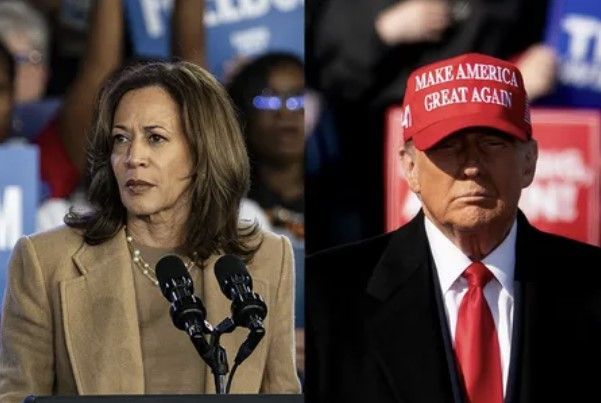
Investors’ attention is focused on the U.S. presidential election results to be held on the 5th. Democratic candidate Vice President Kamala Harris and former President Trump are engaged in a neck-and-neck race until the final moments. According to a poll conducted by The New York Times (NYT) and Siena College from October 24 to November 2 among 7,879 voters in seven battleground states, Vice President Harris held a lead over former President Trump in Nevada, North Carolina, Wisconsin, and Georgia. In Pennsylvania and Michigan, the two candidates were tied. Former President Trump led only in Arizona. However, neither candidate secured a clear lead beyond the margin of error in all seven battleground states, leaving the election outcome uncertain. The rise in Trump’s support in Pennsylvania, the largest battleground state, resulting in a tie between the two candidates, is also a variable.
Michael Gjesdal, strategist at Morgan Stanley, said, "The U.S. presidential election is very important, but there is a high likelihood of significant noise during the process. The difference between navigating through the noise and getting lost in it will be patience and planning."
Equally important as the presidential election results is which party, Democratic or Republican, will hold the majority in Congress. If the two parties split control of the House and Senate, the current situation will be maintained, and the impact on the market is likely to be limited. On the other hand, if either the Democrats or Republicans control both chambers, significant policy changes could occur in government spending or tax cuts.
The market is also paying close attention to the Federal Open Market Committee (FOMC) regular meeting of the U.S. Federal Reserve (Fed) scheduled for November 6-7. Following the first rate cut in September from 5.25-5.5% to 4.75-5.0%, the Fed is expected to cut rates again by 0.25 percentage points in November. According to the Chicago Mercantile Exchange (CME) FedWatch, the federal funds futures market on this day reflects a 99.8% probability that the Fed will cut rates by 0.25 percentage points at the November FOMC. Investors’ main focus is expected to be on Fed Chair Jerome Powell’s press conference, which may provide hints about the pace of future rate cuts beyond this reduction.
Government bond yields are declining. The U.S. 10-year Treasury yield, a global bond yield benchmark, is down 7 basis points (1bp = 0.01 percentage points) from the previous trading day to 4.28%. The 2-year Treasury yield is fluctuating at 4.14%, down 6 basis points from the previous day.
International oil prices are rising. This follows the decision by the Organization of the Petroleum Exporting Countries (OPEC) and the non-OPEC major oil-producing countries coalition, OPEC Plus (+), to postpone the planned oil production increase scheduled for December by one month. West Texas Intermediate (WTI) crude oil is trading at $71.30 per barrel, up $1.81 (2.6%) from the previous trading day, and Brent crude, the global oil price benchmark, is up $1.71 (2.3%) to $74.81 per barrel.
© The Asia Business Daily(www.asiae.co.kr). All rights reserved.

















