Small and Medium Business Ombudsman Holds Daegu·Gyeongbuk S.O.S. TALK
Choi Seung-jae, the Small and Medium Business Ombudsman, announced on the 5th that he held the 'S.O.S. Talk (SME Roundtable)' together with the Daegu Regional Headquarters, Gyeongbuk Regional Headquarters, and Gyeongbuk Southern Branch of the Small and Medium Business Corporation at the Daegu Trade Center.
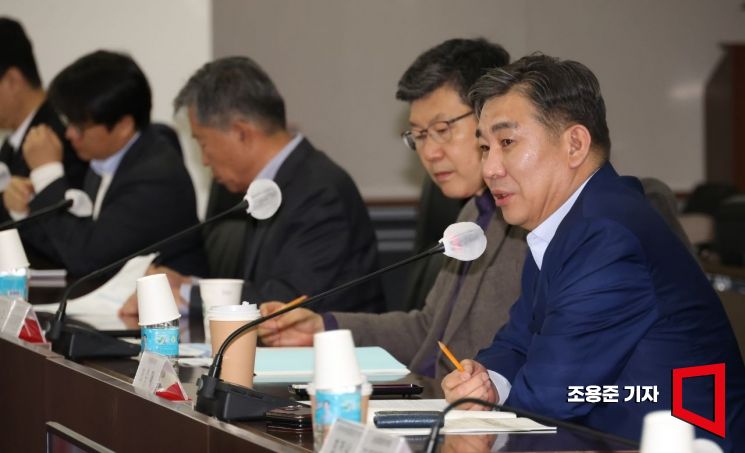
Company A, a sensor development and robot control specialist located in Dalseo-gu, Daegu, requested the establishment of certification and evaluation standardization criteria for safety sensors used in industrial and service robots. As the demand for service robots in logistics, smart manufacturing, and welfare has recently increased, the demand for robot safety sensors has also risen; however, there is currently no domestic certification for safety sensors used in service robots, making domestic production difficult.
Most of the safety sensors currently used in service robots are imported from Japan or Germany. To create demand and commercialize the domestic market, it is necessary to establish evaluation standardization and certification systems to support the development of safety sensors.
The Ministry of Trade, Industry and Energy, the relevant authority, stated that the domestic market size for safety sensors is currently small and heavily dependent on foreign products from advanced countries. Evaluation models and methods related to safety sensors have already been established as international standards.
Furthermore, product safety certification is generally implemented after market formation, and there are currently very few domestic safety sensor manufacturers. However, considering future market expansion, the ministry believes that establishing a certification system should be reviewed in the long term.
Company B, which manufactures extrusion molding machines in Chilgok-gun, Gyeongsangbuk-do, suggested the need to improve the contract power usage range for which credit card payment is possible when paying industrial electricity bills. Currently, credit card payment is allowed for electricity bills if the contract power is 20kW or less, but for business sites with 20kW or more, payment is only possible in cash. Company B appealed to expand the contract power range eligible for card payment, citing cases of delinquency due to temporary liquidity difficulties.
Korea Electric Power Corporation (KEPCO), the relevant institution, stated that since KEPCO is obligated to pay card fees, expanding the scope of credit card payments requires careful consideration with related agencies, taking into account the impact of card fees on electricity consumers and relevant laws.
In addition, attendees raised various field regulations and difficulties, including △ relaxation of the reporting period for aerial photography guidelines to shorten the processing time of the drone one-stop civil service portal △ requests for computerization to simplify document submission when applying for export support projects △ easing the business operation period criteria for selecting innovative SMEs.
Choi Seung-jae, the Small and Medium Business Ombudsman, said, "It was a very meaningful time to directly listen to and discuss the various suggestions and difficulties of SMEs in the Daegu and Gyeongbuk regions," adding, "We will continue to consult with related ministries to resolve field-oriented regulations and difficulties and do our best to achieve good results."
© The Asia Business Daily(www.asiae.co.kr). All rights reserved.

















