Reenactment of Joseon Maninso: "From Yanggu to Busan, Exaggerated"
Half a Century Halt After Only Yeongcheon~Busan Section Opened
Ten cities and counties in the Gyeongbuk and Gangwon-do regions have launched full-scale activities for the early construction of the Nam-Buk 9-Axis Expressway.
The nine participating local governments are Yeongcheon, Cheongsong, Yeongyang, and Bonghwa in Gyeongbuk, and Yeongwol, Jeongseon, Pyeongchang, Hongcheon, Inje, and Yanggu in Gangwon.
The Nam-Buk 9-Axis Expressway Promotion Council (Chairman Park Hyun-guk), which includes these cities and counties, took inspiration from the Joseon Dynasty's Maninso (萬人疏) and collected signatures from over 1,000 residents in each city and county, totaling about 13,800 signatures since July. They submitted a petition along with the signatures to the government on the 22nd of last month.
The petition mainly calls for the inclusion of the project as a priority in the government's ongoing 3rd Expressway Construction Plan (2026?2030) and for the project to be selected as an exemption from preliminary feasibility studies.
Maninso refers to a petition submitted to the king by about 10,000 Joseon-era scholars under a joint name. It was a kind of appeal document created to consolidate public opinion into a single document to influence policy.
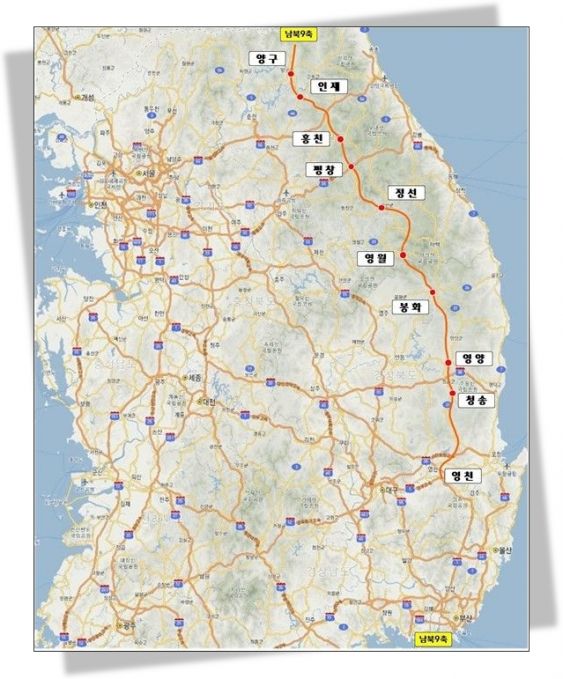
The Nam-Buk 9-Axis Expressway is a 406 km section stretching from Yanggu in Gangwon-do to Busan. Although this section is included in national plans such as the Comprehensive National Territory Plan and the Expressway Construction Plan, only the 96.5 km section between Yeongcheon and Busan was opened in 1969, and the remaining 309.5 km section has seen no progress for half a century.
While other regions have established dense expressway networks like a spider web, securing a foundation for sustainable growth, the ten cities and counties located along the Nam-Buk 9-Axis have been losing vitality due to poor accessibility, facing various issues such as tourism, business attraction, and logistics.
The national trunk road network is being developed based on a grid system of 10 north-south axes and 10 east-west axes, gradually becoming a reality. However, only the inland areas of Gangwon and Gyeongbuk have consistently fallen behind in investment priority, leaving the expressways empty. This is interpreted as the result of all past administrations emphasizing the importance of balanced development but consistently stingy in budget allocation.
Various social indicators show a similar picture. According to the 'Regional Industry and Employment' report released by the Korea Employment Information Service in March, all ten cities and counties are classified as at-risk areas for extinction. Among them, six counties (Cheongsong, Yeongyang, Bonghwa, Yeongwol, Jeongseon, Pyeongchang) are categorized as high-risk extinction areas. The total population of the ten cities and counties is less than 400,000, with about 40% of them being elderly aged 65 or older.
In contrast, Gangnam-gu, which is 297 times smaller in area (39.5 km²) than the combined area of the ten cities and counties (11,723.6 km²), has a larger population of 550,000, clearly illustrating how severe the regional imbalance caused by biased development is.
The council argues that the construction of the Nam-Buk 9-Axis Expressway is the only solution to overcome such imbalances and side effects.
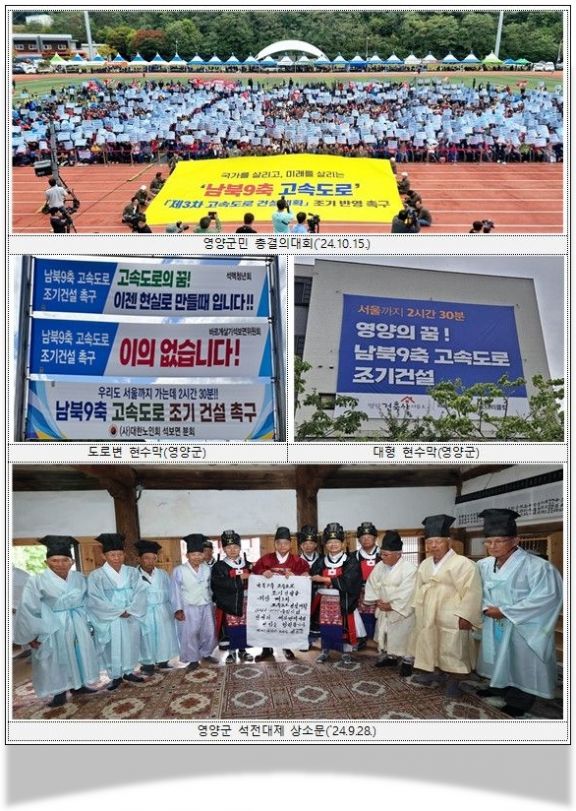
Private sector movements are also becoming active. Residents are leading signature campaigns and putting up banners throughout the region urging the early construction of the expressway, actively participating in the effort. The local residents perceive regional extinction not as a warning but as an actual reality, viewing their participation not as mere involvement but as a fight for survival.
In Yeongyang County, the area with the smallest population inland, banners urging the early construction of the Nam-Buk 9-Axis Expressway are hung at major crossroads, and Confucian scholars are submitting petitions at the Seokjeondaeje ceremony hosted by Yeongyang Hyanggyo. Efforts are being made to convey the urgent voices on-site through various means, including holding a resolution rally at Yeongyang County’s largest event, the Yeongyang County Sports Festival.
Starting with the submission of the petition, the council plans to launch the ‘Nam-Buk 9-Axis Expressway Early Construction Prayer Challenge’ campaign with residents and to raise public interest by promoting the feasibility of the road construction through terrestrial broadcasting and YouTube.
In Gangwon-do, a preliminary feasibility study for the Yeongwol?Yanggu section is underway under the Ministry of Land, Infrastructure and Transport, and in Gyeongbuk, a study for the Gyeongbuk section is being conducted by the provincial and city/county governments. Attention is focused on whether the government will take concrete action in the future.
© The Asia Business Daily(www.asiae.co.kr). All rights reserved.


















