NH Investment & Securities analyzed on the 4th that the possibility of KOSDAQ outperforming has increased following the Democratic Party of Korea's agreement to abolish the Financial Investment Income Tax (FIIT).
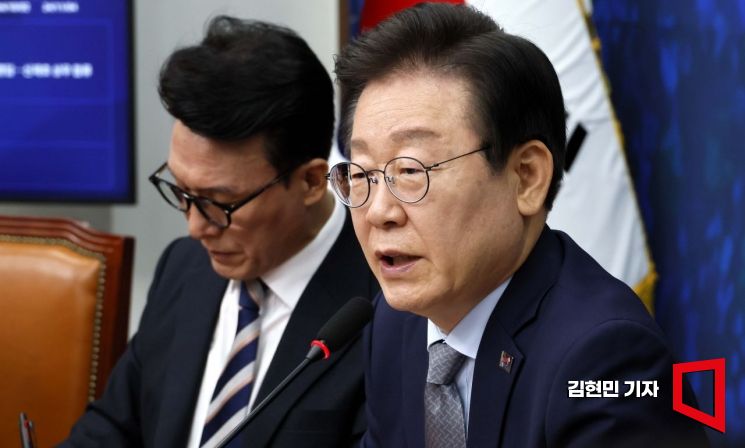 Lee Jae-myung, leader of the Democratic Party of Korea, is speaking at the Supreme Council meeting held at the National Assembly on the 4th. Photo by Kim Hyun-min
On the same day, Lee Jae-myung, leader of the Democratic Party, said at the Supreme Council meeting held at the National Assembly, "We have agreed to abolish the FIIT pushed by the government and the ruling party," adding, "If we postpone or implement improvements on this issue, it seems it will continuously become a subject of political conflict." He continued, "In principle and value, it would be right to enforce (the FIIT) even if it involves pain, but the current stock market is too difficult."
The Democratic Party had been in favor of implementing the FIIT as planned from next year. However, there were consistent calls within the party to postpone or abolish it due to difficulties in the stock market.
The securities industry evaluated that the Democratic Party's decision to abolish the FIIT has increased the possibility of KOSDAQ outperforming.
Kim Young-hwan, a researcher at NH Investment & Securities, analyzed, "Due to concerns about supply and demand outflows caused by the year-end implementation of the FIIT, individual investors have inevitably been passive in domestic stock investments from a mid- to long-term perspective," adding, "Concerns about individual capital outflows due to the introduction of the FIIT were greater in the KOSDAQ market than in the KOSPI market."
He especially expected this decision to improve supply and demand in the KOSDAQ market. He said, "Because the KOSDAQ market has a high proportion of individual investor transactions," and evaluated, "From the perspective of long-term investment, individual capital can flow in, which can improve supply and demand in the domestic stock market, and particularly, the supply and demand in the KOSDAQ market is likely to be positive."
He also analyzed that KOSDAQ is likely to improve relative to KOSPI. Over the past year, KOSDAQ’s returns have significantly lagged behind KOSPI. He advised, "Since the 'Democratic Party's agreement to abolish the FIIT' reduces concerns about rapid outflows of individual supply and demand in the KOSDAQ market, it is necessary to keep in mind the possibility that the performance of the KOSDAQ market may improve relative to KOSPI in the future."
He emphasized, "It is important to remember that the Democratic Party’s basis for agreeing to abolish the FIIT is to first resolve the structural vulnerabilities of the Korean stock market, such as amendments to the Commercial Act," adding, "A Democratic Party-led drive to amend the Commercial Act is expected in the future, and the value-up theme of the Korean stock market may gain additional momentum from these amendments."
He concluded, "In summary, this is interpreted as a positive decision for the domestic stock market," and predicted, "In particular, the possibility of outperformance of the KOSDAQ index and value-up stocks has increased."
© The Asia Business Daily(www.asiae.co.kr). All rights reserved.

![Clutching a Stolen Dior Bag, Saying "I Hate Being Poor but Real"... The Grotesque Con of a "Human Knockoff" [Slate]](https://cwcontent.asiae.co.kr/asiaresize/183/2026021902243444107_1771435474.jpg)















