Increasing Development Projects Highlight Importance of Public Contributions
"Must Function Properly Even with Changes in Demographics and Responsible Officials"
The Yeouido pilot apartment reconstruction complex, the first project under Seoul City's Rapid Integrated Planning initiative, is facing delays due to issues surrounding the installation and expansion of a senior welfare facility called the ‘Daycare Center.’ Seoul City’s demand for the project implementer to donate the contentious Daycare Center as a public contribution stems from the agreement to grant benefits such as a maximum floor area ratio of 400% and a maximum building height of 65 floors.
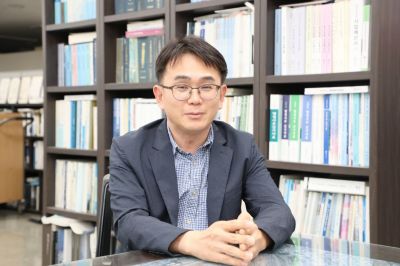 Hachang-gon, Head of the Strategic Urban Development Team, is explaining Yongsan-gu's 'Donation and Communication Plaza.' Provided by Yongsan-gu.
Interest in and utilization of donation-in-kind (public contribution) facilities are increasing. The dictionary definition of donation-in-kind is ‘the state or local government receiving property free of charge from the project implementer to expand infrastructure,’ but as seen in the case of the Yeouido pilot apartment reconstruction complex, it is not strictly free of charge.
Yongsan-gu established its own system, the ‘Donation-in-Kind Information Communication Plaza,’ recognizing the growing importance of donation-in-kind facilities. Local governments must continuously expand not only infrastructure such as roads and parks but also essential public libraries, social welfare facilities, and cultural and sports facilities for residents. However, securing new land and constructing buildings in urban areas is challenging due to scarce land availability and high land and construction costs. Local governments solve this challenge by receiving donation-in-kind from project implementers during large urban development projects or redevelopment and reconstruction processes. This leads to a second problem.
The issue of managing supply and demand for donation-in-kind facilities. Identifying what facilities are truly necessary for the area or residents is not as easy as it seems. Urban development projects, including redevelopment and reconstruction, often take more than 10 years. During this time, it is not easy to continuously revise and supplement plans to reflect changes in population structure and social environment. Both the demand and supply departments experience multiple staff changes, making handovers difficult.
Ha Chang-gon, head of the Strategic Urban Development Team in Yongsan-gu’s Urban Planning Division, which established the Donation-in-Kind Information Communication Plaza system, said, “Excluding the international business district development, 57 projects are underway in Yongsan-gu. If these are not properly organized, facilities cannot be systematically received, causing chaos, and the damage ultimately falls on the residents.”
The Donation-in-Kind Information Communication Plaza is an online administrative portal that consolidates information on the status, implementation details, and planned sites of donation-in-kind facilities. Detailed management cards for drawings and project sites are uploaded so that all employees can access them on the district office’s internal network. The Urban Planning Division, which operates the system, even created webtoons to explain the content in an easily understandable way for colleagues. The system eliminates barriers between departments. If departments responsible for facility demand, such as welfare and culture/sports, understand this status, they can request facility supply at the right quantity, place, and time.
Ha explained, “Internal demand and supply for donation-in-kind are managed in an integrated manner, enabling rapid and efficient allocation. If the local government, which holds the approval authority, makes use decisions quickly, project implementers can also benefit economically by shortening the construction period.” The Strategic Urban Development Team in Yongsan-gu was newly established by Yongsan-gu Mayor Park Hee-young early in his term and also handles external cooperation related to urban development.
No other local governments nationwide have yet established such a system. Yongsan-gu created its donation-in-kind related system independently without spending a large amount of money. By accumulating data such as changes in population structure, it is expected that more effective donation-in-kind supply and demand plans can be developed in the future using artificial intelligence (AI) technology.
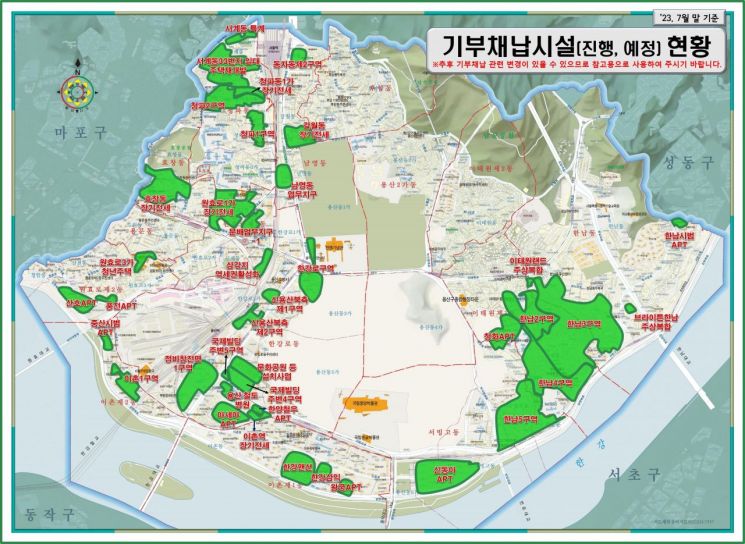 Status map of donation facilities in Yongsan-gu. Yongsan-gu manages the progress and planned status of donation facilities in three stages (Type A to C), such as 'Plan Confirmed', 'Plan Under Development', and 'Plan to be Developed Later'. No separate distinction is indicated on the status map. Provided by Yongsan-gu.
© The Asia Business Daily(www.asiae.co.kr). All rights reserved.


















