Semiconductor R&D Competition Ultimately a 'Race Against Time'
NVIDIA, TSMC, and Others Engage in 'Overnight Research'
Competition Difficult Without Flexible Working Hours
Industry's Sense of Crisis Grows... Government and National Assembly Response in Focus
To promote work-life balance, the institutionalized '52-hour workweek (40 hours of regular work and 12 hours of overtime)' in the workplace is being pointed out as a reason why our semiconductor industry is falling behind global competitors such as TSMC (Taiwan), and voices demanding improvements are growing.
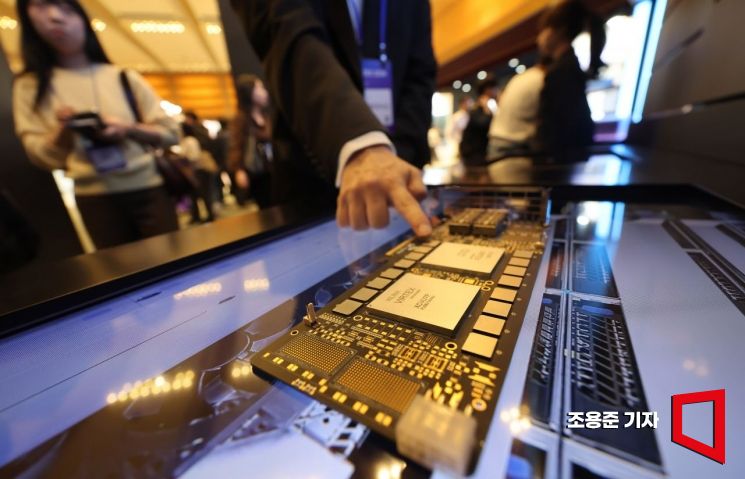 The 'Semiconductor Exhibition (SEDEX) 2024,' where domestic and international semiconductor companies including Samsung Electronics and SK Hynix showcased a large number of new technologies and cutting-edge products, opened on the 23rd at COEX in Samseong-dong, Seoul. Visitors at the exhibition are examining the AI-optimized semiconductor chip presented by SK Hynix. Photo by Jo Yongjun
On the 4th, the semiconductor industry argued that in order for Korean companies to regain their once-proud technological competitiveness in the semiconductor market, working hours need to be made more flexible. In particular, they emphasize that an exception should be made to the 52-hour workweek system for personnel (R&D) who need to research and develop technology for long hours. Developing and competing in semiconductor technology is ultimately a 'battle against time,' and considering this characteristic, the 52-hour workweek system is not suitable at all for the semiconductor field.
Specifically, there are calls to introduce a Korean-style 'White Collar Exemption' system. This system was first introduced by the United States in 1938. It essentially excludes high-level managers, professionals, and high-income earners from working hour regulations. Under this system, high-level managers and administrative/professional workers earning a weekly salary of $684 (approximately 940,000 KRW) or more, and high-income workers with an annual income of $107,432 (approximately 148 million KRW) or more, are exempt from working hour regulations. Since 2018, Japan has implemented the 'Kodo (高度) Professional' system, which excludes high-income professionals from labor hour regulations. Among non-production workers such as financial product developers, analysts, and new product R&D staff, those earning over 10.75 million yen (approximately 97 million KRW) annually are exempt from working hour regulations.
These industry demands have gained more momentum as examples of overseas companies without working hour restrictions have become known. Leading global semiconductor companies such as TSMC and Nvidia (USA) reportedly conduct overnight research and work without working hour regulations. On the other hand, Korean companies subject to the 52-hour workweek system are criticized for struggling to tighten the reins on being overtaken or catching up. If working hours are improved, there is also the challenge that appropriate compensation and welfare must accompany increased work hours. Accordingly, attention is focused on whether our government and National Assembly will respond. It is reported that the 'Special Act for Strengthening and Protecting National Semiconductor Industry Competitiveness,' proposed by many ruling and opposition lawmakers in the National Assembly, does not yet include provisions regarding working hour improvements.
© The Asia Business Daily(www.asiae.co.kr). All rights reserved.

















