Smart Device Penetration Rate 79.1% for 3rd Graders and Above
Management System Exists but Cannot Prevent 'Bypassing'
"Development of Robust Management System Needed"
Concerns are growing that smart devices distributed to schools nationwide are being used for purposes other than studying. Experts advise that "management systems need to be strengthened."
According to the 'Diversity Survey on School Operation and Management Related to the Use of Smart Devices for Learning' conducted by the Seoul Metropolitan Office of Education Research Institute on the 4th, a survey of 135 teachers, students, and parents found that all three groups identified 'problems with use for non-class purposes' as the biggest drawback of using Dibets in classes. Dibet is a learning smart device supported by the Seoul Metropolitan Office of Education, provided in the form of laptops or tablets.
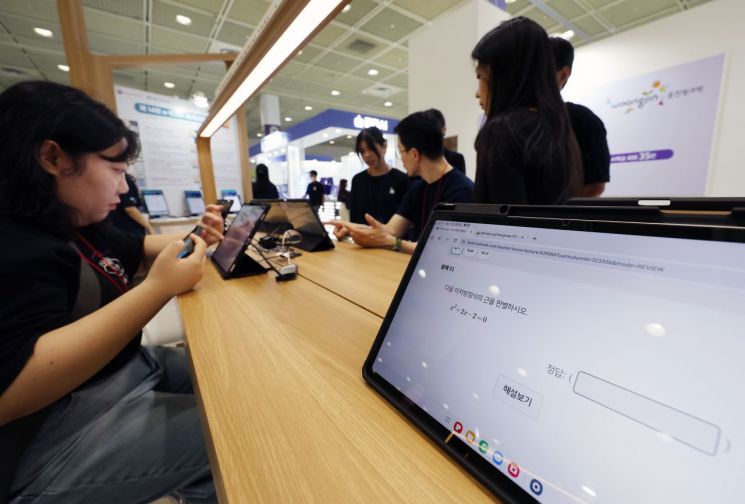
While teachers can directly supervise device use at school, it is difficult to manage when students use the devices outside of school. The Seoul Metropolitan Office of Education has restricted elementary students to use the devices only at school, while middle and high schools are allowed to decide autonomously whether to permit off-campus use based on opinions from students, teachers, and parents. It is said that even the device management program (MDM) installed on the devices is easy to 'bypass.' A middle school teacher lamented, "The device management system (MDM) controls access to applications like YouTube, but it is impossible to block access when students bypass through the web," adding, "There are also issues such as slow MDM performance and inadequate monitoring."
As of December last year, the smart device distribution rate among students in grade 3 and above nationwide reached an average of 79.1%. Since the education authorities are promoting the expansion of device distribution aiming for 'one device per student' in line with the phased introduction of AI digital textbooks, the distribution rate is expected to increase further. An official from the Ministry of Education explained, "The distribution is sufficient enough for students in grades 3 and 4 of elementary school, grade 1 of middle school, and grade 1 of high school?who are the target for next year's AI digital textbook application?to use smart devices."
The research team viewed strengthening the management system as an urgent task. They stated, "It is necessary to develop a robust MDM so that teachers can effectively manage students' use of smart devices," and added, "In the long term, a period of awareness change is needed, and proactive measures such as blocking harmful information and controlling device usage time should be implemented together."
© The Asia Business Daily(www.asiae.co.kr). All rights reserved.

















