Government "Sympathizes with Purpose" of School Smartphone Ban Bill
Regulatory Trends Abroad as Well
As countries like France, the United States, and the United Kingdom implement policies to address students' digital overdependence, the ruling party in South Korea has pushed for a bill banning students from using smartphones within schools. The government has expressed agreement with the intent, lending support to the related legislation.
According to the National Assembly and education circles on the 3rd, Jo Jeong-hoon, a member of the National Assembly's Education Committee from the People Power Party, officially proposed an amendment to the Elementary and Secondary Education Act on August 13, which restricts the use of smart devices on school premises.
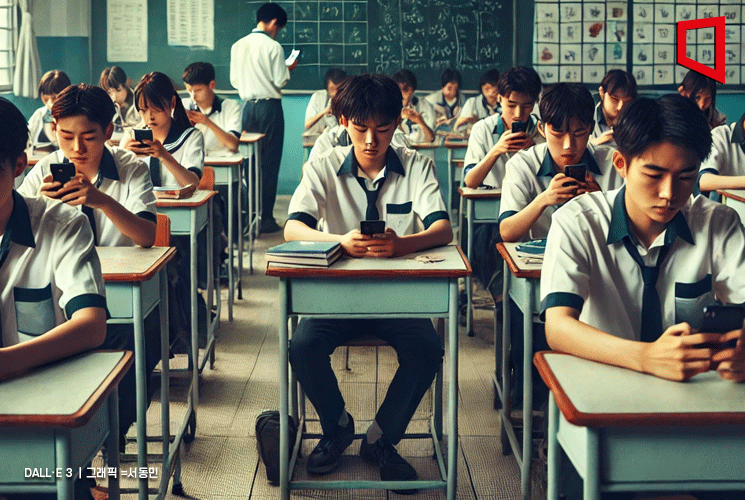
Rep. Jo stated, "Smartphone addiction among students has become a social issue," and explained, "The proposal aims to restrict the use of smart devices on school grounds except when permitted by the school principal and teachers to protect students' mental health."
The amendment introduces Article 20-3 (Guidance on Students' Use of Mobile Phones), which states, "Students shall not use smart devices on school premises. However, use is allowed if permitted by the school principal and teachers for educational purposes or in emergency situations."
In response, the Ministry of Education said, "Recently, social networking services (SNS) have adversely affected students' intelligence, cognition, and mental health development, and students have been exposed without protection to harmful and illegal content as well as cyber (sexual) violence," adding, "We strongly agree with the intent of the amendment to legally restrict students from using smart devices on school grounds."
With AI digital textbooks set to be fully distributed starting next year, education authorities recognize the need to limit smartphone use in schools as a measure to alleviate concerns about digital overindulgence.
There is also strong support among teachers and parents for regulating students' smartphone use.
In a joint statement released in September, the Federation of Teachers and Parents' Associations emphasized, "We feel that children are losing their way amid the waves of smartphones and SNS," and stressed, "The bill is not merely a regulation but a solution to protect children's lives and help them reclaim a genuine childhood."
According to the 2024 Youth Media Usage Habit Diagnosis Survey conducted by the Ministry of Gender Equality and Family targeting 1,249,327 students in grades 4, 7, and 10, 221,029 youths were identified as at risk of internet and smartphone overdependence, accounting for 17.7% of the total surveyed.
The at-risk groups for internet and smartphone overdependence numbered 174,374 and 127,845 respectively, with 81,190 youths falling into both categories.
Following the National Human Rights Commission's decision last month that the collective collection of mobile phones at schools does not constitute a human rights violation, political circles and the government have reached a consensus on the necessity of restricting students' smartphone use, accelerating the processing of related bills.
Overseas, regulations limiting smartphone use in schools are already being established one after another.
France is currently piloting a smartphone ban in some schools and is considering expanding this regulation to all elementary and middle schools in time for next year's admission season. The method involves creating separate lockers within schools where students deposit their smartphones upon arrival and retrieve them when leaving.
California in the United States enacted a law in September that restricts or bans students' smartphone use on school premises. The law requires education boards to establish policies banning or limiting smartphone use by July 1, 2026, and mandates policy reviews every five years.
However, there are concerns about restricting students' smartphone use through law rather than school rules or official notices.
Go Min-jung, a member of the Democratic Party of Korea, criticized, "I think it fails to recognize students as independent subjects," and pointed out, "Schools should encourage students to create their own rules or solutions through student self-governance activities."
An official from the Ministry of Education said, "Once principles related to smartphone use are established in the law, the government will go through procedures to revise subordinate regulations," adding, "Specific restriction measures or disciplinary provisions are expected to be determined by individual schools."
© The Asia Business Daily(www.asiae.co.kr). All rights reserved.

















