KT SAT Signs MOU with Korea Aerospace Industries
KT announced on the 3rd that it has signed a business agreement with KT SAT and Korea Aerospace Industries (KAI) to cooperate on 6G and low-earth orbit satellite business.
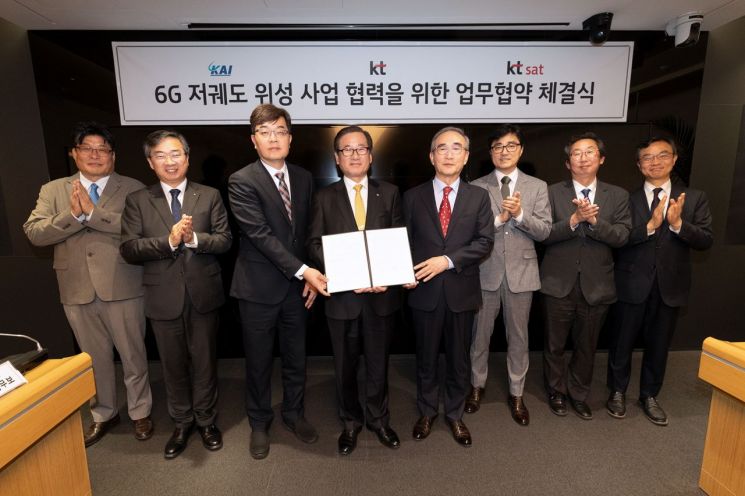 Kim Young-seop, CEO of KT (4th from right), Kang Gu-young, President of KAI (5th from right), Seo Young-soo, CEO of KT SAT (6th from right), and executives from three companies are signing a business agreement and taking a commemorative photo at the KT Gwanghwamun Building East in Jongno-gu, Seoul.
As 6G communication coverage is expected to expand from ground to satellite domains, this business agreement was planned to respond to the competition for leadership in the low-earth orbit (LEO) satellite industry. Currently, the low-earth orbit satellite industry is led by global companies with massive capital and technological capabilities such as SpaceX and Amazon Kuiper Systems.
Low-earth orbit satellites orbit at an altitude of 500 to 1,200 km, which is closer to Earth compared to geostationary orbit (GEO) satellites (at about 35,800 km altitude). Due to the closer distance, data transmission latency is shorter, allowing LEO satellites to provide relatively high-speed communication services.
Through this business agreement, the three companies agreed to jointly develop core technologies for communication satellite systems, create related ecosystems, and cooperate on domestic and international projects such as building 6G low-earth orbit communication satellites and manned-unmanned complex systems.
Primarily, KT will develop core technologies that can efficiently link low-earth orbit satellite communication systems with terrestrial wireless networks. KT SAT plans to secure operational know-how for LEO satellite systems based on decades of experience operating geostationary satellites and discover new services combining LEO and GEO satellites.
KAI will be responsible for developing LEO satellite systems and manned-unmanned complex systems, and will lead participation in military-led satellite communication projects based on its defense industry experience.
KT completed the construction of a satellite-based femtocell (ultra-small base station for mobile communication) at the Antarctic base in 2015 and has been operating it since then. Recently, it completed interoperability testing with Starlink.
Since 2019, KT has independently introduced satellite mobile base stations into the government disaster safety communication network, providing mobile communication services even in disaster and emergency situations. In the future, once Korea secures its own LEO satellites, KT plans to continuously develop technologies to expand communication based on them.
Kim Young-seop, CEO of KT, said, "In the 6G era, the coexistence of terrestrial and satellite networks will be emphasized," adding, "KT will lead the domestic 6G low-earth orbit satellite communication market through cooperation among companies representing mobile and satellite communications."
© The Asia Business Daily(www.asiae.co.kr). All rights reserved.
![Clutching a Stolen Dior Bag, Saying "I Hate Being Poor but Real"... The Grotesque Con of a "Human Knockoff" [Slate]](https://cwcontent.asiae.co.kr/asiaresize/183/2026021902243444107_1771435474.jpg)
















