Employee Stock Ownership Subscription Competition Rate 0.35 to 1
General Investor Competition Rate 772.8 to 1
A large-scale undersubscription occurred in the employee stock ownership association (ESOA) subscription of The Born Korea, led by cooking researcher Baek Jong-won.
On the 1st, The Born Korea's ESOA subscription rate recorded 35.4% (competition rate 0.35 to 1) according to the Financial Supervisory Service's electronic disclosure system (DART). The Born Korea's ESOA allocation was 600,000 shares, which is 20% of the total public offering volume, but only 212,266 shares (7.21704 billion KRW) were subscribed.
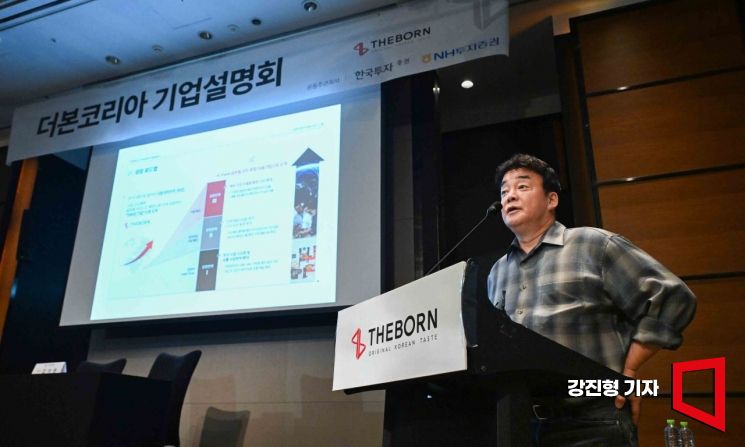 CEO Baek Jong-won of The Born Korea is giving a corporate presentation at The Born Korea corporate briefing session (IPO) held at the Conrad Hotel in Yeongdeungpo-gu, Seoul on the 28th of last month. Photo by Kang Jin-hyung
As of the end of July this year, The Born Korea had 713 regular employees, which means that on average, each employee subscribed to 298 shares. Calculated at the public offering price of 34,000 KRW, the subscription amount per person is approximately 10.13 million KRW. The undersubscribed shares (387,734 shares) were additionally allocated to institutional investors and general investors, with 237,734 shares and 150,000 shares respectively.
The Born Korea's investment prospectus states that if there are forfeited shares in the ESOA subscription, the company can allocate up to 150,000 shares additionally to general subscribers. Accordingly, The Born Korea allocated 150,000 of the forfeited shares to general subscribers and transferred the remainder to institutional investors.
The lukewarm response of The Born Korea's executives and employees to the ESOA subscription is interpreted as due to the burden of the one-year mandatory holding period and the low expectations for future stock price increases.
The ESOA allocation is subject to a one-year lock-up period during which shares cannot be sold and must be held compulsorily. Profit occurs only if the stock price exceeds the public offering price after one year, but recently, many public offering stocks have failed to surpass the offering price and have even declined, which seems to have contributed to the burden of risk-taking.
In contrast, individual investors showed strong enthusiasm. In the public offering subscription for general investors held from the 28th to 29th of last month, the competition rate reached 772.8 to 1, gathering subscription deposits amounting to 11.8238 trillion KRW. The subscription deposit requires paying half of the order amount in advance, and about 26 million KRW in deposits must be paid to reliably receive one share of the public offering stock.
Earlier, The Born Korea recorded a competition rate of 734.67 to 1 in the demand forecast for institutional investors conducted from the 18th to 24th of last month. The Born Korea is scheduled to be listed on the KOSPI market on the 6th.
© The Asia Business Daily(www.asiae.co.kr). All rights reserved.
![User Who Sold Erroneously Deposited Bitcoins to Repay Debt and Fund Entertainment... What Did the Supreme Court Decide in 2021? [Legal Issue Check]](https://cwcontent.asiae.co.kr/asiaresize/183/2026020910431234020_1770601391.png)















