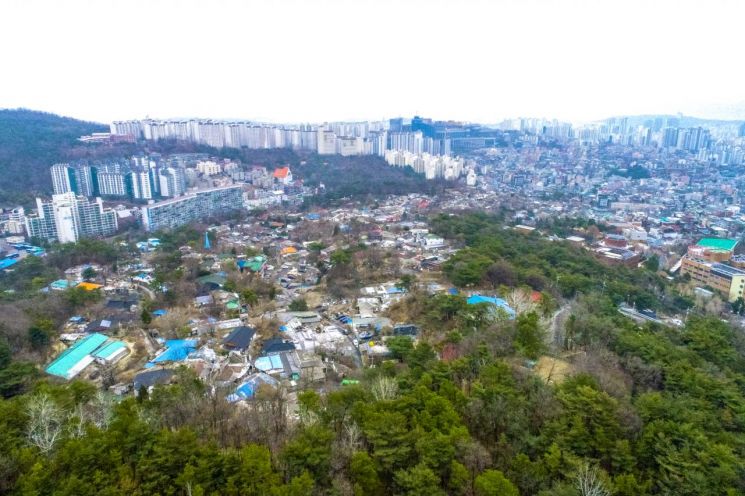
Jeongneunggol, known as one of the few remaining dal-dongnae (old hillside neighborhoods) in Seoul, has recently become embroiled in conflict among its association members over a redevelopment project. Although most of the permits and approvals have been completed, the content of the construction contract with the contractor has become a stumbling block. The conflict deepened within the association after the contract signed differed from what was announced at the contractor selection general meeting. The association president subsequently resigned, but members are protesting, calling it a "scapegoating" move.
According to the maintenance industry on the 1st, the Jeongneunggol District Redevelopment Emergency Countermeasures Committee will hold a general meeting to dismiss the association executives on the 16th. A committee official stated, "The association removed all the stringent conditions that were initially presented during the contractor selection when signing the main contract with the contractor," adding, "They changed the clauses to favor the contractor, increasing the burden on the members, but did not inform them."
The main reason for the dismissal push is the 70 billion KRW bid deposit returned to the contractor POSCO E&C without gathering the opinions of the association members. The construction contract proposed by POSCO E&C specifies that the bid deposit will be refunded after project completion. However, the association returned 55 billion KRW just one week after selecting the contractor, only after a board resolution.
The association explained, "The bid deposit converted into project funds is not an interest-free loan, so interest burden starts accruing from the time of contractor selection," adding, "As of February, the loan interest rate was 5.18%, and to reduce interest burden, only the necessary funds were retained while some were refunded." However, members opposing this argue that interest debt should not start accruing immediately after contractor selection. A committee official claimed, "The monetary loan agreement containing the interest terms was signed 10 months after contractor selection," and "Until then, there was no separate interest agreement, so there was no obligation to pay interest." He further stated, "If the association had kept the bid deposit, it could have earned interest income." The committee estimates the damage at about 1.7 billion KRW annually, calculated at a 4% interest rate.
Another issue raised was that the contract was signed with modifications unfavorable to the contractor, differing from the construction contract draft disclosed at the contractor selection general meeting. A representative example is the clause regarding the 550.3 billion KRW project loan interest. POSCO E&C had promised during the bid proposal to bear interest and other financial costs. However, this clause was omitted in the main contract. Annual financial costs are estimated at around 20 billion KRW. Assuming the project takes more than 3 to 4 years to complete, association members would have to share nearly 100 billion KRW in costs.
The association explained, "We received a reply from POSCO E&C stating that the construction contract draft was prepared confusing the roles of the parties, so we corrected it," adding, "Why should the contractor bear the interest? It is not customary."
For members who only knew the content from the contractor selection general meeting, this came as a shock. One member said, "It feels like being stabbed in the back by the association that pushed the project forward unconditionally," adding, "Even if the main contract was entrusted to the delegates, if the content significantly affecting members' interests changed, there should have been an explanation or ratification process, but we were not informed of this at all after the contract was signed."
As the controversy continued, the association president resigned. However, the conflict is expected to persist. The emergency committee insists on forming a new executive team to renegotiate the problematic parts of the construction contract with POSCO E&C and, depending on the situation, push for a contract renewal. On the other hand, the association plans to hold a general meeting in January next year to conduct a by-election for the association president and proceed with changes to the maintenance project plan, regardless of the emergency committee's dismissal push.
Meanwhile, the Jeongneunggol District is located behind Kookmin University and adjacent to Bukhansan Bogukmun Station on the Ui-Sinseon Line. In the 1960s, displaced residents gathered here to build and live in shantytowns. It is also famous as the area where the late author Park Kyung-ri, who wrote the novel "Toji" (The Land), lived. As most buildings aged over 40 years and deteriorated, development demands arose, and in 2003, the area was removed from the greenbelt. Subsequently, it was designated as a maintenance district in 2012, the association was established in 2017, project implementation approval was granted in December 2021, and management disposition approval was completed in January this year. Through redevelopment, a townhouse complex with over 1,400 households is planned.
© The Asia Business Daily(www.asiae.co.kr). All rights reserved.

















