Increase Government Investment to Reduce Private Burden
Poor Performance in Debt Guarantee Supply Despite Budget Increase
Underfunding of Saemaul Loan 15 Contribution Budget for Low-Income Borrowers
The Financial Services Commission's budget plan for next year's 'New Start Fund' has drawn criticism for reducing resources while increasing government contributions.
According to the National Assembly Budget Office's analysis report on the 2025 Budget Plan for the Political Affairs Committee released on the 1st, the required funds for the Financial Services Commission's New Start Fund bond purchases decreased by 4.4 trillion won from the initial 18 trillion won to 13.6 trillion won. However, the government's contribution increased from 3.6 trillion won to 4.01 trillion won, while the Korea Asset Management Corporation's own burden significantly dropped from 14.4 trillion won to 9.59 trillion won. The New Start Fund is a program that supports debt restructuring for borrowers facing difficulties in loan repayment or at risk of default.
This is because the government raised the expected default rate used to calculate the contribution size (from 20% to 29.5%). The Financial Services Commission explained to the Budget Office that, so far, no losses have been realized in this project, and the result was derived by referring to the effectiveness of other similar debt restructuring programs (such as the past Credit Recovery Committee's rapid and preemptive debt restructuring, individual workouts, and the Asset Management Corporation's debt restructuring programs).
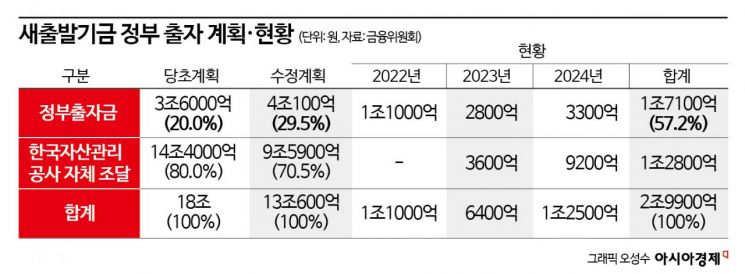
In response, the Budget Office stated, "Considering that no losses from bond defaults have occurred yet, but government contributions are made annually, resulting in a government contribution ratio significantly higher than planned relative to the total resource procurement scale," it pointed out the need to review the appropriateness of the government contribution size.
Concerns were also raised about excessive budgeting for the refinancing guarantee subrogation repayment project. This project, guaranteed by the Korea Credit Guarantee Fund, converts high-interest loans (over 7% per annum) of small business owners and self-employed individuals into low-interest (around 5% per annum) guaranteed loans. The Financial Services Commission drastically increased the 2025 plan to 713.9 billion won, a 180.6% increase compared to the previous year (254.4 billion won). This budget was prepared based on the assumption that the bad debt balance at the end of this year will be 78.2 billion won and that the net increase in bad debt next year will be 932.8 billion won.
However, according to the Budget Office, the current guarantee supply performance is only 1.4951 trillion won, which is just 15.7% of this year's supply target of 9.5 trillion won. The Budget Office suggested, "Since the refinancing guarantee has a structure of 3 years grace period and 7 years installment repayment, even if guarantee supply expands, it is unlikely to immediately lead to bad debt occurrence and the resulting subrogation repayment needs," and recommended "reassessing the size of next year's plan by comprehensively considering actual bad debt trends and grace periods."
On the other hand, the 'Hae-sal-lon 15' project for supporting low-income financial consumers raised opposite concerns. The Financial Services Commission allocated the same 90 billion won in the 2025 budget plan as the previous year, which the Budget Office analyzed as not reflecting guarantee demand. The budget was set for guarantee supply of 650 billion won, the same scale as this year, while the guarantee supply volume of Hae-sal-lon 15 has exceeded 1 trillion won annually since 2021. Despite the expected increase in guarantee demand for Hae-sal-lon 15, the budget was frozen, revealing imbalances in budget allocation across projects.
Hae-sal-lon 15, transferred from the National Happiness Fund to the Korea Inclusive Finance Agency in July this year, is a financial product supporting institutional financial use by low-income and low-credit individuals. The Financial Services Commission and the Korea Inclusive Finance Agency stated that this project started as a National Happiness Fund project, not a fiscal support program, and that contributions to the Korea Inclusive Finance Agency are a temporary project due to the National Happiness Fund's temporary financial shortage, making it difficult to coordinate with fiscal authorities.
However, the Budget Office emphasized, "Considering recent economic conditions and household debt trends, it is difficult to expect a short-term decrease in demand for loan guarantee products including Hae-sal-lon 15," and stressed the need to "prepare specific measures such as securing resources to stably supply the expected guarantee volume."
© The Asia Business Daily(www.asiae.co.kr). All rights reserved.

![Clutching a Stolen Dior Bag, Saying "I Hate Being Poor but Real"... The Grotesque Con of a "Human Knockoff" [Slate]](https://cwcontent.asiae.co.kr/asiaresize/183/2026021902243444107_1771435474.jpg)















