Selected 18 Hospitals for 'Structural Transformation Pilot Project' to Reduce 1,800 Beds
Expecting Fee Increase and Incentive Support Despite Fewer Patients
Active Consideration Even in Regional Hospitals with Low Bed Occupancy Rates
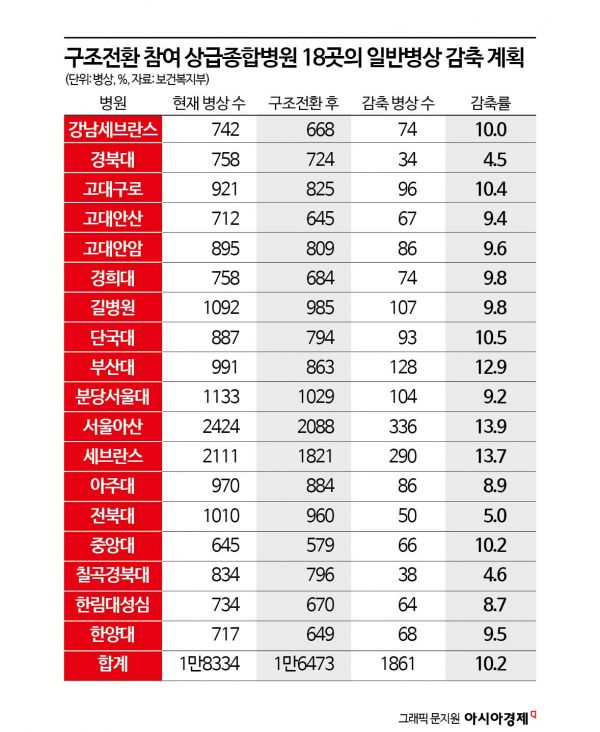
Eighteen tertiary general hospitals, including Seoul Asan Medical Center and Severance Hospital, have decided to reduce more than 1,800 general beds to shift their structure toward focusing on critically ill patients. In terms of the number of beds, this is equivalent to the entire main building of Seoul National University Hospital in Yeongeon-dong, Jongno-gu, Seoul (a total of 1,803 beds) disappearing. When the number of beds for hospitalization decreases, the number of outpatients also declines. Seoul National University Hospital sees an average of 10,000 outpatients daily, totaling 2.44 million annually. Since the collective resignation of residents in February, the scale of treatment, surgery, and hospitalization at tertiary general hospitals has all been reduced, resulting in even the large Big 5 hospitals (Samsung Seoul, Seoul National University, Seoul St. Mary's, Seoul Asan, Severance) posting losses of hundreds of billions of won in the first half of the year.

According to the Ministry of Health and Welfare and the medical community on the 1st, the total planned reduction of general beds by the 18 hospitals selected for the pilot project to restructure primary and secondary tertiary general hospitals recently amounts to 1,861 beds. As a condition for participation, the government required medical institutions in the metropolitan area with 1,500 or more beds to reduce general beds by 15%, other institutions by 10%, and non-metropolitan institutions by 5%. It is expected that about 1,200 beds will be cut from the Big 5 hospitals alone, and if all 47 tertiary general hospitals nationwide participate in this project, approximately 4,000 beds will disappear.
Hospitals participating in the pilot project must expand beds in surgical intensive care units, pediatric emergency intensive care units, stroke specialized treatment rooms, neonatal intensive care units, and also increase the number of high-risk maternal intensive care beds while reducing general beds. Beds accommodating patients with severe chronic diseases and those undergoing relatively minor surgeries will inevitably be prioritized for reduction. It is reported that many hospitals have already reduced bed operations by converting existing 5-6 person rooms into 4-person rooms. A representative from a tertiary general hospital explained, "After the medical-policy conflict, surgeries decreased by about 30%, leaving 30-40% of hospital rooms empty. Therefore, there is no need for artificial bed reduction for the pilot project."
However, as the structure of tertiary general hospitals changes in this way, the overall scale of medical care shrinks, and the number of new outpatients decreases, inevitably impacting hospital operations. Accordingly, the Ministry of Health and Welfare decided to support inpatient treatment fees equivalent to 30% of the reduced beds for tertiary general hospitals that reduce beds. The required support fund is about 340 billion won annually. Additionally, the fees for intensive care units, which had been low compared to the manpower input, will be increased by 50%, and fees for 910 severe surgeries and anesthesia will also be raised by 50%. Annual support for these will be 460 billion won and 350 billion won, respectively.
A hospital official said, "When the government first proposed the restructuring project, there were concerns about deteriorating hospital revenues due to bed reductions, but internal simulations at each hospital concluded that if inpatient fees are raised and incentives are supported, there would be no major problems." Another hospital official hinted, "In some regional hospitals, bed occupancy rates have significantly dropped since COVID-19, causing operational difficulties, so they tend to be more proactive in this project, which reduces beds and medical personnel while receiving government support."
However, there are side effects of operating beds excessively focused on profitability. On the 29th of last month, at Hanyang University Hospital, the hospital director sent text messages to specialists instructing them to prioritize admitting patients to intensive care units to maximize hospital revenue or to recommend high-priced laparoscopic or robotic surgeries, causing controversy.
Ahn Ki-jong, president of the Korea Patient Organization Federation, said, "It is essential to correct the medical delivery system through structural transformation where mild patients are treated at secondary hospitals and critically ill patients at tertiary hospitals." However, he added, "There is concern that as the number of beds decreases, it may become difficult for patients with severe or rare diseases to be admitted to the Big 5 hospitals." He also pointed out, "The biggest concern is whether the referral and return system, where critically ill patients undergo surgery and recovery at tertiary hospitals and then receive follow-up care at local hospitals, will function properly, and whether a fast track will be available for rapid readmission to tertiary hospitals in case of disease recurrence or emergencies."
A medical community official said, "The government plans to invest a total of 10 trillion won in fee increases and other support over the three-year pilot project, but there are concerns about what support will continue afterward and how additional funding will be secured." He added, "It will take at least about a year to evaluate whether the current medical vacuum caused by the departure of residents can be overcome and whether the transition to specialist-centered hospitals can lead to a desirable medical utilization system for the public."
© The Asia Business Daily(www.asiae.co.kr). All rights reserved.
![Clutching a Stolen Dior Bag, Saying "I Hate Being Poor but Real"... The Grotesque Con of a "Human Knockoff" [Slate]](https://cwcontent.asiae.co.kr/asiaresize/183/2026021902243444107_1771435474.jpg)












