Hydrogen Concept Car 'Inisium' Debuts
Hydrogen Vehicle Research Since the 1990s
Increased Hydrogen Tank Capacity and Improved Stack
Over 650 km Driving Range on a Single Charge
Hyundai Motor Company unveiled its next-generation hydrogen electric vehicle concept car, ‘Inisium,’ for the first time on the 31st. This model offers a glimpse into the new technologies and design direction that will be incorporated into the successor to the Nexo, scheduled for release in the first half of next year.
Drawing on experience since the 1990s in hydrogen vehicle research and being the first in the world to mass-produce and supply hydrogen vehicles to the market, Hyundai has embedded this expertise into the concept. As hydrogen is recognized as a ‘clean and equitable’ energy source, the company plans to accelerate the hydrogen society by promoting its widespread use across various industries, including transportation. This marks the full-scale launch of the hydrogen ecosystem that Hyundai began unveiling earlier this year.
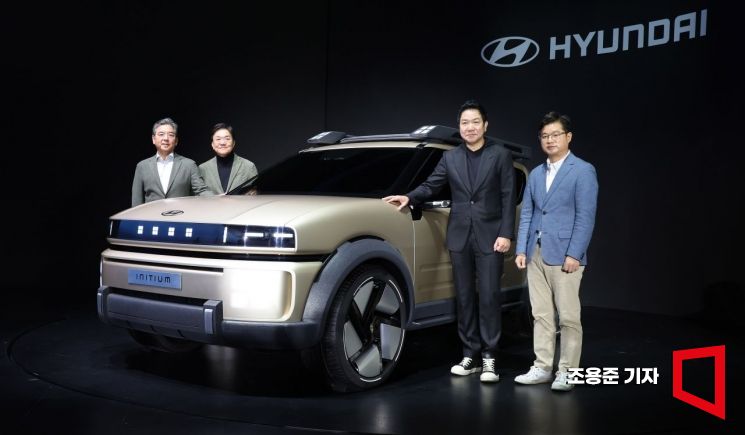 Jang Jae-hoon, President of Hyundai Motor Company (left), Lee Sang-yeop, Vice President (second from right), and other development executives are unveiling the hydrogen electric vehicle concept car 'INITIUM' for the first time on the 31st at Hyundai Motorstudio Goyang in Gyeonggi Province. Photo by Jo Yong-jun
Jang Jae-hoon, CEO of Hyundai Motor Company, said at the unveiling event held at Hyundai Motorstudio Goyang, "Through the hydrogen value chain business brand H-TWO, introduced earlier this year, we will provide solutions tailored to every stage of production, storage, transportation, and utilization," adding, "As a leading company in the hydrogen sector, we will further expand the hydrogen vehicle market."
The concept car revealed on this day refines the existing second-generation fuel cell stack to improve performance such as driving range and output. The hydrogen tank storage capacity has been increased, and wheel and tire resistance reduced, enabling a driving range of over 650 km on a single charge. This exceeds the current Nexo’s cruising range of 609 km. The fuel cell system and battery performance have been enhanced, with the motor’s maximum output reaching 150 kW, an improvement over the Nexo’s 113 kW. These upgrades reflect customer feedback gathered from selling hydrogen passenger cars.
The design concept, called ‘Art of Steel,’ emphasizes the material steel. It reflects the purity and strength that resonate with hydrogen. The lamp design symbolizes Hyundai Motor Group’s hydrogen business brand ‘H-TWO’ and is exclusively applied to hydrogen vehicles. Lee Sang-yeop, Vice President and Head of Hyundai Genesis Global Design, said, "We aimed to embody the values pursued by customers choosing hydrogen electric vehicles, their environmental consciousness, and their pride as pioneers."
The concept car also features a navigation function that efficiently routes through hydrogen charging stations on the way to the destination, and a V2L (Vehicle-to-Load) function that allows outdoor activities to use the vehicle’s power. These are functions specialized for electric vehicles. Nine airbags are installed, and the structure is reinforced to enhance collision safety performance.
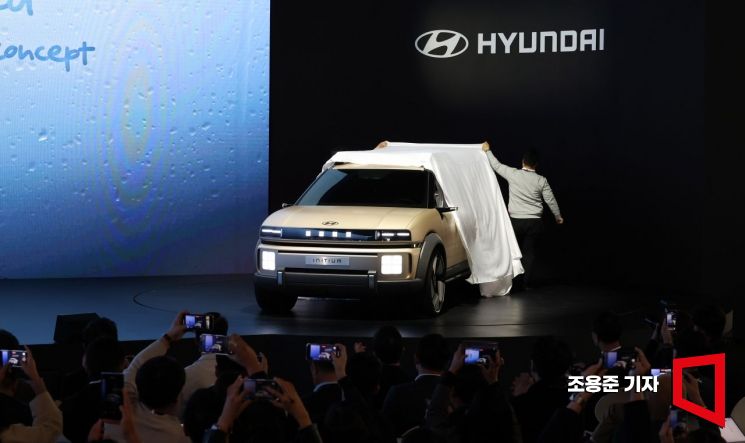 On the 31st, Hyundai Motor's hydrogen concept car was unveiled at Hyundai Motorstudio Goyang in Gyeonggi-do. Photo by Jo Yong-jun
The hydrogen concept car unveiled this time is interpreted as demonstrating Hyundai’s commitment to building a hydrogen ecosystem. Hyundai established a dedicated hydrogen team in 1998 and began developing hydrogen electric vehicles. In 2000, it jointly developed a hydrogen electric vehicle with the U.S. fuel cell company UTC Power over six months, showcasing it for the first time.
In 2004, Hyundai developed a hydrogen vehicle using a self-developed stack and established the Environmental Technology Research Institute the following year to refine hydrogen vehicle technology. This led to the launch of the world’s first mass-produced hydrogen electric vehicle, the Tucson ix Fuel Cell, in 2013. Five years later, in 2018, Hyundai released the hydrogen electric vehicle dedicated model Nexo. If the new model is released next year, it will be after seven years.
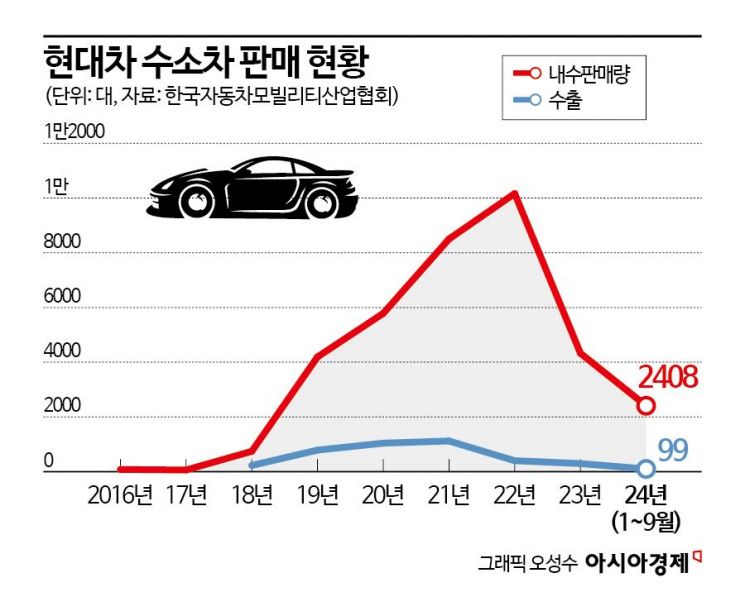
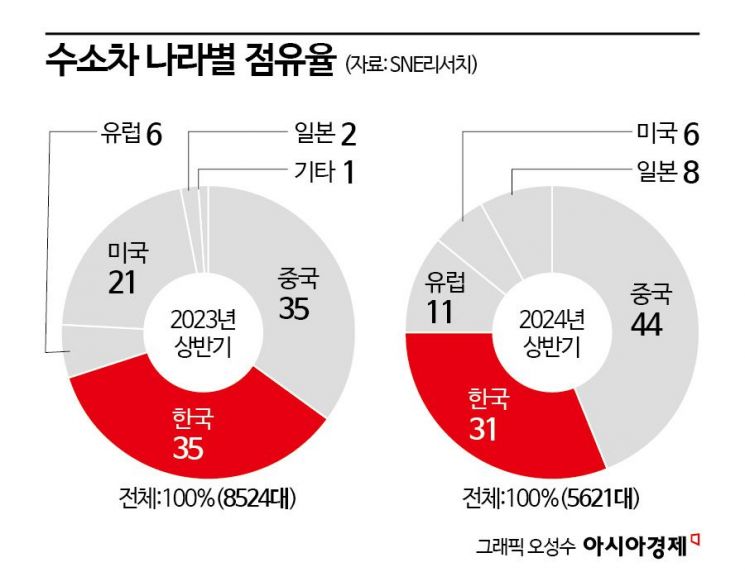
Alongside hydrogen vehicle development, infrastructure such as hydrogen charging stations is also expected to be accelerated. This is to dispel the perception that hydrogen vehicles, which are more expensive and less convenient than battery electric vehicles that are already struggling in sales, will have difficulty succeeding in the market.
Among major automakers, only a few, including Hyundai, Toyota, Honda, and BMW, have actively pursued hydrogen electric vehicle development. In China, activity has recently increased, mainly focusing on commercial vehicles such as trucks. Commercial vehicles can expand adoption quickly because charging stations only need to be established at fixed points. Some European manufacturers, such as Iveco, are cooperating with Hyundai in developing hydrogen buses and vans.
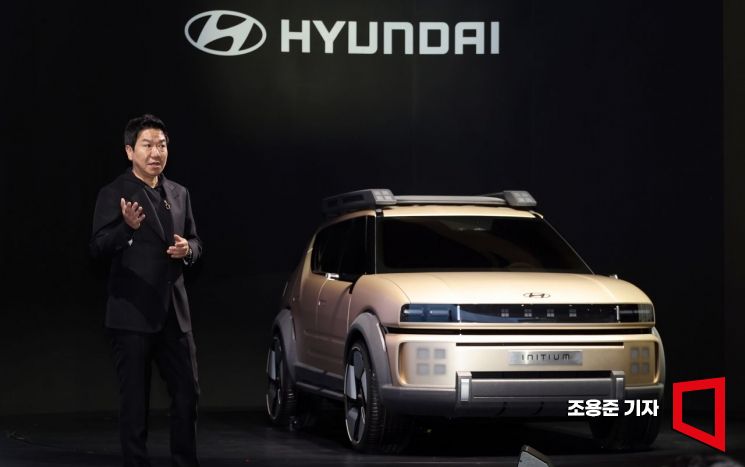 Hyun Sang-yeop, Vice President of Hyundai Motor Company, is presenting the new hydrogen concept car, which will be mass-produced in the second half of next year, at the Hyundai Motor Studio Goyang in Gyeonggi-do on the 31st. Photo by Jo Yong-jun
Regarding this, CEO Jang emphasized that Hyundai will actively collaborate not only in developing new vehicles but also with various heterogeneous industries. He believes that expanding the application range and increasing demand will realize economies of scale, thereby accelerating the hydrogen society. Jang said, "The unwavering challenges and decisions Hyundai has made over the past 27 years were driven by a steadfast belief in the value of hydrogen," adding, "Hydrogen is not only a clean energy for future generations but also highly accessible and therefore an equitable energy. We plan to show a world where hydrogen is used by everyone, for everything, everywhere."
© The Asia Business Daily(www.asiae.co.kr). All rights reserved.



















