September Financial Institutions Weighted Average Interest Rate
Mortgage Loan Interest Rate Rises Most in 2 Years
Impact of Bank Spread Increase
As banks raised additional interest rates to manage household loans, mortgage loan (Judaemae) interest rates surged the most in two years since September 2022.
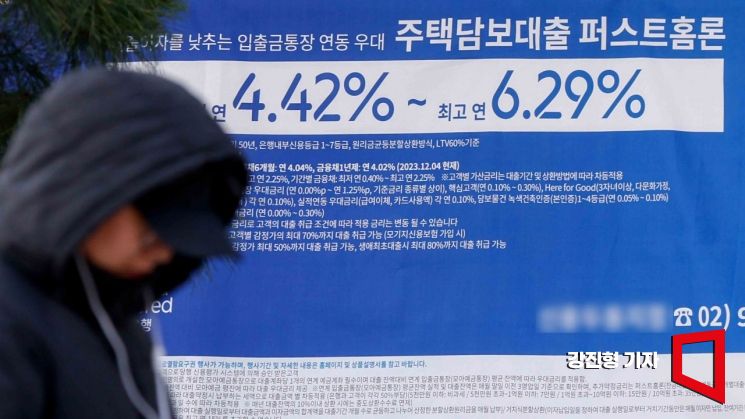 On the 26th, when the 'Stress DSR,' which precisely reflects future interest rate fluctuation risks in the Debt Service Ratio (DSR), was implemented, a real estate mortgage loan interest rate table was posted on the exterior wall of a branch of a commercial bank in Seoul. The Stress DSR system is a measure that applies an additional interest rate (stress interest rate) when calculating the DSR, considering the possibility that borrowers using variable interest rate loans may face increased principal and interest repayment burdens due to rising interest rates during the loan period. The stress interest rate applied until the first half of this year is 0.38%. Photo by Kang Jin-hyung aymsdream@
According to the 'September Financial Institution Weighted Average Interest Rates' announced by the Bank of Korea on the 31st, the loan interest rate (weighted average, based on new contracts) of deposit banks last month was 4.62% per annum, up 0.14 percentage points from the previous month.
The mortgage loan interest rate among household loans rose 0.23 percentage points from the previous month to 3.74% per annum. This is the largest increase since the 0.44 percentage point rise in September 2022. The fixed-rate mortgage loan interest rate increased by 0.23 percentage points to 3.72% per annum, while the variable-rate mortgage loan interest rate rose by 0.04 percentage points to 4.08% per annum.
Kim Minsu, head of the Financial Statistics Team at the Bank of Korea's Economic Statistics Bureau, said, "Although the 5-year bank bond rate, which is the benchmark rate for fixed-rate mortgage loans, remained stable, mortgage loan interest rates rose as banks increased additional interest rates to manage household loans."
Loan interest rates are the sum of benchmark interest rates and additional interest rates. Fixed-rate mortgage loans use the 5-year bank bond rate as the benchmark, while variable-rate loans use COFIX (Cost of Funds Index) as the benchmark rate.
Regarding why the increase in fixed-rate mortgage loan interest rates was higher than that of variable-rate loans, Kim explained, "The 5-year bank bond rate, the benchmark for fixed-rate mortgage loans, showed little change compared to the previous month, while the COFIX rate, the benchmark for variable-rate mortgage loans, declined."

Corporate loan interest rates rose 0.1 percentage points from the previous month to 4.77% per annum. This was due to a slight increase in benchmark rates such as negotiable certificates of deposit (CDs) and some banks adjusting additional interest rates. Loan interest rates for both large corporations (up 0.03 percentage points) and small and medium-sized enterprises (up 0.15 percentage points) increased compared to the previous month.
The interest rate on savings deposits, based on new contracts, rose 0.05 percentage points from the previous month to 3.40% per annum. This was influenced by banks' increased demand for funds, such as re-attracting large-scale time deposits maturing as the year-end approaches. Pure savings deposits, mainly time deposits, rose by 0.05 percentage points, and market-type financial products, centered on financial bonds and CDs, increased by 0.04 percentage points.
The interest rate spread between loans and savings deposits widened by 0.09 percentage points from the previous month to 1.22 percentage points. The spread turned to expansion for the first time in six months since April (1.24 percentage points).
Among non-bank financial institutions, deposit interest rates (based on 1-year maturity time deposits) declined for credit unions, mutual finance, and Saemaeul Geumgo, except for mutual savings banks. Loan interest rates (based on general loans) decreased for savings banks, credit unions, and Saemaeul Geumgo, except for mutual finance.
© The Asia Business Daily(www.asiae.co.kr). All rights reserved.


















