MBK-Youngpoong Alliance to File Injunction Against New Share Issuance
Emphasizes Illegality of Paid-in Capital Increase Amid Management Dispute
Past Precedents Unfavorable to Korea Zinc... Need to Justify Capital Increase Purpose
Choi Yoon-beom's Side: "Aims to Resolve Shareholder Damage Caused by Dispute"
The MBK Partners and Yeongpung alliance is taking legal action, including filing an injunction to prohibit the issuance of new shares, against Korea Zinc's 2.5 trillion won rights offering. It is observed that Korea Zinc chose a general public offering method for the rights offering, considering that a third-party allotment rights offering during a management dispute could be illegal. The MBK-Yeongpung alliance harshly criticized it as an illicit and illegal rights offering aimed at diluting the opposing party's shareholding and securing friendly shares through allotment to the employee stock ownership association.
Meanwhile, analysis suggests that, based on existing precedents, the MBK-Yeongpung alliance's claims carry weight. In 2003, during a management dispute between KCC (then Kumgang Korea Chemical) and Hyundai Elevator, the court blocked a large-scale public offering rights issue pushed by Hyundai Elevator. For Korea Zinc to overturn this precedent, it will likely need to demonstrate that this rights offering has sufficient business purposes.
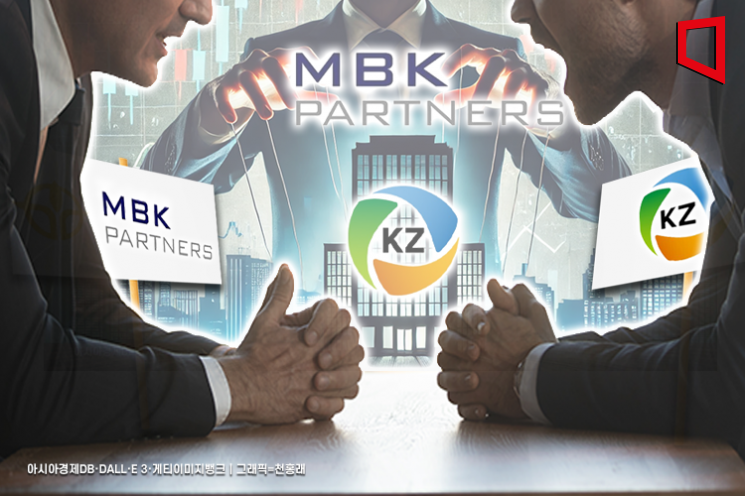
Third-party allotment rights offerings during disputes are ‘illegal’... Korea Zinc opts for ‘general public offering’
On the 30th, Korea Zinc announced at an emergency board meeting that it had decided on a rights offering worth approximately 2.5 trillion won. The plan is to issue 3,732,650 new shares through a general public offering at a 30% discount to the market price. At the same time, 20% of the new shares will be preferentially allocated to the employee stock ownership association. Additionally, applicants other than the employee stock ownership association will not be allocated more than 3% of the total public offering shares. The intention is to prevent institutions or foreigners with massive financial power from participating in the rights offering and acquiring large-scale shares.
In this regard, the investment banking (IB) industry views Korea Zinc’s choice of a ‘general public offering’ method as an attempt to avoid illegality. An industry insider explained, "A third-party allotment rights offering targeting specific friendly shareholders during a management dispute violates the principle of shareholder equality and is mostly blocked by courts. To avoid this, a public offering targeting an unspecified majority was chosen."
However, the MBK-Yeongpung alliance argues that even if Korea Zinc formally adopts a public offering method, it is illegal because it is clearly aimed at defending management rights. They point out that it is a ‘trick rights offering’ that opens the door for friendly shareholders such as the employee stock ownership association to participate at a significantly low price to respond to the management dispute.
The public offering price for Korea Zinc’s rights offering is currently about 670,000 won, applying a 30% discount to the reference price based on the current stock price. However, the final public offering price is calculated by applying a 30% discount to the weighted arithmetic average stock price of the past 3 to 5 trading days before the subscription date. Considering the stock price decline due to the large-scale rights offering, it is not impossible that the public offering price at the subscription in December will fall below 500,000 won. If the stock price falls below 700,000 won, the public offering price will be under 500,000 won.
A representative of the MBK-Yeongpung alliance said, "The public offering price is likely to be set lower than the stock price before the management dispute," and criticized it as "an illicit and illegal rights offering that opens the opportunity for friendly shareholders, including the employee stock ownership association and Chairman Choi Yoon-beom of Korea Zinc, to buy shares at a very low price." On the other hand, they pointed out, "Institutions and general shareholders who acquired shares at a high price must become the sacrificial victims of share dilution."
Limiting the number of shares allocated per person is also evaluated as an attempt to dilute MBK-Yeongpung’s shareholding. Although Chairman Choi’s shareholding will also be diluted, if the shares allocated to the employee stock ownership association join Chairman Choi’s friendly shares, there is an analysis that the shareholding ratio between the two sides could be reversed.
Past precedents favor MBK-Yeongpung
Based on past precedents, it is expected that the MBK-Yeongpung claims are likely to be accepted by the court. This is because there is a precedent where the court blocked a large-scale rights offering pushed by Hyundai Elevator, the holding company of the Hyundai Group, during a management dispute with KCC in 2003.
At that time, KCC, along with Shinhan BNP Paribas private equity fund (PEF) and others, accumulated a 20.78% stake in Hyundai Elevator, threatening Hyundai Group’s management rights. In response, Hyundai Elevator Chairman Hyun Jung-eun announced a rights offering issuing new shares amounting to 178% of the issued shares (10 million shares). The general public offering method, a 30% discount on the new share issuance price, and a subscription limit of 300 shares per person resembled the rights offering currently being pursued by Korea Zinc.
KCC filed an injunction with the court to block Hyundai Elevator’s rights offering, and the court sided with KCC. The court stated, "If defending management rights itself benefits the company and general shareholders, an exception can be made to exclude existing shareholders’ preemptive rights, but this new share issuance does not meet such circumstances," and ruled, "The 10 million share rights offering is not for raising funds for company management but is for defending management rights of the existing major shareholders and the current board during a management dispute, as sufficiently demonstrated by KCC’s evidence."
For Korea Zinc to overturn past precedents, it is expected to argue that this rights offering is not a response to a management dispute and sufficiently benefits the company and general shareholders. A legal expert commented, "It is difficult to predict the court’s judgment, but no one is unaware that Korea Zinc is in a management dispute, and there seems to be insufficient grounds to claim that a large-scale rights offering benefits general shareholders."
Korea Zinc: Legal rights offering... Will seek judgment on distortion and market disruption
Korea Zinc emphasized, "This rights offering was decided through legal procedures under the Commercial Act and Capital Markets Act to enhance corporate transparency, minimize the possibility of delisting, and reduce shareholder damage caused by stock price fluctuations," adding, "It provides opportunities for various investors, including the general public, to participate as shareholders and is promoted to minimize ongoing dispute factors that act as significant constraints on company management and development."
They also stated, "The rights offering is due to concerns about stock price volatility and corporate value damage caused by hostile mergers and acquisitions (M&A)," and warned, "If the MBK-Yeongpung alliance continues to distort facts and disrupt the market regarding this legally conducted general public offering rights issue, they will face severe legal judgment."
© The Asia Business Daily(www.asiae.co.kr). All rights reserved.
!["The Woman Who Threw Herself into the Water Clutching a Stolen Dior Bag"...A Grotesque Success Story That Shakes the Korean Psyche [Slate]](https://cwcontent.asiae.co.kr/asiaresize/183/2026021902243444107_1771435474.jpg)
















