Brazilian Poisonous Scorpion Found in UK Home
"May Have Been Transported via Overseas Shipping Parcel"
A deadly venomous scorpion that can cause human death was found in a household in the United Kingdom. This scorpion is originally native to Brazil in South America but is believed to have arrived in the UK via an internationally shipped package.
On the 27th (local time), British media including The Sun reported that a "yellow scorpion" was discovered in a residence in Wokingham, Berkshire. This scorpion carries venom that can be fatal to vulnerable individuals such as children and the elderly, and its primary habitat is Brazil.

Page Aitchison, who lives in the house, said he first found the scorpion in the hallway of his home. He told the media, "I came home and when I opened the front door, something huge caught my eye," adding, "At first, I thought it was a spider, and I assumed it was a common spider you might see around the house."
However, neighbors who saw the photo of the scorpion Aitchison posted on social media realized that the creature was not a spider but a yellow scorpion. They contacted the National Reptile Welfare Centre located in the UK. Thanks to this, volunteers from Berkshire visited Aitchison’s home and safely collected the scorpion within about 90 minutes.
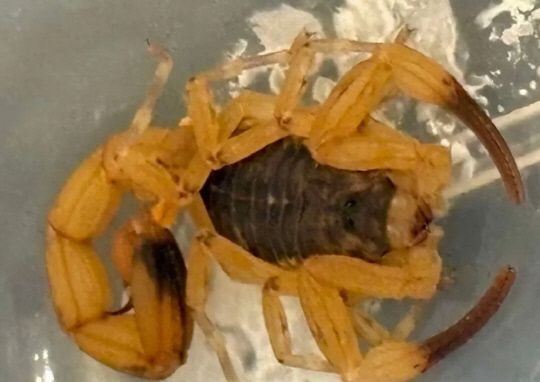
Before collecting the scorpion, staff asked Aitchison, "Have you recently received any packages?" He replied, "I didn’t mention it that day, but I had received a few packages a few days earlier." The welfare center reportedly warned that the scorpion could have entered through packages shipped from Shuin and Temu.
The welfare center also stated, "While it is possible the scorpion entered via a package, there is no way to confirm this," and urged, "People should be careful when opening packages from overseas and always check carefully before opening."
The Brazilian yellow scorpion is considered one of the six most venomous scorpion species worldwide. It originally lives in forests, but due to rapid urbanization in Brazil and the destruction of forests, it is now often found in urban areas as well. Adult scorpions typically measure 5 to 7 cm in length and can be mistaken for spiders if not observed carefully.
The fatality rate of yellow scorpion venom is 1 to 2%, so the toxicity itself is not extremely lethal. However, exposure to the venom can be life-threatening for young children and the elderly. Moreover, the species’ strong reproductive drive leads to a large population, which is a concern. According to an epidemiological study conducted in Brazil from 2000 to 2012, there were 482,616 reported cases of yellow scorpion-related incidents during that period, with 728 resulting in death.
If the venom of this scorpion is injected, victims may experience various symptoms such as pain, sweating, high fever, and gastrointestinal issues. In rare cases, it can lead to seizures, coma, or cardiopulmonary failure.
© The Asia Business Daily(www.asiae.co.kr). All rights reserved.


















