Partial Ban on Fitness Center Entry
Business Freedom vs. Equality Rights in Direct Conflict
Current Laws Unable to Resolve, Alternatives Needed
Although tattoos have become commonplace in South Korea, with approximately 13 million users, controversy is growing over the emergence of ‘No Tattoo Zones’ that restrict entry for people with tattoos, mainly in some hotels and fitness centers. Recently, 5-star hotels such as Conrad Seoul, Fairmont Ambassador Seoul, and Paraspara Seoul have implemented ‘No Tattoo Zone’ policies.
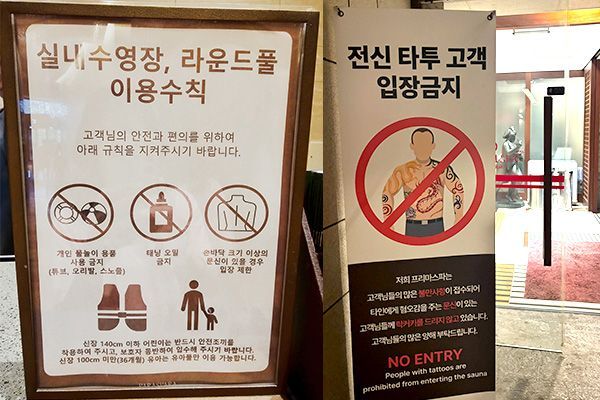
Since No Tattoo Zones involve a conflict between business owners' freedom and customers' right to equality, legal experts caution that the government should be careful about intervening hastily to mediate the issue.
According to data submitted by the Ministry of Health and Welfare to the National Assembly Legislative Research Office in October 2021, there are 350,000 tattoo practitioners nationwide and 13 million tattoo users.
The ‘No Tattoo Zone’ issue involves a clash between Article 15 of the Constitution, which guarantees freedom of business (freedom to choose one’s occupation), and Article 11, which guarantees the right to equality. Because tattoos can cause discomfort to others, legal circles argue that factors such as the size, shape, and location of tattoos, which may cause aversion, should be considered when approaching this issue.
Attorney Lee Myeong-ung (65, Judicial Research and Training Institute class of 21), a former constitutional researcher, explained, “Unlike No Kids Zones, the degree of discomfort caused by No Tattoo Zones varies depending on the size and shape of the tattoo. If a person with a small tattoo is denied entry, it does not substantially interfere with business operations and could lead to a violation of the right to equality.”
According to Article 2, Paragraph 3 of the National Human Rights Commission Act, discrimination based on gender, religion, disability, age, appearance, etc., is prohibited. However, this provision is not binding, and there is no clear legal interpretation as to whether tattoos fall under ‘appearance.’
Attorney Noh Hee-beom (58, class of 27), also a former constitutional researcher, added, “No Tattoo Zones are a complex issue involving the freedom of business owners, the rights of tattoo bearers, and the rights of other customers, so legal regulation should be approached with great caution.”
Although current laws cannot resolve the No Tattoo Zone issue, legal experts emphasize that social discussion should take precedence over government intervention. A constitutional researcher who requested anonymity said, “If the government intervenes and regulates private matters, it could excessively protect one side’s rights and infringe upon the fundamental rights of the other side. Since laws prohibiting discrimination for public interests, such as those protecting people with disabilities or women, already exist, the government should be cautious about intervening in all situations by labeling them as discrimination.”
Lee Jin-young, Legal Times Reporter
※This article is based on content supplied by Law Times.
© The Asia Business Daily(www.asiae.co.kr). All rights reserved.
![Clutching a Stolen Dior Bag, Saying "I Hate Being Poor but Real"... The Grotesque Con of a "Human Knockoff" [Slate]](https://cwcontent.asiae.co.kr/asiaresize/183/2026021902243444107_1771435474.jpg)
















